
GD writes: CommonMan – our grassroots columnist in the vanua – returns for election year with a thought-provoking, even incendiary, article that demolishes the carefully-crafted image of the Prime Minister as having empowered and unified the iTaukei.
Read on for the harsh pronouncement on Sitiveni Rabuka by a largely self-educated farmer and villager from Nadroga who is as close to genuine iTaukei opinion as it is possible to be.
While some may cast CommonMan’s views as reflecting mostly opinion in the West and among Rabuka’s political opponents, if enough voters in the country as a whole share his conclusions come election day, the Prime Minister isn’t the shoo-in that many expect. He is toast.
———————
Even as the Rabuka-led Coalition government stumbles from one tragedy into another and from one debacle to another, news has percolated from the Prime Minister’s end of the vanua that Rabuka may yet lead the Peoples Alliance Party into the 2026 General Elections.
It seems that the vanua-based political strategists behind the party had read the tea leaves in the bilo ni yaqona and surmised that the crossing over of eleven former FijiFirst MPs into the Coalition’s rank and file was an auspicious sign. That with the integration of nearly three-quarters of all MPs, the omens can only be good.
However, Rabuka’s political history is far more complex than what the mainstream imagery has constantly suggested. An image that has been carefully crafted over the years to portray him as the only person capable of unifying the iTaukei. A closer scrutiny of the books suggests otherwise. If anything, he has been the cause of division.
A critical re-examination of his four-decade political career suggests a startling conclusion: the man often framed as the “Great Unifier” of the iTaukei has historically been the primary architect of indigenous political fragmentation.
One of the most important historical facts about Rabuka is that he has never won any General Election by an outright majority. Not in 1992, 1994, 1999, 2018 or 2022. Never. That profound fact in and of itself exposes the fallacy that he is a unifier.
One of the biggest cons imposed on the national political psyche is that the clear majority of the iTaukei supported the 1987 coup. The way Rabuka himself continues to frame and justify his act of domestic terrorism on May 14 to this day always seems to suggest that.
But the elections of 1992 proved this not to be true, even though it was carried out under the provisions of an imposed 1990 Constitution, which was specifically designed to ensure and entrench iTaukei paramountcy and a majority in Parliament.
The SVT (Soqosoqo ni Vakavulewa ni Taukei ) had to rely on a coalition with Labour and the General Voters Party to ensure SVT became the government of the day. And Rabuka has also done no better under the 1997 and the 2013 Constitutions.
Even in 2018, his presence as SODELPA party leader was insufficient to garner an outright majority. In fact, the result was a split in the party.
And in the election of 2022, he needed the support of both SODELPA and the NFP to make up the numbers.
Which subsequently brings to bear the second historical fact, a consequence of the first: Rabuka has always relied on Coalitions to govern; his style of (mis)management has always led to the disintegration of both the Coalition and his own party.
This is true in 1994, 1999, 2001 and 2018. In 1993, his fiscal malpractice led to divisions within his own party and the collapse of the coalition. It led to the formation of the Fijian Association Party, led by Josevata Kamikamica in 1994.
Even though he won the snap elections of 1994, he betrayed the FLP that had catapulted him to power in 1991 and sided with the NFP. His mismanagement of even this Coalition led to severe losses for both NFP and SVT in 1999 and their ejection from power.
The SVT subsequently further disintegrated into three more parties (Soqosoqo ni Taukei ni Vanua, Veitokani ni Lotu Vakarisito, and the Party of National Unity) by the 2001 elections.
In fact, where there were only two other indigenous parties in 1992, this number had proliferated to seven by 2001, less than a decade later.
Under Laisenia Qarase, most of these indigenous parties were later absorbed into SDL ( Social Democratic Liberal Party, the precursor to SODELPA) so that it was the only indigenous party contesting the general election of 2014. However, Rabuka’s entry in 2018 led to internal divisions.
By 2022, SODELPA had splintered into five political groupings – the Peoples Alliance Party, which Rabuka himself formed after promising he would not establish another party, Unity Fiji, We Unite Fiji, All People’s Party, and the New Generation Party.
It is perplexing how many indigenous people are so blind to the fact that discord and division seem to follow Rabuka wherever he goes. It’s as if a curse follows him; he brings division to indigenous unity.
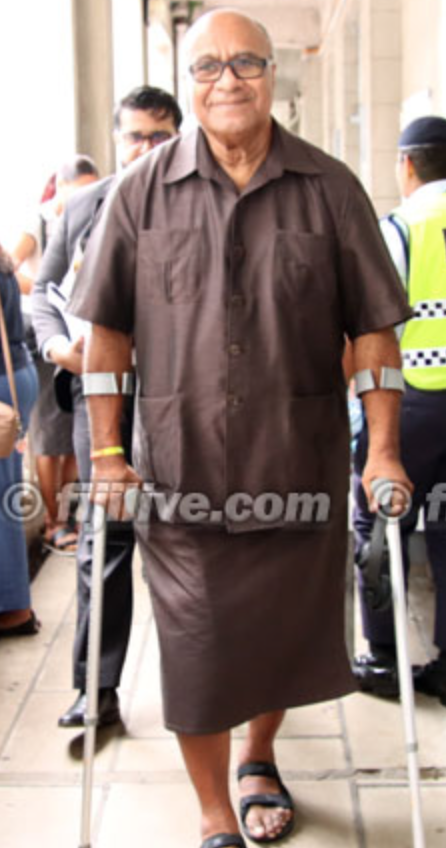
There is every chance that PAP may further fragment into another offshoot led by Manoa Kamikamica, who has massive support within the Kubuna Confederacy.
The more the people of Kubuna see him stand before the courts, the more keenly they feel that Rabuka has betrayed and abandoned a true son of Tailevu.
They see Kamikamica as a victim of Rabuka’s gross mismanagement of the selection of the FICAC Commissioner’s position, a stark contrast from his initial campaign trail promise, where FICAC was supposed to have been phased out and absorbed into the Police Force.
Only this time the conclusion is far from being foregone because from all appearances, Rabuka seems to have neither learnt anything from history nor from his mistakes.
————————-
NOTE:
A reminder that I will be out of commission for the time being for medical reasons.
Sota tale as soon as I am able. But please keep those comments coming.
Election year is already hotting up. And we especially look forward to more insights from CommonMan as the year unfolds.
Excellent article and outlining of Rabuka’s divisive history.
I think a powerful underlying dynamic that keeps the likes of Rabuka rolling is the culture of apologising and entitlement to forgiveness and a clean slate without any accountability.
The extremist Christian mindset of erasing past transgressions for another chance is so ingrained in the psyche of so many Fijians that it prevents people from remembering and analysing patterns of behaviour. It is patterns of behaviour that define the personality disorders that clearly need to be kept out of leadership. And let us also remember that these apologies are only self-serving: they only come when caught, and serve a purpose to absolve and save one’s ass. In decent democracies, there is an apology and resignation to take accountability.
I commend CommonMan for laying out Rabuka’s pattern of behaviour and can only hope that his writings can influence enough people to face this reality.
What I do not understand is that everyone in Fiji and their dog wants to move on and move forward. That is what they all keep saying everytime there is criticism of Rabuka and his crooking and thievery since 1987 and I quote “move on, that was in the past”.
But then these same people, mostly iTaukei, vote for Rabuka or want to go back to him and his racism. And that kind of ‘moving forward and moving on’, back to the same person, has been happening for the 40 years now – that is half a life time! What the f**k kind of moving forward and moving on is that when the same person is still around after 40 years? These people do not even realise that their kind of moving forward and moving on is sheer stupidity.
How many such people are there in Fiji who are totally oblivious and proud that they are stupid?