

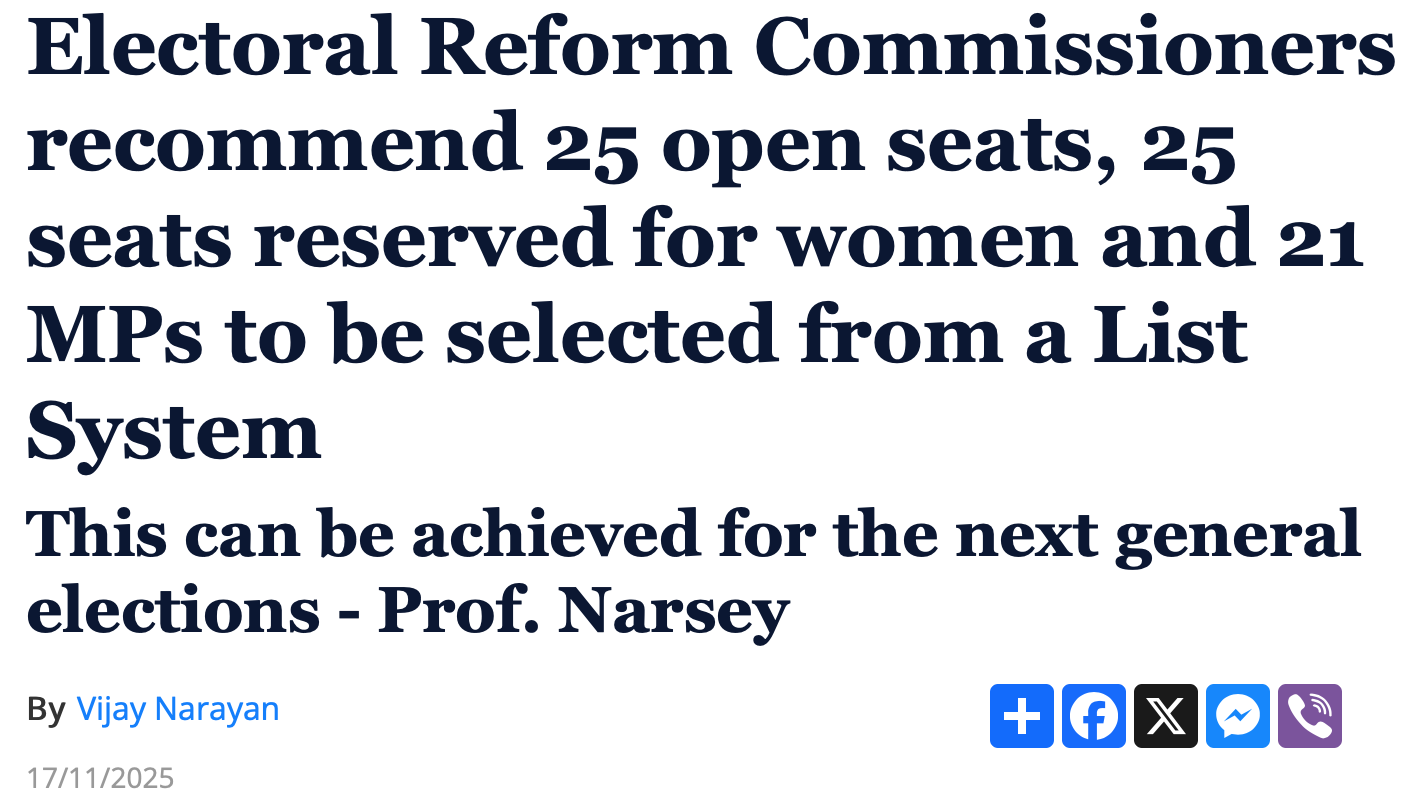
The government has lurched into a fresh crisis, with Professor Wadan Narsey losing patience with the four-month delay in releasing the Electoral Law Reform Commission recommendations for changing the electoral system and taking it upon himself to do so.
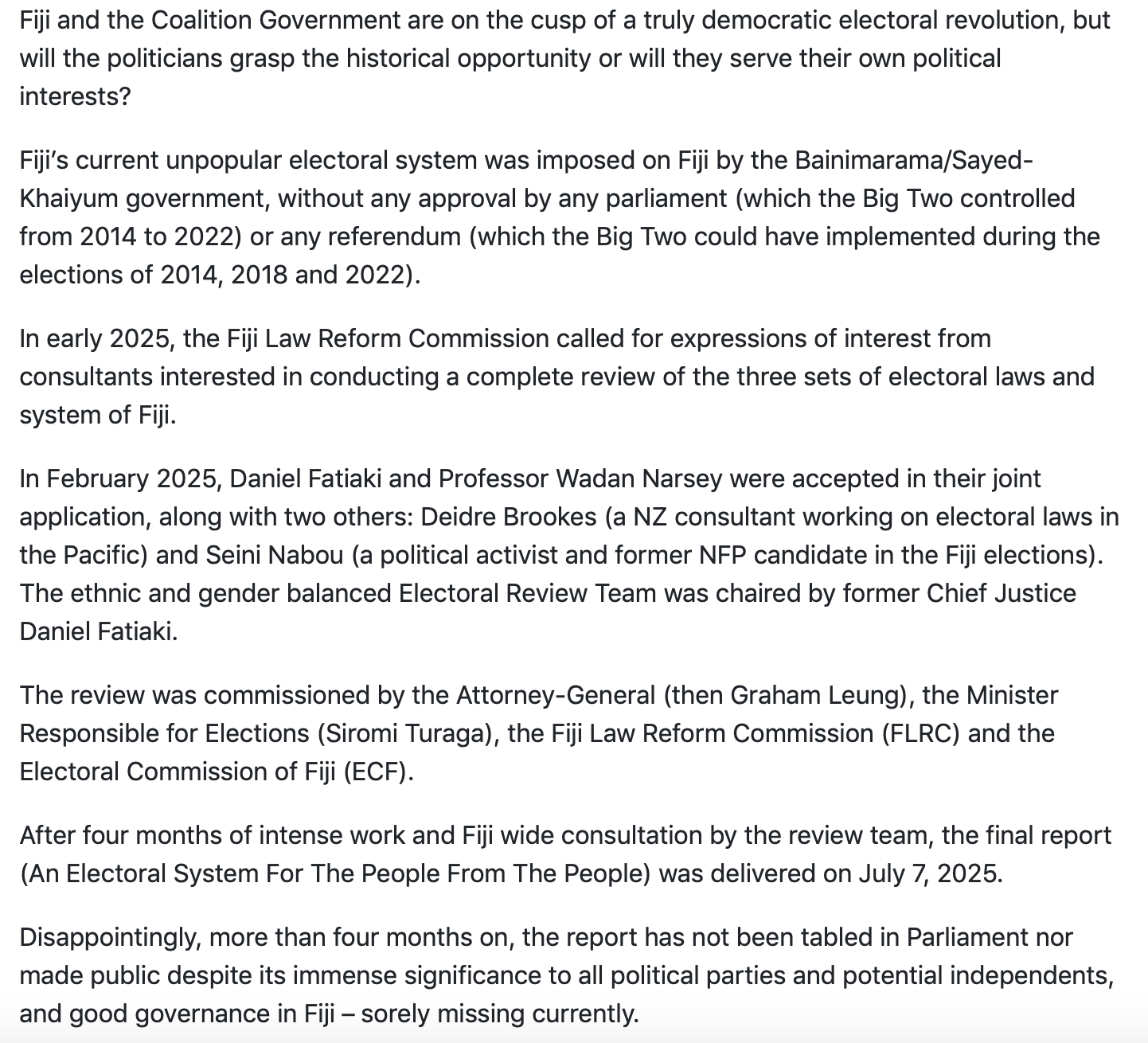
The Commission’s Report was presented to the government back in July but has been sitting on the desk of the acting Attorney General Siromi Turaga ever since. Why hasn’t it been acted upon? The answer to that is obvious to anyone with any political nous and is something Grubsheet has referenced multiple times in recent months.
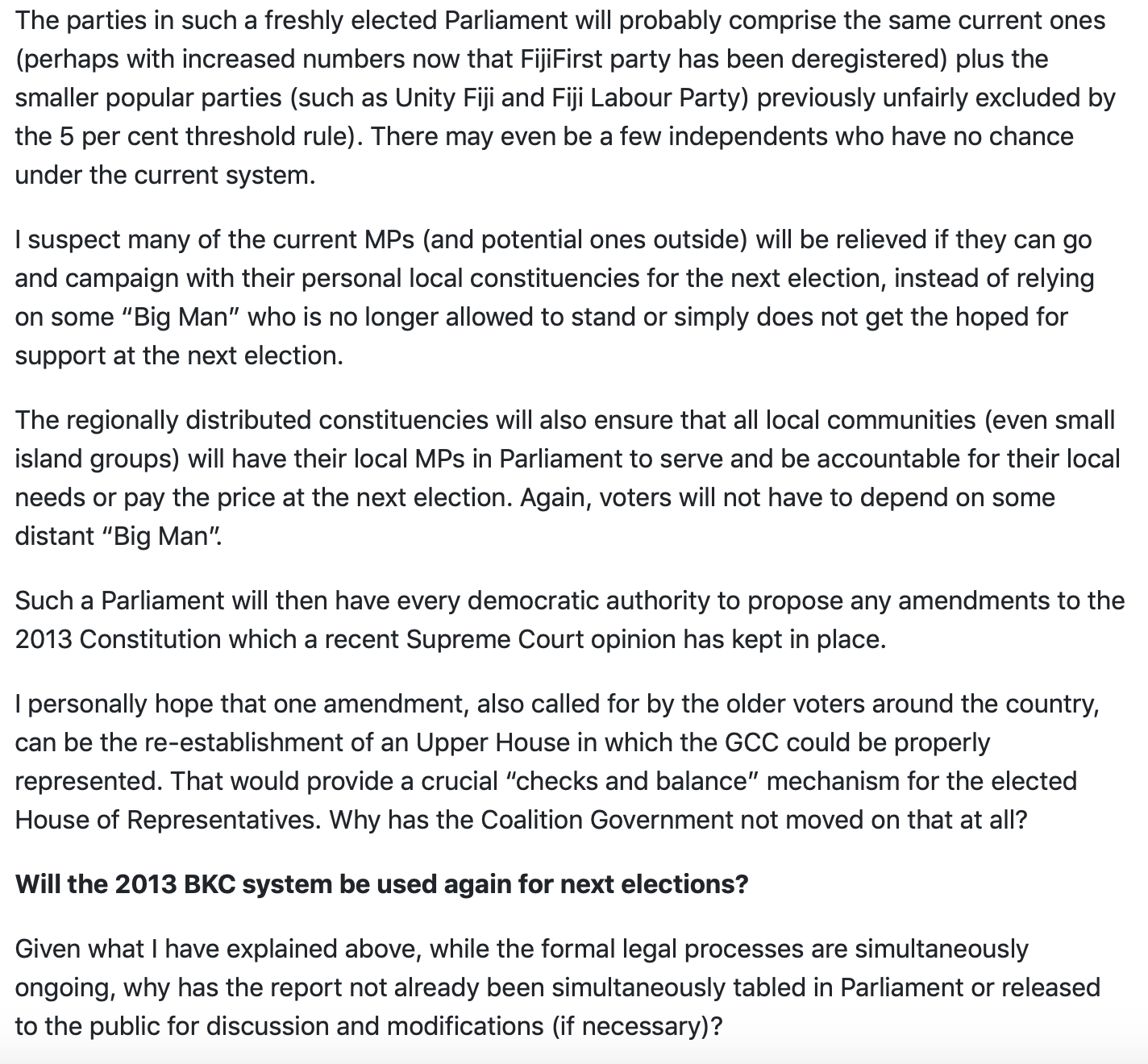
In essence, the Commission recommends that the current d’Hondt “big man” voting system is abolished and replaced by a return to individual constituencies. But this clearly doesn’t suit the sole remaining “big man” since Frank Bainimarama left politics – the Prime Minister, Sitiveni Rabuka.
Abolishing the d’Hondt system makes him just another candidate contesting an individual constituency – not a party leader in a national constituency capable of taking a host of others into the parliament with him, some of them with barely any votes at all. And while the present system suits the Prime Minister’s purposes, it will certainly not change before the next election.
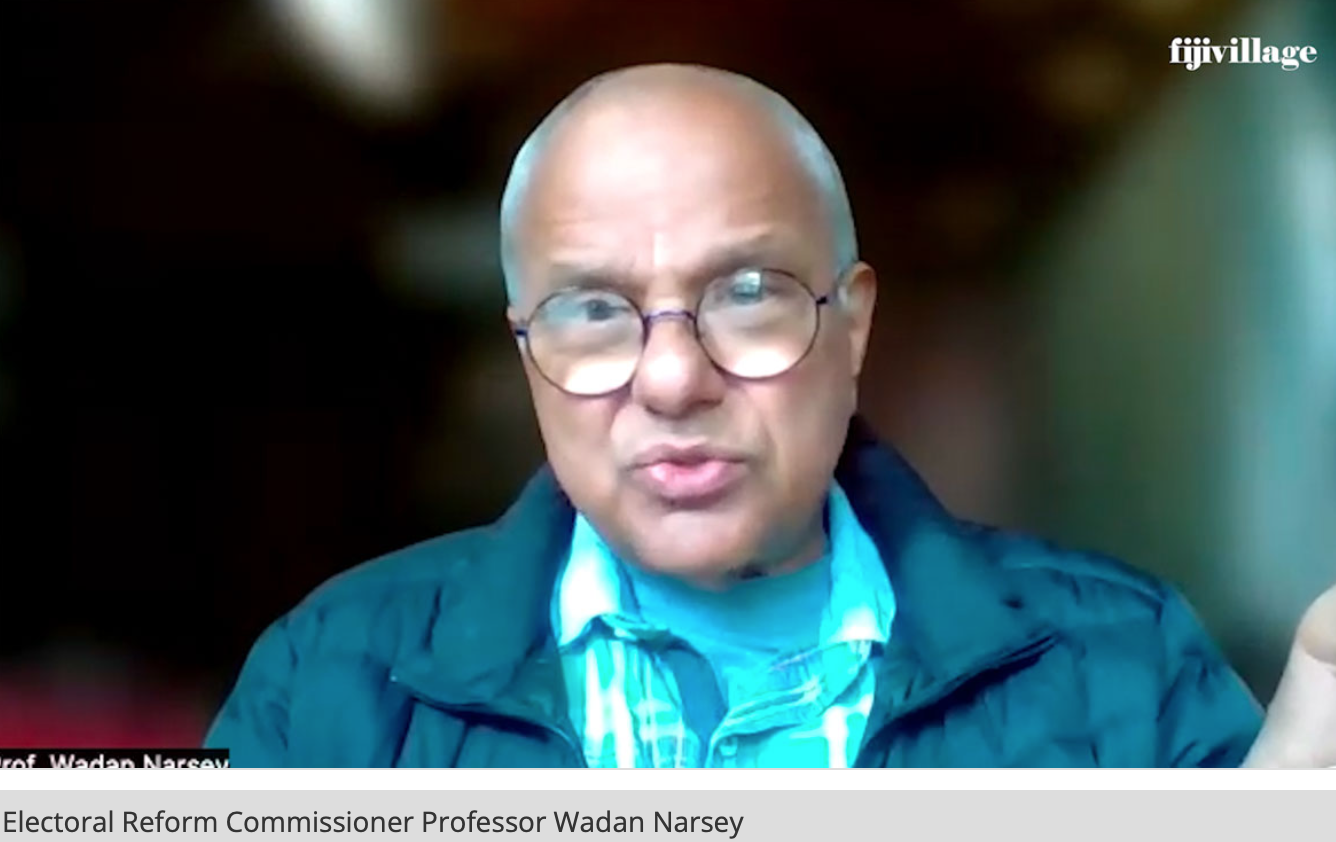
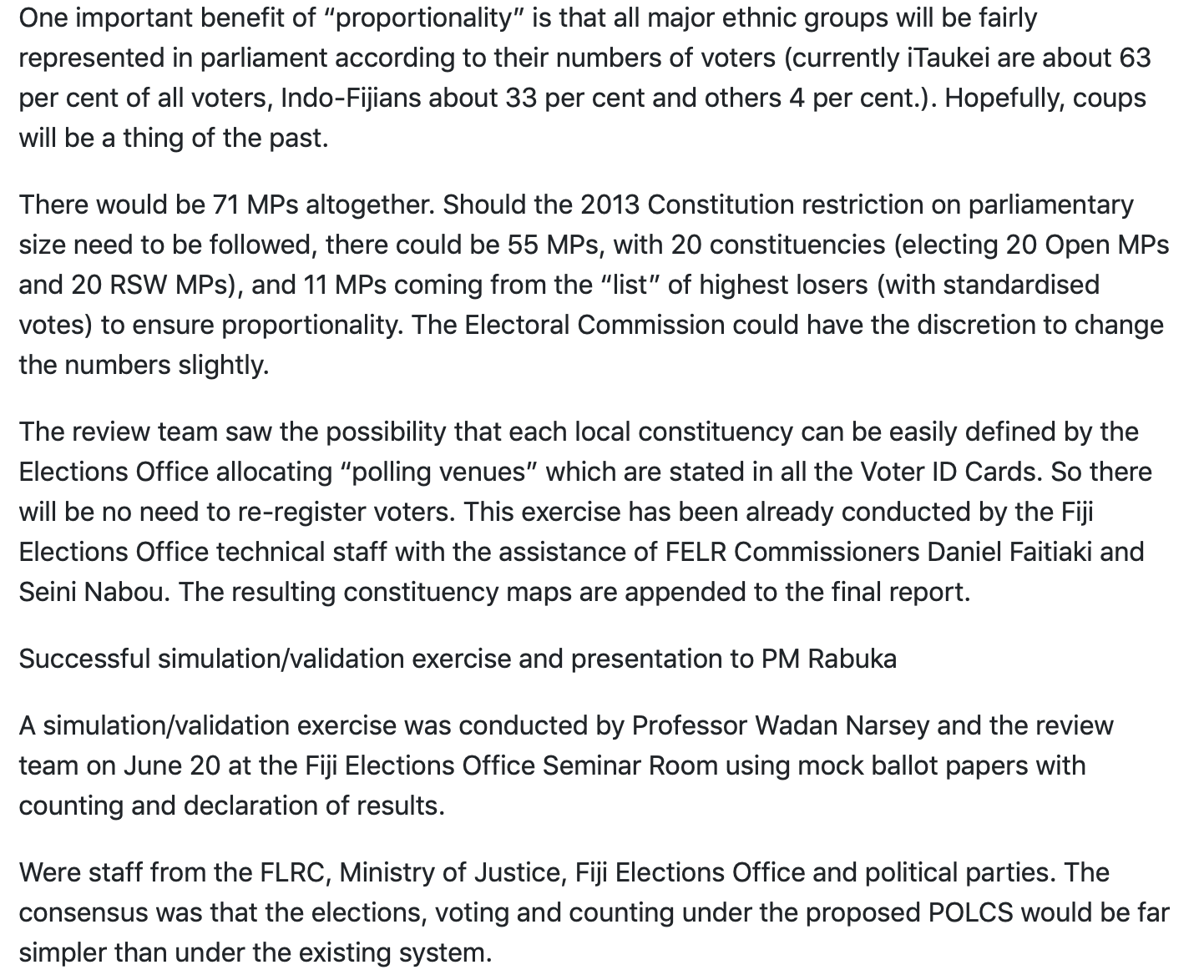
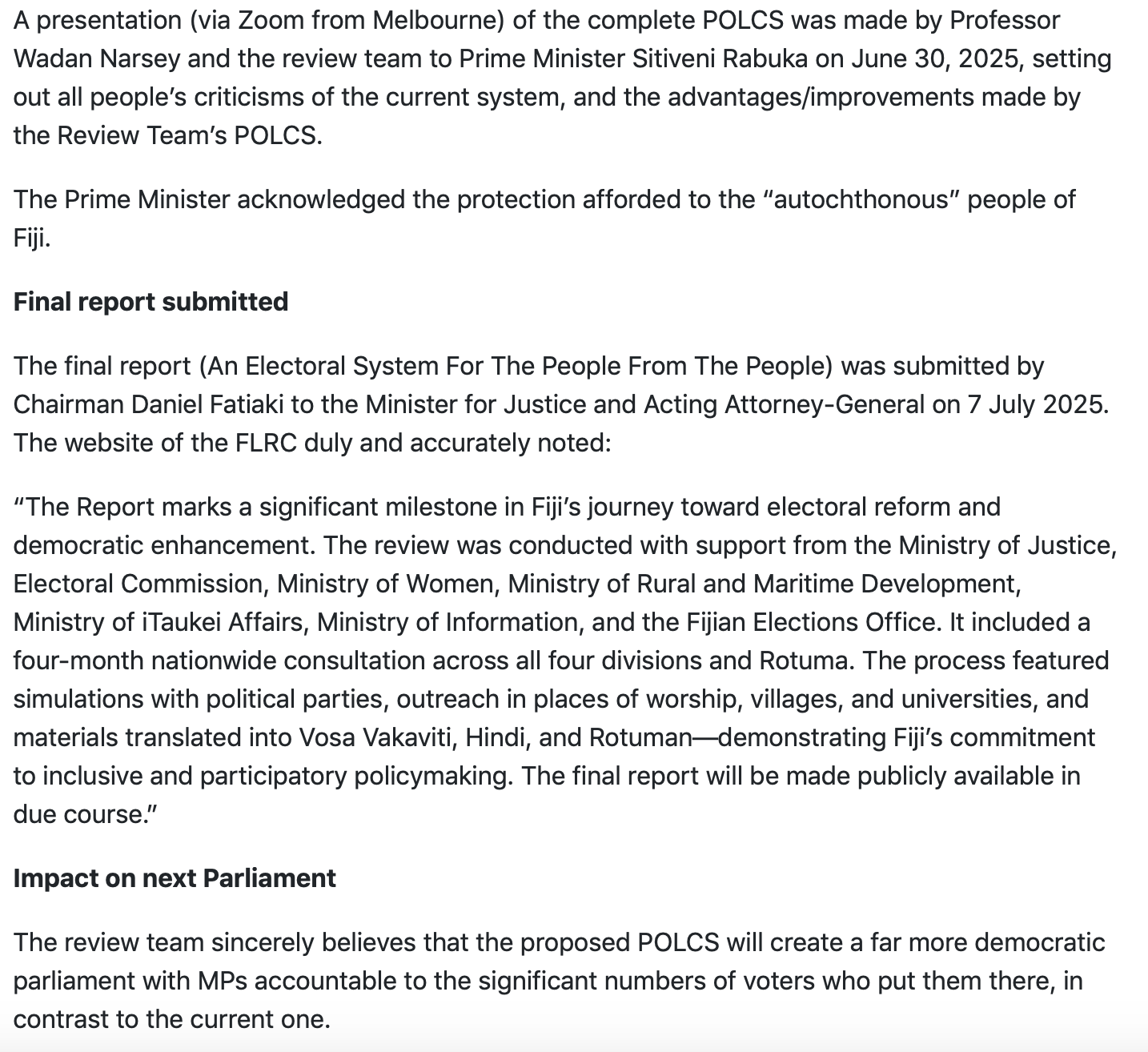
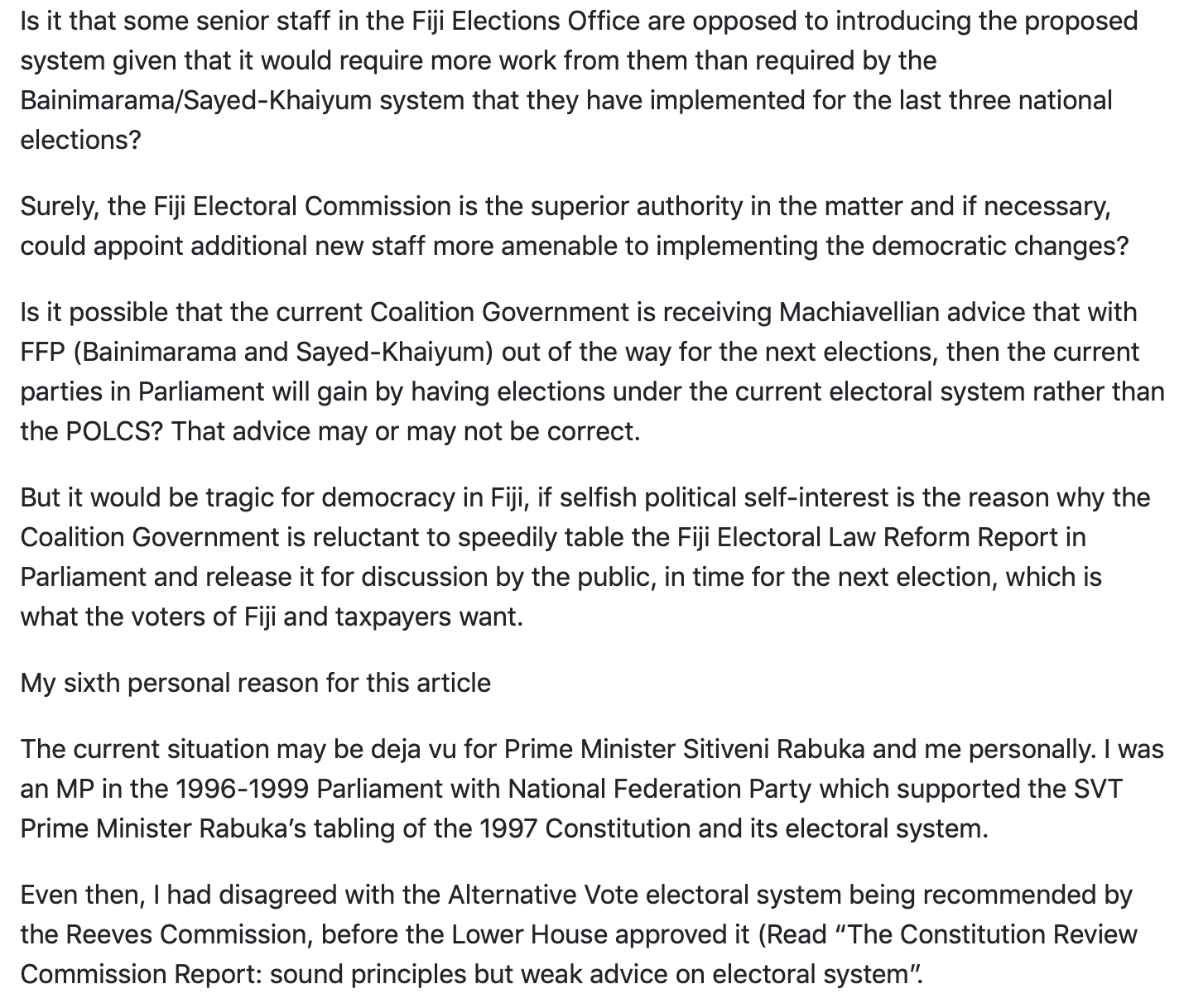
Wadan Narsey presumably knows this but clearly doesn’t care. And he has dramatically raised the stakes and political temperature by going rogue and publicly releasing the findings of the four-person Commission he sat on, which was headed by the former Chief Justice, Daniel Fatiaki.
The Professor’s interview with CFL’s Vijay Narayan is a breathtakingly intervention to try to force the government’s hand. Yet it is also just the latest in a series of events – including the debacle over the Ashton-Lewis Supreme Court Commission of Inquiry into the Malimali affair – which constitutes clear evidence of a government out of control and lurching from one crisis to another.
What the Electoral Law Reform Commission has recommended is enough to trigger a crisis all on its own – a constitutional crisis. Because while Wadan Narsey says the changes proposed can be implemented without changing the 2013 Constitution and can be in place before the election next year, the hard evidence suggests otherwise.
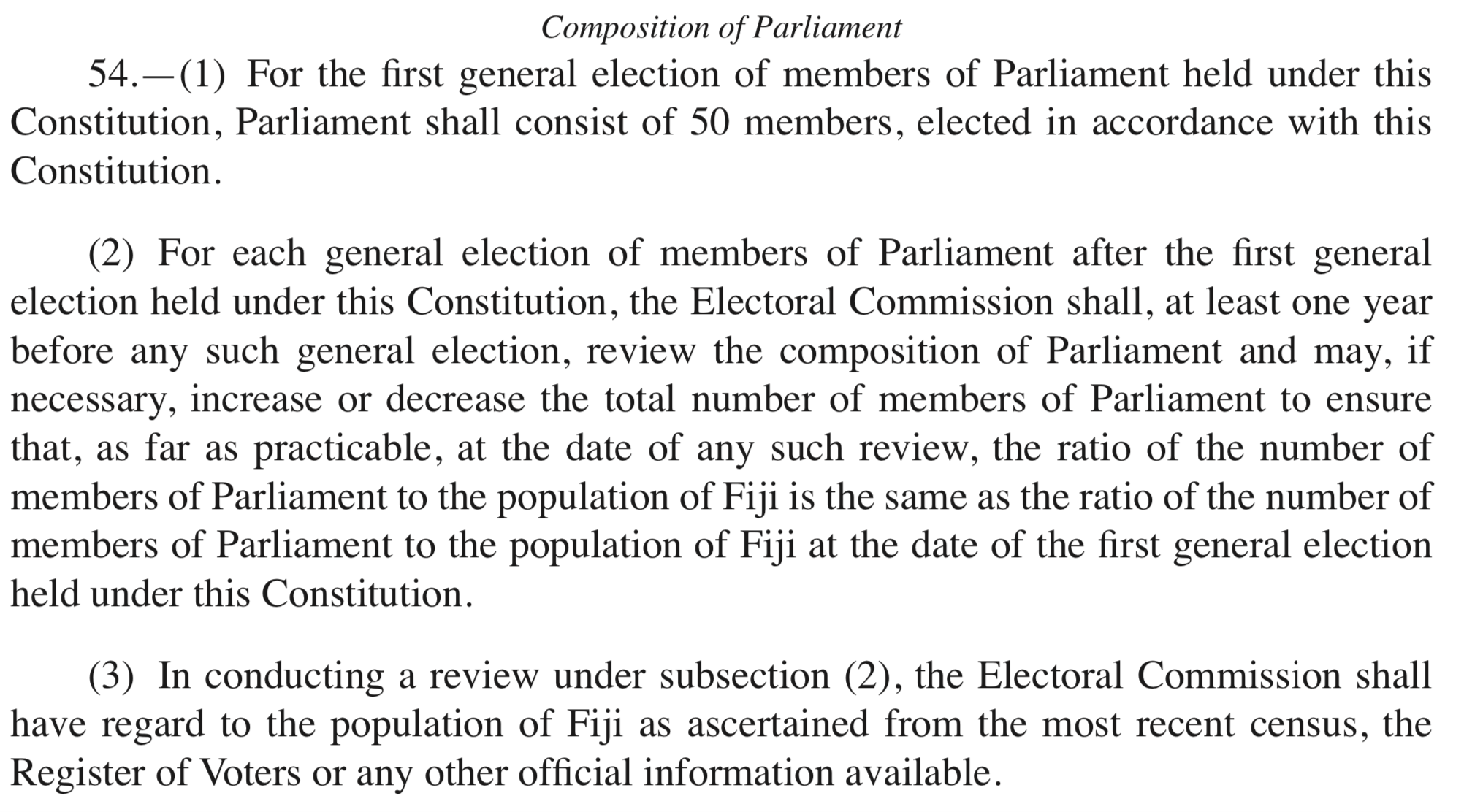
The Professor’s opinion is based on a section of the Constitution which doesn’t stipulate a single national constituency – the present arrangement – but a “single electoral roll”, which would remain under the revised provisions and which the supporters of change argue means no change to the Constitution would be required. Yet there’s another major stumbling block that would undoubtedly trigger a constitutional challenge.
This is the Commission’s recommendation that the current parliament be increased in size from 55 seats to 71 seats. It is an extraordinary proposition in itself because the cost of the nation’s MPs would skyrocket. But the Constitution specifically stipulates that the number of MPs can only be increased if the population as a whole increases (see below). And that just isn’t happening. On the contrary, the population is shrinking – with an official exodus from the country of 114,000 in the past five years and unofficial estimates of 130,000 and more.
How is the Electoral Law Reform Commission going to win a constitutional argument on this? Answer: It can’t. So get set for the official shock of Wadan Narsey jumping the gun and releasing the recommendations even before they have gone to cabinet to give way to intense argument over the constitutional issue, let alone some of the proposals being envisaged.
Professor Narsey says everything the Commission has recommended is at the request of the Fijian people. Yet they are clearly a prescription for a great deal of dispute which suggests that even without a constitutional impediment, achieving a consensus across the political spectrum in time for the next election is impossible.
Take, for instance, the provision of 25 per cent of seats being reserved for women. What about reserved seats for young people? For the disabled, diabetics or dog lovers? And the astonishing world-first proposition of individual seats having two MPs?
How would that work? What happens when those two MPs are at loggerheads about development priorities in their individual constituencies? How can both of them speak with one voice? What happens when a male MP and a woman MP in the same constituency can’t agree? It seems – at first glance at least – highly impractical and we need to know a lot more about how the Professor and his Commission colleagues envisage the changes working.
And then there is the over-riding concern about whether a nation the size of Fiji can afford the luxury of 71 MPs – 21 more than the 50 when we returned to parliamentary rule under the d’Hondt system in 2014. (It was subsequently increased by 5 seats to 55). How will increasing the number of fat-cat politicians improve the current woeful standards of governance in Fiji? What happened to the principle of “less is more” when the nation is already living beyond its means?
This is a bombshell dropped by Wadan Narsey at the worst possible time for the government – with two of its three deputy Prime Ministers facing serious criminal charges, a court challenge to the Ashton-Lewis Commission of Inquiry and seemingly a dog’s breakfast at every turn, which now includes open defiance of proper process by an Electoral Law Reform Commissioner trying to force the government’s hand.
Professor Narsey might be frustrated by the delay in acting on his recommendations but going rogue has increased the perception of overall crisis and dysfunction. And with his former USP colleague, BIman Prasad, before the courts on corruption charges, the Coalition is stumbling towards year’s end in the worst possible position to face the Fijian people at an election in 2026, whatever system that election is fought under.


A ” single national electoral roll” not a single national constituency: The section of the 2013 Constitution that the proponents of change say allows the reintroduction of individual constituencies without changing the Constitution, which would require a two-thirds vote in favour in the parliament and 51 per cent of the electorate in a referendum.

But a major constitutional impediment in that the parliament cannot be expanded from 55 to 71 unless the population of Fiji increases. And it is shrinking.
NOTE TO READERS:
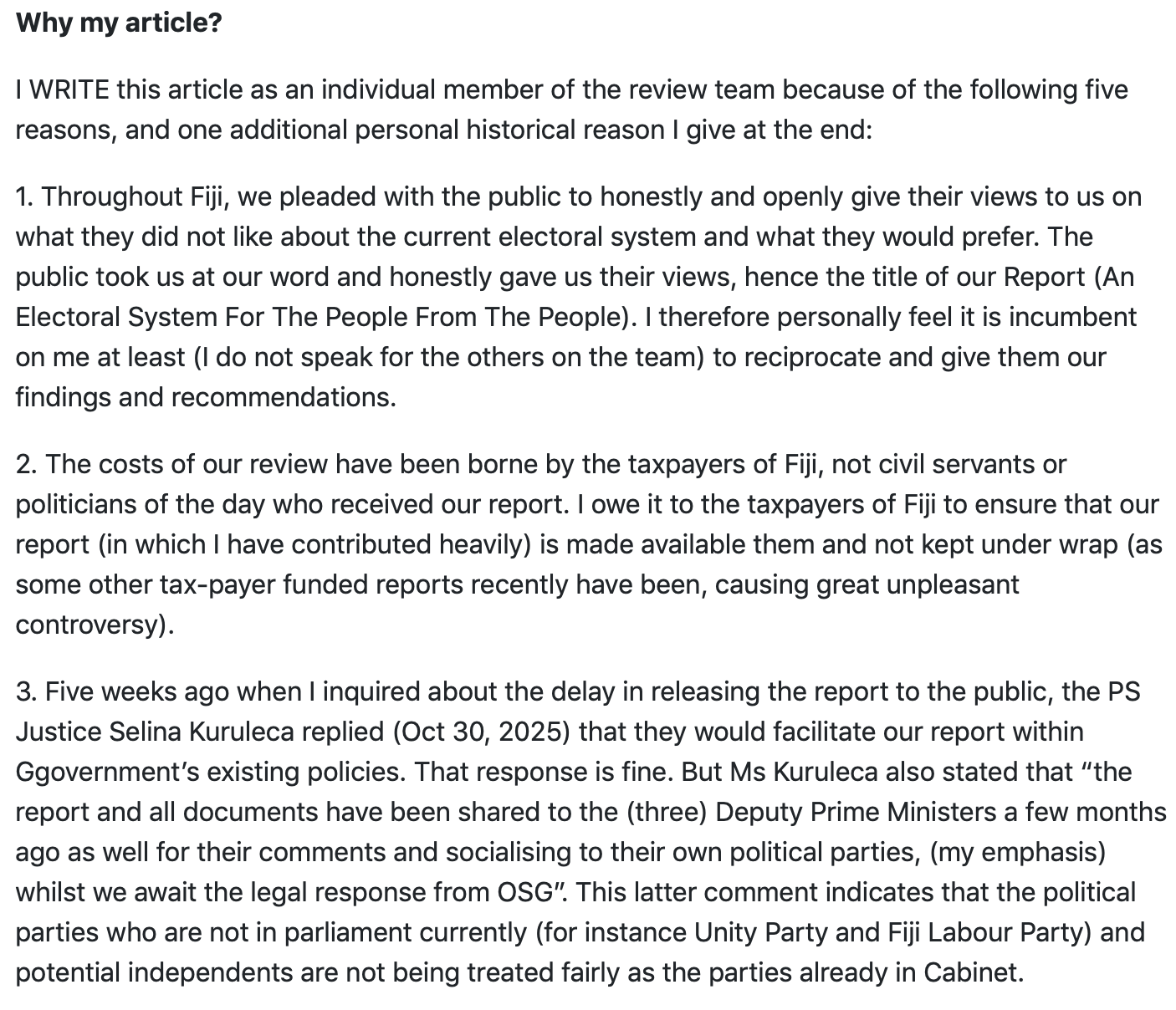
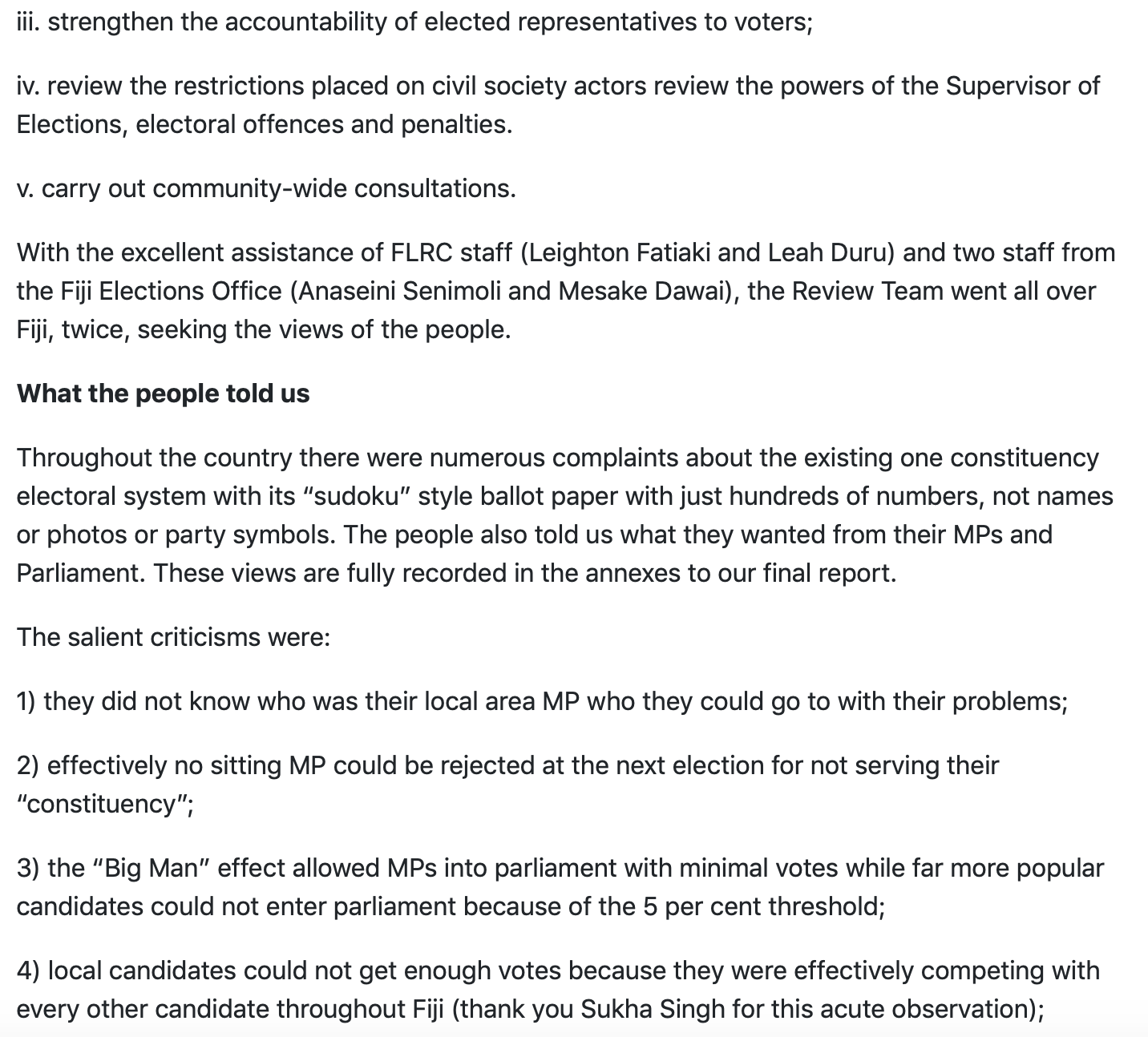
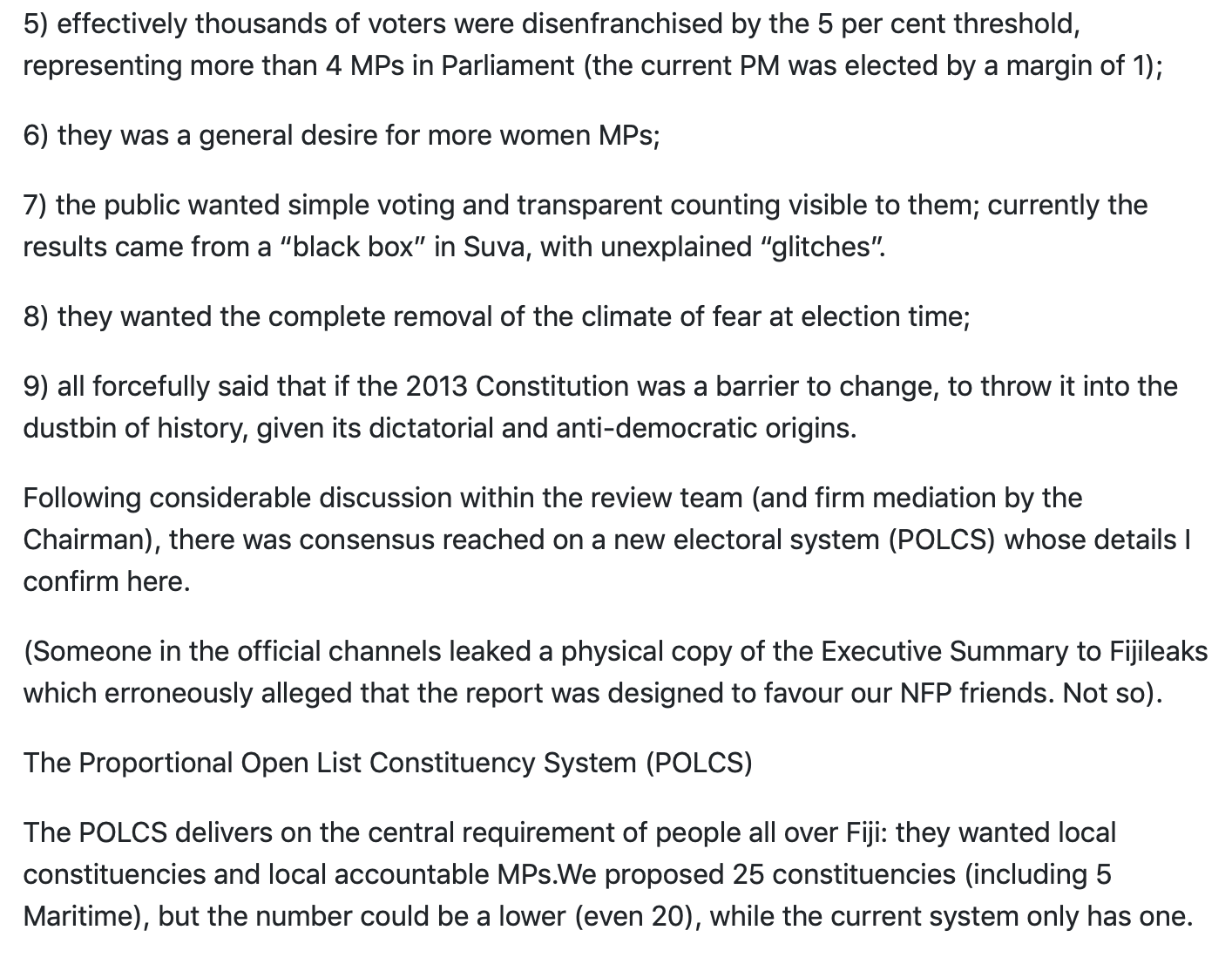
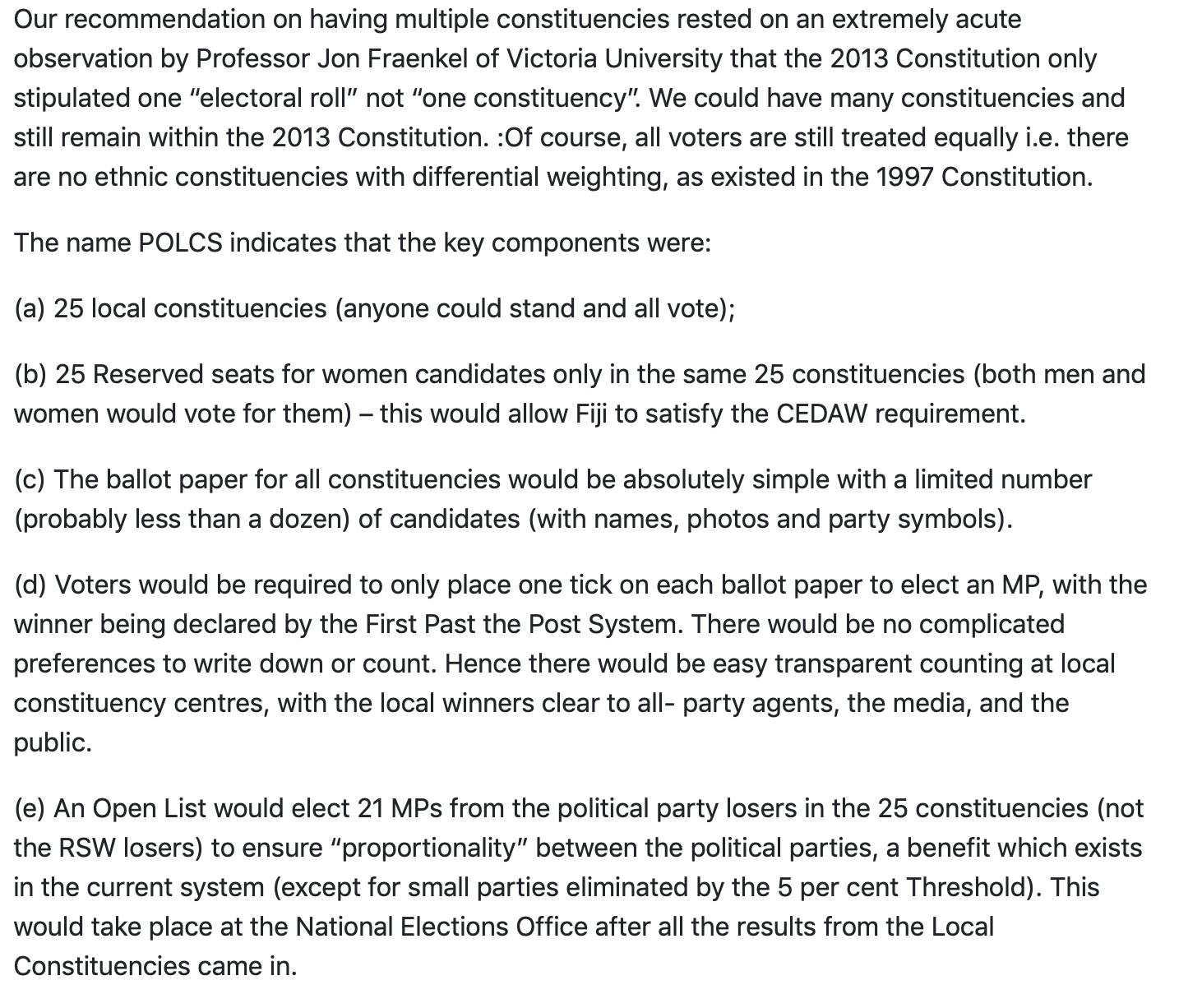
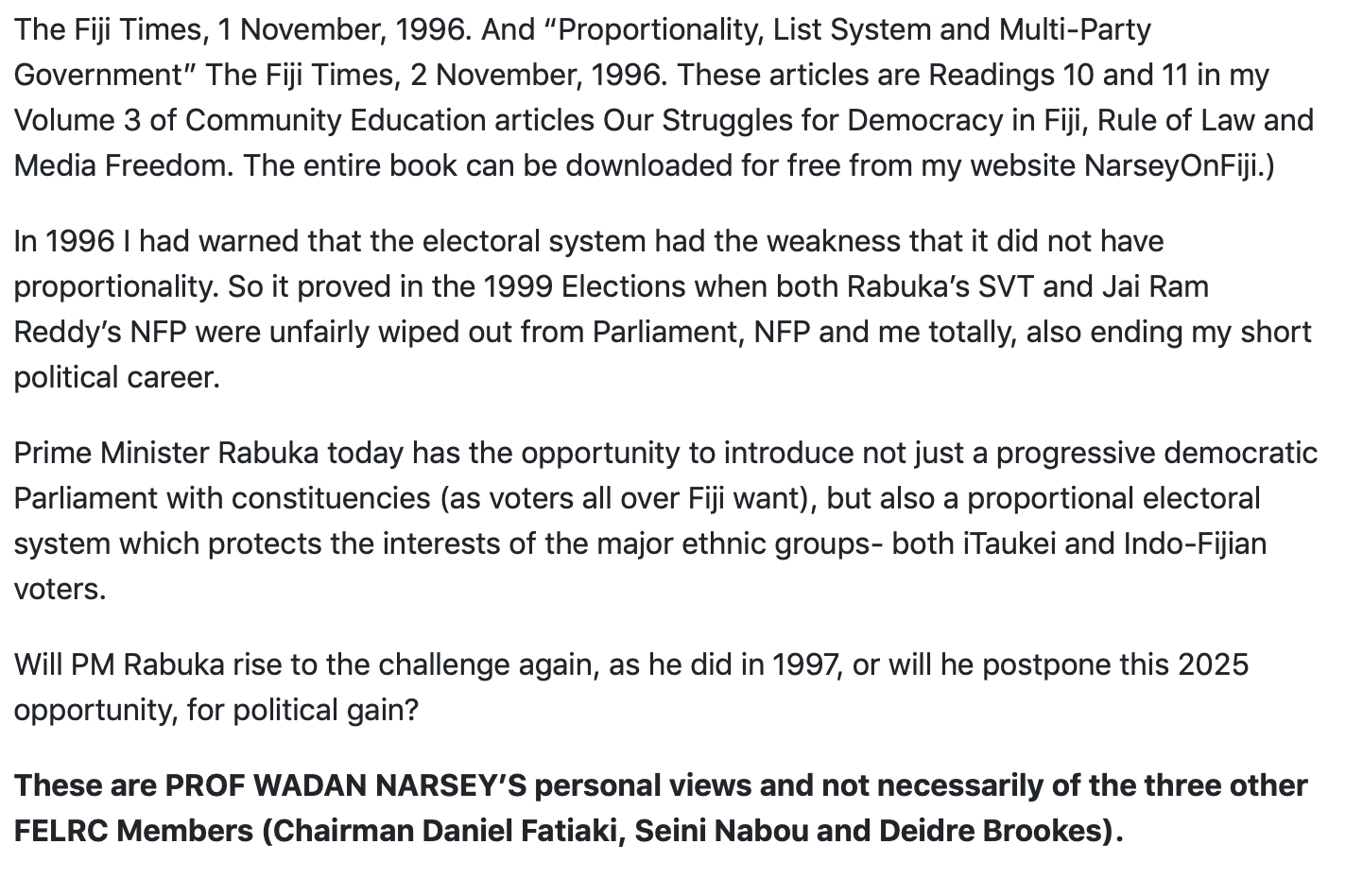
Some of the issues were covered in the following Fiji Times article by Wadan Narsey at the weekend.
But much of the detail was buried and it is his interview with Vijay Narayan that has lifted the lid on the Commission’s specific recommendations and will be causing a great deal of heartburn in the government.


FURTHER NOTE TO READERS:
I said on Sunday that I was taking a break but this was a big enough issue for me to interrupt that break. I am now resuming it and the interruption to normal transmission means I won’t be publishing daily, as I usually do, and readers comments won’t be cleared as quickly as usual.
The UN Convention on the Elimination of All Forms of Discrimination Against Women (CEDAW) may set international standards, but that does not oblige us to implement every provision. Like many other UN declarations, it functions primarily as a guideline rather than a binding legal requirement. Over the years, our women have achieved commendable progress on their own, including success in winning parliamentary seats through elections.
Similarly, the Paris Agreement on climate change calls on nations to limit the rise in global temperatures to below 2 degrees Celsius, preferably 1.5 degrees. Yet even that agreement allows flexibility in how countries meet their targets. On average, a Member of Parliament’s annual greenhouse gas emissions range from 10 to 40 tonnes of CO₂ equivalent, mostly from travel and office operations. If we are to apply such international benchmarks consistently, then Narsey’s proposal for a 71-seat parliament should be reconsidered. A smaller legislature would not only align with emission reduction goals but also help contain government costs.
For a country of our size, a 71-seat parliament is excessive. A more practical structure might include around 30 members, with two seats reserved for women and one for Rotuma. These could be elected through an open-list system that also allows representation and voting from our diaspora communities around the world.
Nonetheless, one commendable aspect of Narsey’s recommendations is the call for multiple constituencies based largely on geographic or provincial lines. This was indeed a common call from those who presented their views to Narsey’s Committee and it is a move that would strengthen local representation and local accountability.
Another NFP wala rears his ‘ugly’ head.
By recommending a 71-seat parliament aged professor Wadan has shown total disregard for taxpayers. Trodding the same path as Mr. 15% VAT Richard ‘I have the means’ Naidoo and Badia Baiman with their elitist mindsets.
‘Know it all’ Wadan probably dominated the commission.
After Richard Naidoo and Kirti Patel, another disastrous appointment by Baiman. Thank God he’s no longer finance minister.
It’s also time for retire Wadan for good.
What a disaster NFP has proven to be.
No more NFP please!
Waddy Wadan does it yet again. Clueless, needless, tone deaf ideas.
Waddy Wadan hooked his wagon to the wrong train – again.
I agree that the current system is a dog’s breakfast (well only one person can eat it all).
Adopting our Australian system better. But the itaukei elites change their constitution and electoral system as often as Lynda Tubuya her bedroom partners.
Another useless exercise by Wadan Narsey.
The size of Parliament should be based on need and what Fiji can afford. At the same time, the size of the constituency and its boundaries must make it affordable and accessible for candidates. This is where Voreqe’s single constituency is better but the threshold by 2% based on a 50 seat Parliament.
Every one and their dog want to go backwards to the old ways.
What the f*ck is wrong with Fijians – especially the so called educated ones.
And then they all wonder why Fiji is where it is!!!
With idiots like these, where else will the country be?
Narsey is a loose cannon and is irrelevant. He is a failed politician having lost election in 1999. His recommendation of 71 seats is laughable!
Seats allocated for women only?
Isn’t that discrimination?
Also based on tons of research and personal anecdotal experience, we definitely don’t want to be led by women.
This is a stupid recommendation of 71 seats from the professor in economics! the nation currently in debt of $10billions+ with high % salary increase to the current MPs and will be increased to $20billions in the next 10 years if we are not careful in our budget spending; we must stick with the current 55 seats – with an equitable apportions as follow:
Reserve 20 open seats
Reserve 2 seats for Rotuma
Reserve 2 seats for Generals
Reserve 8 seats for Women
Reserve 1 seat for Disabled people
Reserve 14 seats for rural indigenous Fijians
Reserve 8 National/Rural seats for Indo-Fijians
God Bless FIJI!
I hope the Professor in Economics is seeing this because this is what we suggested to his group during its consultations…what a shame!
There should be nothing reserved – greatly sugercoats the sense of entitlement us coconuts already have.
All seats should be open roll with merit (if there is such a thing left in bitchi) to decide who wins the seat.
In agreement with open roll and merit based. We women have been screaming from the roof tops for equality. So why the special treatment?
Warden N Arse Y is an imbecile and a moronic wannabe. His childish temper tantrums is not so childish when you consider the position of his protege now benefactor Baimaan Lamp Chops.
Then you have NFP with its own inner circle of know all Kainidia patriarchs. Women at NFP HQ are for serving tea n gulgula. It all makes sense. Except to WN Bania and Bhadia Lamp Chops and Dick Nuniless.
Wadan Narsey talks about “what the people told us”.
The “people” would be pap/nfp/sodlepa arse lickers I take it.
No matter which electoral system is put to Cabinet, the Coalition’s behaviour has left no doubt that it will be weaponised for their own gain and cannot be trusted.
The discrepancy between what they say/the spin and their actions will continue and only ramp up.
In other news, that honest cop Tuidravu reports that drug related crime is down 30% in the 1st quarter compared to the same period last year.
Can I have some of whatever he is smoking?
Whatever happened to NFP’s Common Roll?