
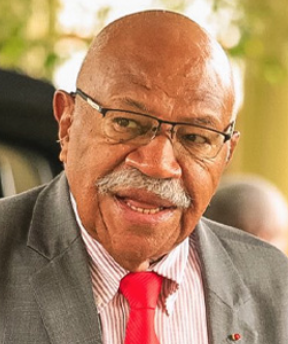
“Sitiveni Rabuka’s submission to the T & R C was to be the crowning event of the last few days. His submission was supposed to cleanse his plate and free his name from blame.
Everyone waited with bated breath, hoping that Rabuka would name names and bring some sort of closure to the 38-year guessing game.
From blaming Ratu Mara to a divine commission (“it was God’s plan”), to being forced to do it by ethno-nationalists, in the end, he made it all about himself and how he and his family had suffered.“
Don’t miss the penetrating analysis of the week’s events from our columnist in the vanua.
If this is the way iTaukei generally feel about the Prime Minister’s notion of “truth” and his explanation for the upheaval of 1987, Rabuka is in all sorts of political trouble.
A damp squib indeed. What a waste of time and resources.
A robber enters a house to rob, there’s a scuffle with the home owner, and the robber gets injured.
Now the robber shares his pain to the court with the hope of clemency.
And we wonder why there’s already been one prominent international figure resign from the Truth and Reconciliation Commission for “personal reasons.”
Can’t wait to see Rabuka’s flesh rot on his body and fall off while he’s still alive.
Fellow Fijians please ensure to pay your taxes so that it can be wasted on things like this bullshit reconciliation commission.
A snake will always be a snake…it will always wriggle out of issues….I sometimes wonder that he fancies being around his grandchildren and how much he loves them…what sort of legacy is he leaving behind for his immediate family members….For once be a leader you supposed to be and speak the truth…life is too short for you….
Suggest everyone reads a candid and masterpiece of analysis by Victor Lal on Fijileaks.com.
Rabuka still feels Fijians generally and Indo Fijians in particular are idiots and will continue to believe his drivel and deception.
It is amazing how the current government, aided by the likes of Biman, Sashi and Agni, continue to be the agents for Rabuka’s attempts to lie and masquerade as a genuine leader.
The TRC is a complete waste of tax payer’s money and meaningless exercise being implemented by nincompoops.
Thanks, Diane. I have added a link to Victor’s piece in the body of CommonMan’s article. Agree it is well worth reading.
Welcome back Graham. I hope you are well.
I had always thought that in 1987 Rabuka was very popular among the i-Taukei, and that many regarded him as a hero — even a “godsend.” So I was surprised to read at the Truth and Reconciliation meeting that, after the 1987 coup, he and his family were actually isolated by some of their own friends and relatives. I find this hard to believe, especially since he still appears to be very popular among his people today.
Vinaka but I am only back to publish CommonMan today. Hoping to be able to write again after (another) Cortisone injection in my injured shoulder this week.
Was that all slr could say? how it affected him and his wife?
How about the thousands of lives that were destroyed?
I should have run this snake over in Greig Street back in the 90s when he walked out onto the road without looking.
There is value in acknowledging the past, but Fiji cannot pretend that an apology neatly closes the chapter on 1987.
That period wasn’t a political misstep , it unleashed violence, racial hatred and human suffering that many families, including mine, have never forgotten. Those wounds weren’t abstract; they were lived.
An apology is only meaningful when paired with accountability.
Saying “sorry” while remaining in power risks turning forgiveness into a political instrument rather than a moral act.
Leadership should carry higher standards, not lower ones. If a person admits responsibility for unleashing instability and human rights abuses, the question isn’t whether they can apologise — it’s whether they should continue to govern the very people harmed.
And this is the heart of Fiji’s problem: our political culture never fully recovered from the coups.
The institutions that should have barred coup leaders from holding office again were weakened, and over time the coups themselves became normalised.
When the person who breaks the system ends up defining it, accountability becomes optional.
Add cultural loyalties, ethnic voting patterns, and a long-standing leadership vacuum, and Fiji ends up in the painful position where the very people who once destabilised the nation can walk back into power.
This isn’t about punishment. It’s about integrity. Nations heal when accountability matches the gravity of the harm done. Fiji deserves leaders who strengthen unity and trust, not ones whose past actions still divide the country.
If we want genuine reconciliation, words must be accompanied by consequences. History can be acknowledged — but it should never be rewritten.
Given Rabuka’s central, decision-making role in launching the coups — and the enormous harm those coups inflicted on many other Fijians — this self-portrayal as a victim today can reasonably be read as a form of narcissistic narrative control. He appears to shift focus away from his responsibility for overthrowing democracy and the ensuing suffering, casting instead a personal image of guilt, trauma, and wounded innocence. That inconsistency — between being the architect of a violent takeover and now presenting oneself as harmed by it — suggests a deep desire to recast his legacy, avoid full accountability, and evoke sympathy rather than condemnationu.
Rabuka’s body language from pictures and videos of 87 doesn’t it any way indicate that he is conflicted.
In fact he is seen carrying himself like a conquering hero entering Rome.
What a f**king narcissist.