
GD writes: In the space of a month, CommonMan – our weekly voice from the grassroots in the vanua – is already making an impact on the national debate. And this week, he dedicates his column to the increasing power of the Internet in iTaukei society.
It includes a remarkable event that has gone unnoticed in the mainstream media – how the financial plight of a struggling student caught the attention of two local podcasters, Bis Moce and Lesi Vanuavou, whose coverage of her story resulted in her university debt of more than $16,000 being cleared in less than 24 hours.
Imagine the possibilities if instead of the mindless ranting and finger-pointing that is the downside of Facebook, the Internet could be harnessed for many more positive initiatives like this? Imagine its potential impact on politics and the way people vote?
With their extraordinary audience reach, CommonMan predicts that Bis and Lesi are destined to become a powerful force in the lead-up to next year’s election and beyond. With the ability not only to influence opinion but encourage politicians and the wider community to give new life to the old iTaukei concept of solesolevaki – service for the common good.
—————
The technological advances of the 21st Century have ushered in the Information Age, characterised by a rapid shift from traditional industries to the widespread use of digital technology and the Internet in daily life. So much so that the iTaukei and the vanua, its foundational ideological framework, its values, customs, and rituals, seem archaic and out of touch with modern-day realities. There is no doubt that in order to survive, it has to evolve. Cultural adaptability.
In my introductory piece a month ago, I advanced the notion of a ‘digital vanua.’ In brief, it is the re-imagining of the traditional concept of vanua, within online spaces in the digital ‘world’ while still keeping its core values and principles. But what would this adaptation look like? How do we bridge this ever-widening chasm and bring the core beliefs of the vanua into the 21st Century unscathed?
The answer lies in an event that occurred last week. To me, it is the story of the year. Because it encapsulates how iTaukei podcasters have successfully harnessed digital media to bring to life, live and on a grander scale, the indigenous custom of ‘solesolevaki.’ And, in so doing, have profoundly resurrected and redefined this once rigid and slowly dying custom.
In a world where rights and privileges are constitutional guarantees, entitlement is an expectation. But in the true iTaukei worldview, one of the foremost virtues is duty or ‘i tavi.’ Solesolevaki is based on the concept of duty. Put simply, it is when members of a village or community work together for the common good without expectation of reward or payment.
The most common form of solesolevaki is the ‘cakacaka va-koro’ or the general communal/village work. This happens every first Monday of the month, a day dedicated solely to communal service. Mostly it is a village clean-up day, but it may also take other forms such as farm work or repair of the community hall, etc.
In terms of hygiene, there is the quarterly ‘rai-koro’ or general village inspection by the ‘nasi-ni-koro’ (village nurses). Usually, all the nasi-ni-koro from one district inspect the villages in another district and their report is tabled at the bose-vakoro. My village has twice won the cleanest village in Fiji award in the late 70s and the early 80s.
The decline in general communal standards of discipline is attributable to a number of factors, chief of which – in my opinion – is the gradual transition into a rights-based society. I would like to postulate here something that many may disagree with: that the decline in old-school communal virtues and morals can be directly attributed to the rise in rights. Rights are only good for societies based on individualism. But it sounds the death knell for communalism.
But I digress.
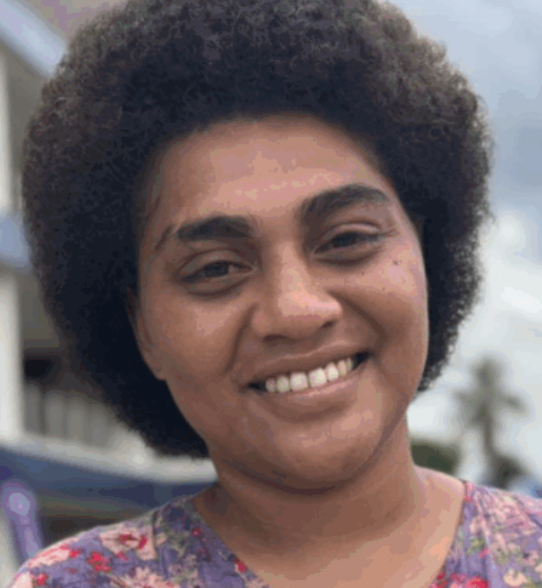
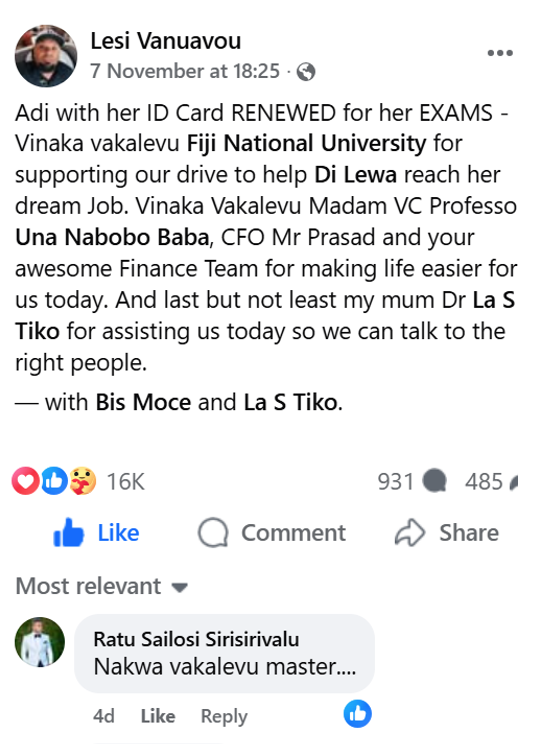
Last week, two of Fiji’s biggest social media influencers or podcasters (I introduced them in my introductory piece), Lesi Vanuavou and Bis Moce, – who have a combined 200,000 plus followers – received a plea for assistance from one Adi Lewa Daunibau, a fifth-year student doing a Bachelor’s Degree in Oral Health. She was to have sat her final exams this week, but the FNU administration had barred her due to non-payment of fees, the sum of $16,608.

On Friday morning, Nov 7, 2025, Lesi Vanuavou and Bis Moce went live, interviewing Adi Lewa about her personal and financial struggles. The livestream went viral, watched by hundreds of thousands of viewers. Donors from all over the world pitched in and paid off the fees in less than 24 hours. People of all races and all occupations had helped a struggling villager from rural Tailevu. From America, Britain, Europe, Australia and New Zealand, everyone gave what they could.
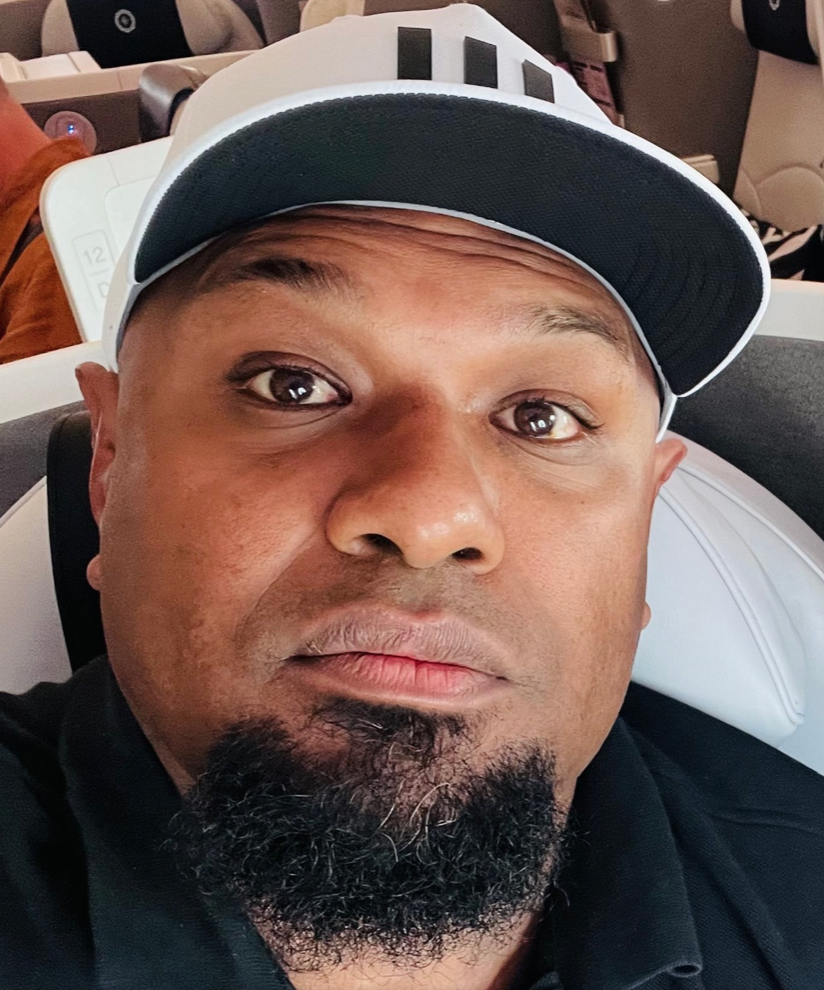
Lesi, whose mum is also a University lecturer, even received a message from the FNU finance department saying, ‘What is happening?’ They were bewildered by the sheer volume of money that was being transferred to Adi’s FNU account. Needless to say, donations exceeded the amount required.
Instead of having Finance transfer the surplus to her own private bank account, Adi requested that it be used to pay the outstanding fees of another student facing a similar problem, totaling $920.00.
Adi’s story was watched by nearly 700,000 people, had about 3,000 interactions, 10,800 reactions and was shared over 2000 times.

This is not a one-off for Bis and Lesi. These influencers and content creators have been doing this for some time.
Then there is Arisi Tabuasei , another prominent content creator and media professional, who commands a following of 199,000 plus followers on his See Saw Facebook page. He possibly has the biggest number of online followers.
In addition to his role as a director and producer with FBC, Tabuasei spearheads the Loloma Movement, a grassroots initiative that mobilises global donations to support disadvantaged or vulnerable communities nationwide. Beneficiaries include boys’ homes, HART villages and elderly care facilities, with the movement providing essential food supplies and humanitarian aid.

The emergence of the Digital Vanua marks a new era of solesolevaki that has been elevated to a global scale for the common good. This digital vanua transcends village, tikina, and national boundaries, weaving together communities across the globe. It is transnational. In this space, race and identity dissolve, and all stand equal as human beings before God. Its true currency is not wealth, but perseverance, kindness, faith, hope and love.
In a year when a government that took office in Fiji with high expectations has staggered from one crisis to another, stories like this seldom reach the headlines. Yet every dark shadow of foreboding has a silver lining. Initiatives such as these rekindle the spirit, reminding us that hope endures for Fiji and for humanity.
It is fascinating to contemplate just how influential these content creators could be if they chose to wade into the political space with intent. I personally believe these podcasters will have a profound impact on the outcome of of the 2026 Election, should a political party they believe in choose to harness their reach. By the general election of 2030, they may very well influence the outcome as Joe Rogan, the American podcaster, has done with Donald Trump in US presidential elections.
Another crucial point to note is that all of these big podcasters in Fiji are in their early to late 30s, the perfect age range given that at last count, 60 per cent of our voting population is between the ages of 18 to 45. They could very well be the axis or fulcrum around which to coalesce or attract political support.
The sheer volume of their following means their message is resonating with the masses. And their followers are willing to back these influencers with their own money to put it to good use. That level of trust can easily be extrapolated into the political arena if the messaging is right.
This possibility underscores a broader trend: the democratisation of influence. Traditional media no longer holds a monopoly on shaping political narratives.
In Fiji, as elsewhere, digital voices are emerging as powerful actors capable of mobilising communities, reframing debates, and redefining the contours of political engagement.
—————————
NOTE TO READERS:
Many of you have been speculating about the identity of CommonMan – the real person behind the pseudonym. And especially those who doubt – because of his writing skills – that he really is a farmer and village commoner who is largely self-taught.
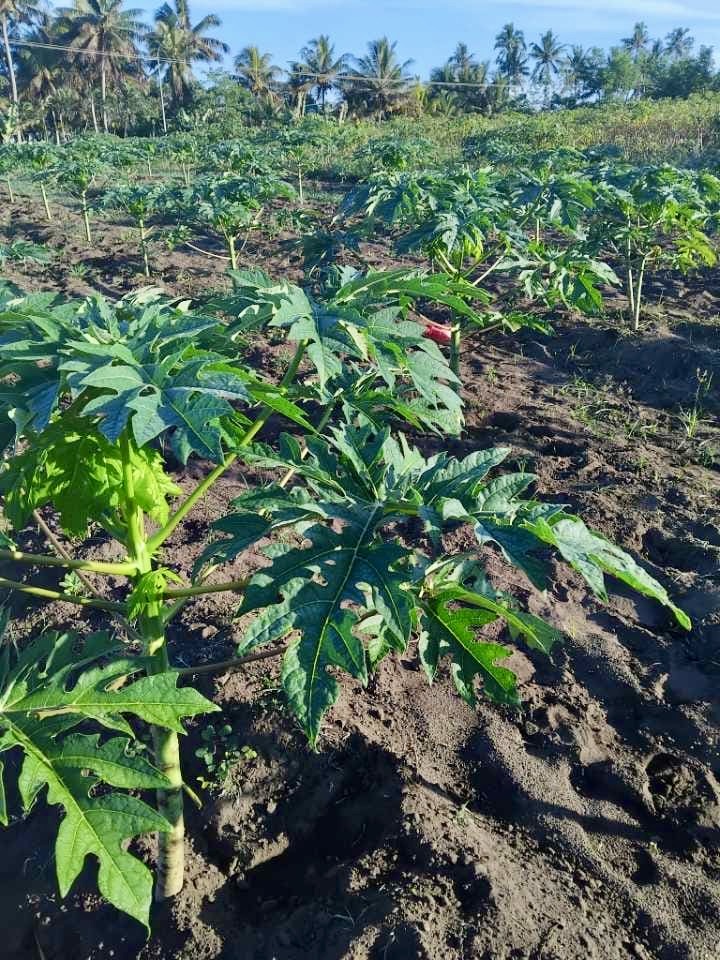
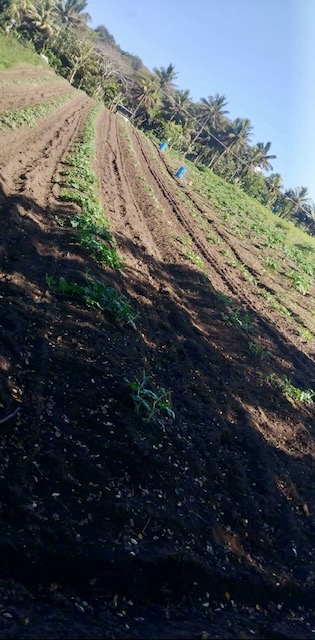
While we are withholding his name so that he can continue to comment on national issues without being subjected to pressure (or retaliation), here’s some photos of CommonMan’s farm somewhere in Nadroga.
That’s him posing in his Number 5 “Nadro” rugby jersey – proof that he really is sprouting crops as well as ideas and is 100 per cent authentic. Though in real life, he’s a lot better looking and certainly not plastic, as in fake or insincere.

More from CommonMan next Sunday.
UPDATE SUNDAY PM:
In the meantime, someone else who is authentic too is taking a short break while his cousin – the niece of the late Rev P.K Davis – is in town from Lodoni. The original, not its namesake in Tailevu.

Back in a couple of days with a huge reveal – how Lynda Tabuya isn’t the only government minister double dipping on her expenses.
Virtually the whole lot of them are on the take. At your expense.
Sota tale.
We hope that CommonMan fights the next elections. He will certainly get my vote and I’m sure that of many others as Fiji needs thinkers and doers like him.
Not looking or thinking that far ahead. For far too long, it’s the views of the iTaukei academics and technocrats that have gotten “airtime.”
At the moment, the main objective is to present the perspective of the vanua.
Who is going to present the views of the Indo-Fijians. Or should they just stick to getting permission to do everything?………….because, you know, they do not really belong even after 150 years and having no other country.
I am sick of the iTaukei and vanua words, designed to discriminate and isolate the vulagi. The views of the iTaukei and the vanua are not the issue. It is racial discrimination that is the issue. Racial discrimination is a normal part of life in Fiji and it is a normal part of the views expressed by CommonMan. It is just that he does not realise it just like everyone else in Fiji.
If the Indo-Fijian all went “home”, will the views of the vanua or the iTaukei be relevant? Will the land be relevant? Will the GCC be relevant? Will the whole tradition and culture and the kalavata be relevant?
What do they do in PNG?
Then it will be dog eat dig – back to cannabalism
I fully understand your sensitivity under the circumstances in an environment where even the elected representatives of the minorities are betraying us by enabling extreme indigenous opinion. But CommonMan has already demonstrated that his personal attitude is one of inclusiveness and that we all have the right to fully belong.
I don’t think you can just cancel out the words “iTaukei” and “vanua” when they are clearly an established fact. The whole purpose of giving CommonMan a forum is to tap into the attitudes and feeling of regular iTaukei in the vanua, rather than the political and academic elite. And I think he has already demonstrated a sensitivity towards the feelings of people like you that isn’t always reflected by the elite.
I would just ask you to reflect on a universal truth. When you give respect, you are in the best position to gain respect. It is clear to even the dimmest person in Fiji that ordinary iTaukei are being manipulated for political purposes to think that their land and way of life is under threat when it patently is not.
CommonMan is giving us a very different insight into how the grassroots really feels. And I personally think this is a valuable exercise that non-indigenous Fijians should support.
@helloworld. The itaukei and vanua are one and unless others understand the difference between the right to own and to gift, another five generations and the vulagi will be visitors still.
Land ownership has nothing to do with the right of all Fijians to equal status and the right to belong. The common and equal citizenry is not yours to bestow.
Great to see social media put to positive use. Your views are refreshing and timely.
Hope Fiji benefits and is enlightened.
Long term, in my opinion, the Indo Fijian is irrelevant in Fiji politics and their numbers will continue to dwindle
The sooner this is accepted by this community, the better for them.
Wish CommonMan and those of his ilk the best.
One 5 litre watering can for a farm which appears to be in the acres is the way to go in Fiji, I guess. Makes a lot of sense to me, not sure about anyone else. And yes, I can see that this is Nadroga.
The 5 litre cans are for the kids. The kids of most farmers assist in the farms as after school chores. There are also 15L and 20L canisters, they’re just not in the picture. A smart farmer also carefully calculates when he plants. It’s the rainy season now in the West, so watering is mostly done by the rain.
Social media sure can harness goodwill and generosity when it is in good people’s hands.
I can’t imagine the damage that could occur should any of Fiji’s current leaders get access to such a following.
Awesome post. We need more of these young people who really have Fiji at heart to drive out these expired leech politicians who should be at the Old People’s Home. Starting from Fiji’s White House.
So it’s up to the Content Creators now to upgrade CWM hospital, the electricity and water infrastructure, crowd fund scholarships and overseas rugby trips, etc etc. Perhaps one day they will also facilitate binding referendums that become part of legislation.
Move over government.
Careful though. The last ‘content creator’ crowd funded to pay for the infamous $3m flight.
We need more posts that are creative, forward-thinking, and focused on lifting Fiji up. For the next election, Fiji needs a truly forward-looking political party—one that unites our people rather than dividing us along racial lines.
We do not want to see old politicians return to power, especially those who prioritise their own interests over the nation’s. The government elected next must encourage investment, reduce poverty, raise the standard of living, and genuinely promote unity among all communities.
It has been nearly 37 years since the first coup, yet we remain divided on racial lines. We should reflect on the era of Ratu Sir Kamisese Mara – an era remembered for unity, progress, peace, and warmth—and strive to restore that spirit for the future of Fiji. It is pleasing to see photos on facebook of our Fijian brothers and sisters planting cash crops.
Thanks GD for giving CommonMan a platform and voice. Fiji lacks and needs progressive citizens. We hope the newspaper column discussed previously comes through so that CommonMan gets another outlet to share his views. We look forward to next Sunday’s installment.
And can’t wait for the big reveal on our double-dipping Ministers and MPs. They are nothing but parasites. The whole bang lot of them.
In the meantime, have a well deserved break, GD.