
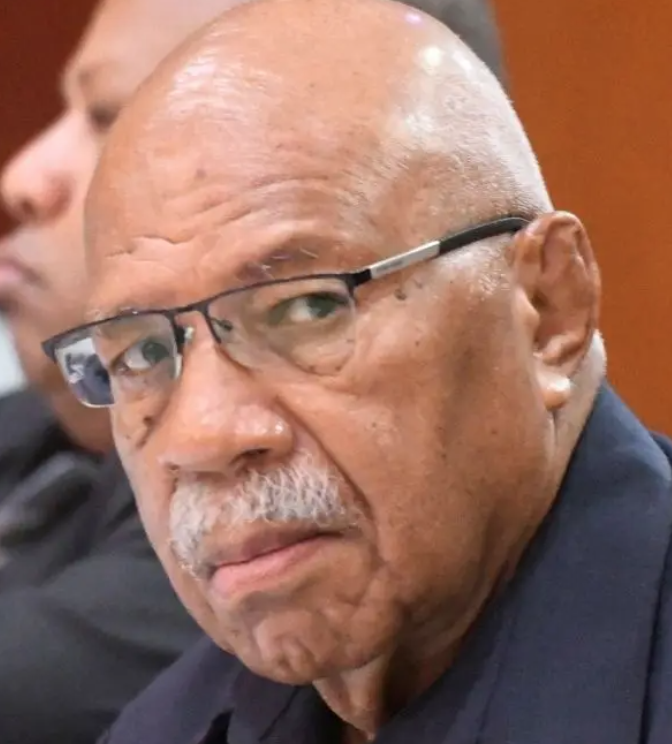
We’re just going to have to suck it up, Fiji. We’re getting a new constitution foisted on us by Christmas whether we like it or not, just like the last one was foisted on us. Except that this time, we’ve got to pretend that we had some say in it when we didn’t.
The unholy alliance of the Prime Minister, his People’s Alliance colleagues and the Great Council of Chiefs are pressing ahead with a document that not only enshrines the power of the chiefly elite in the supreme law but gives them exceptional power.
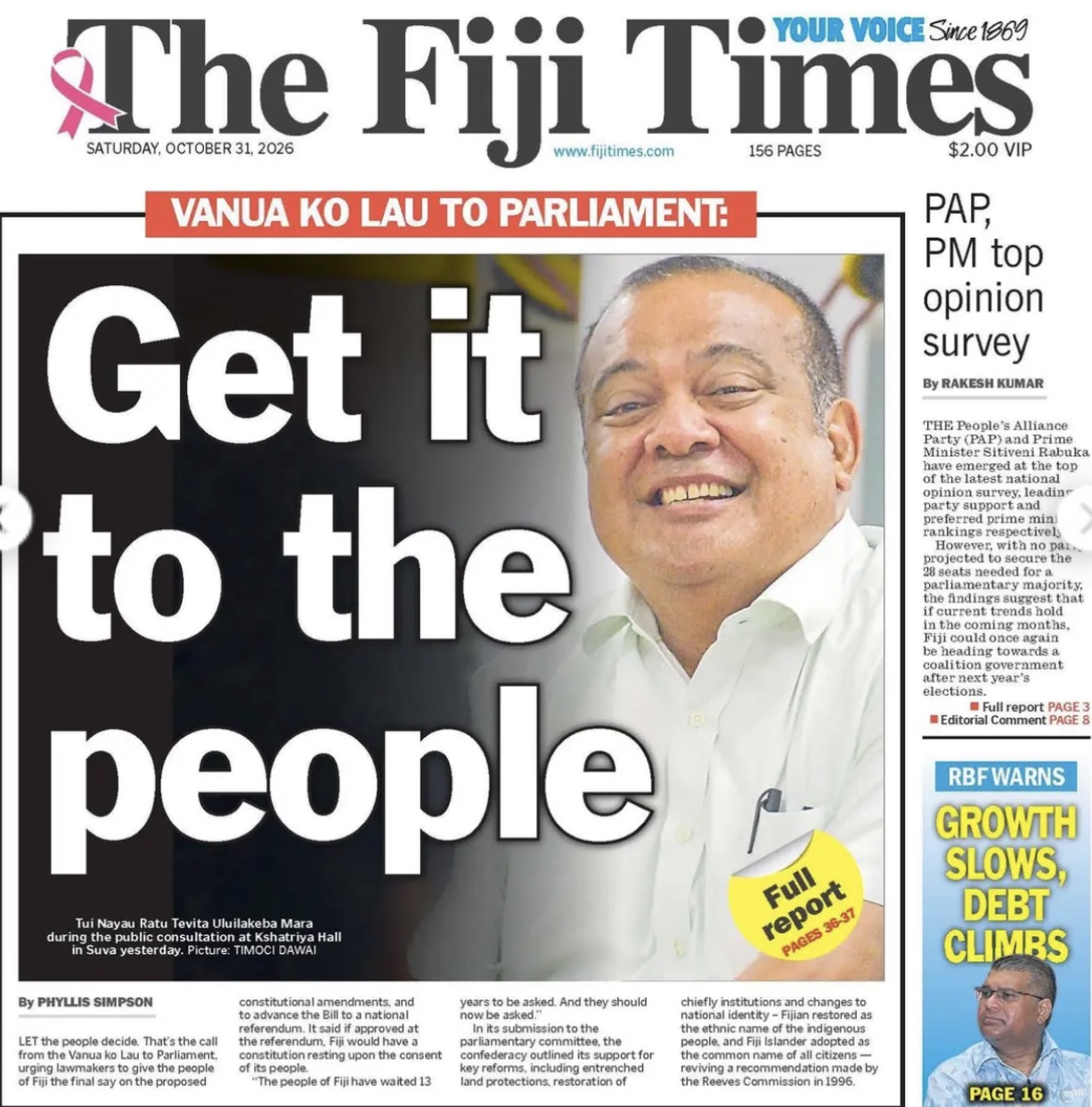
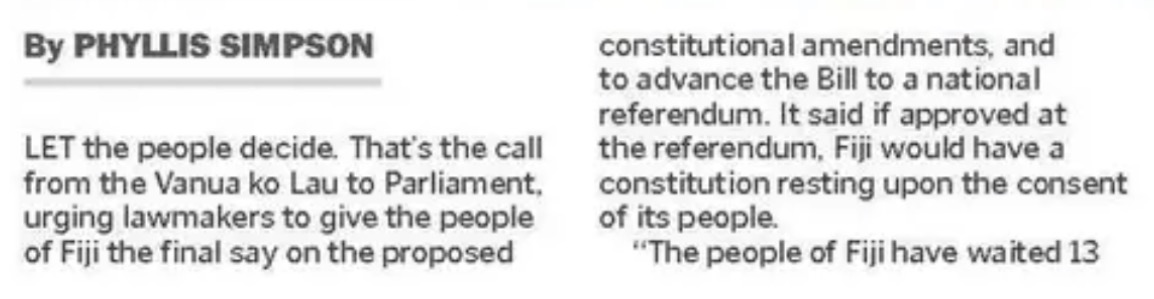
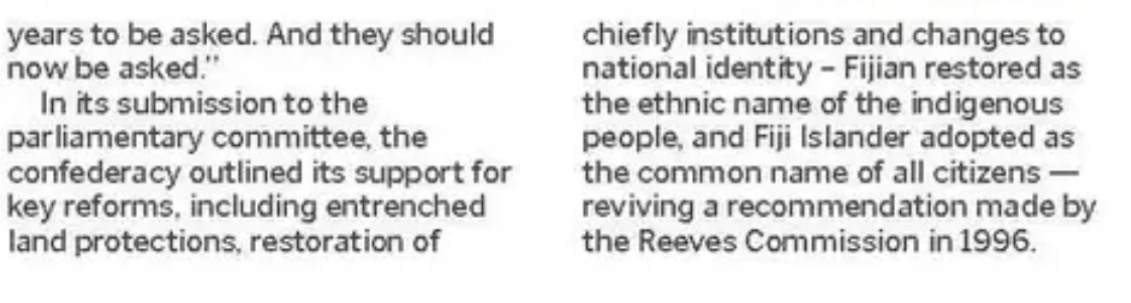
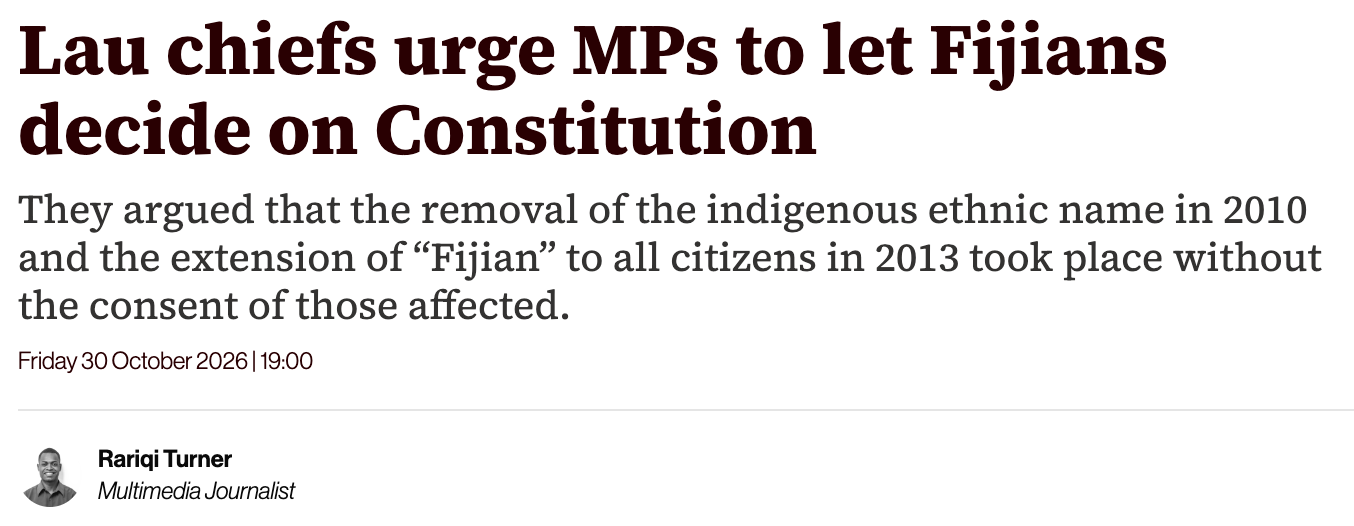
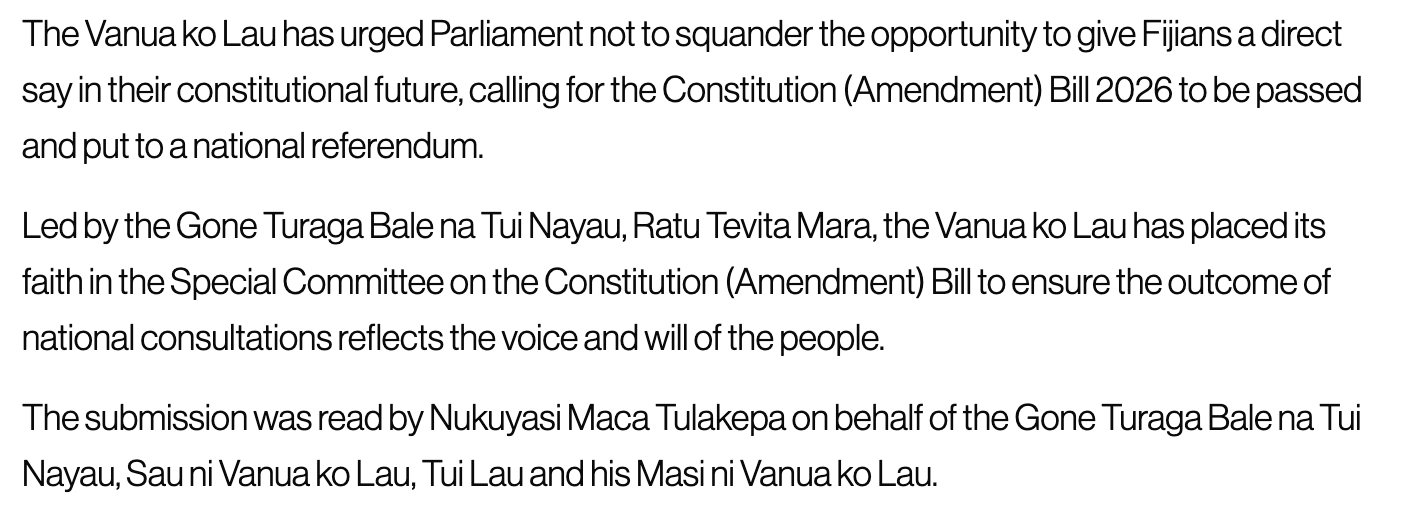
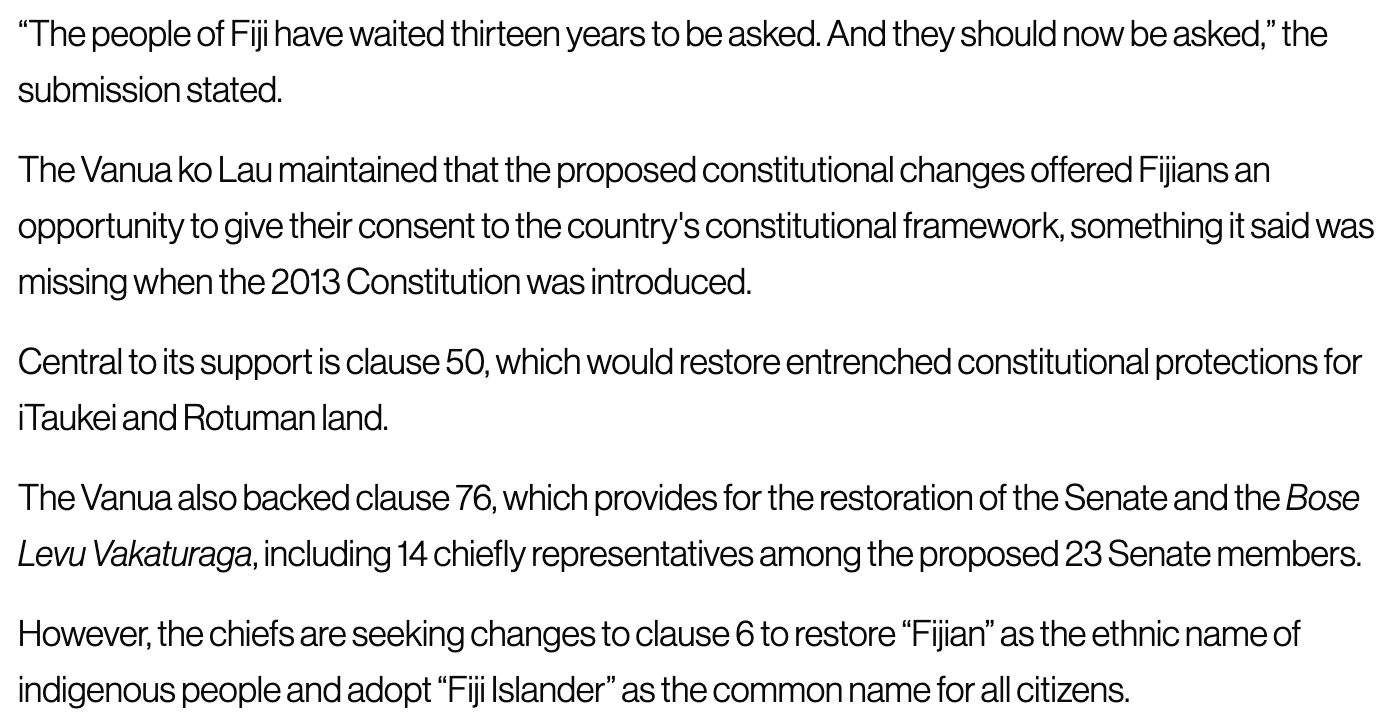
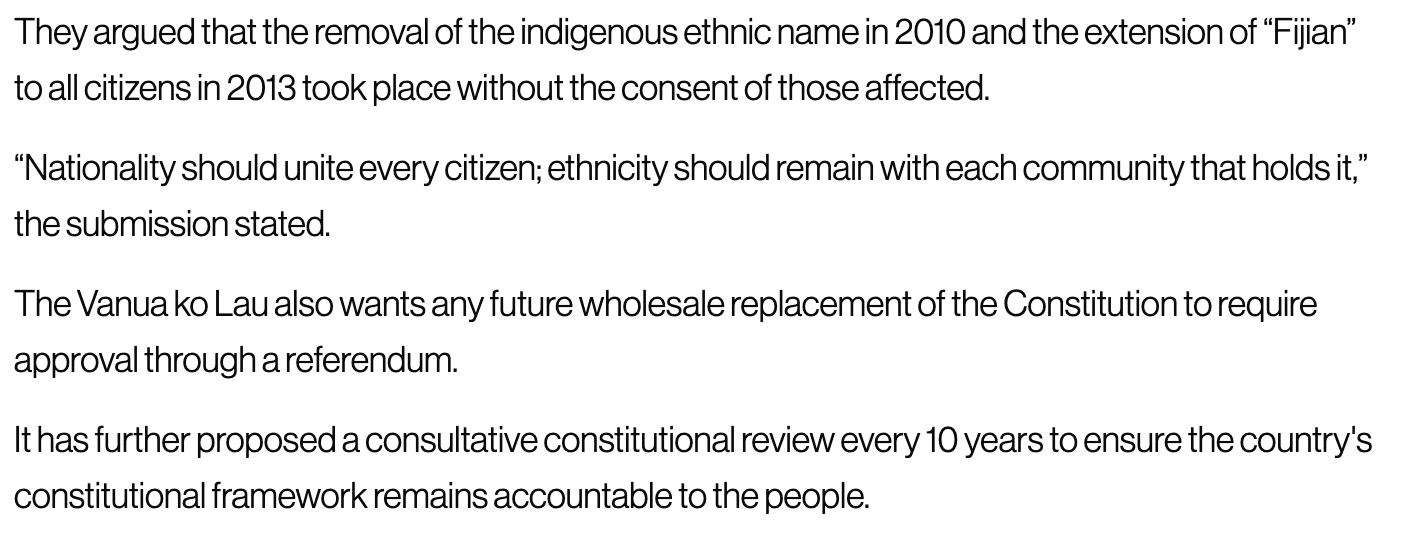
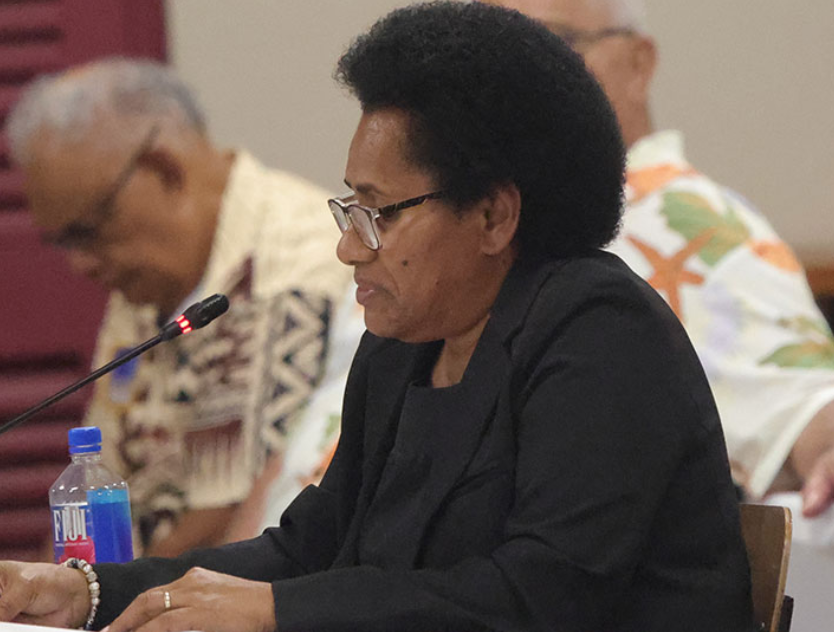
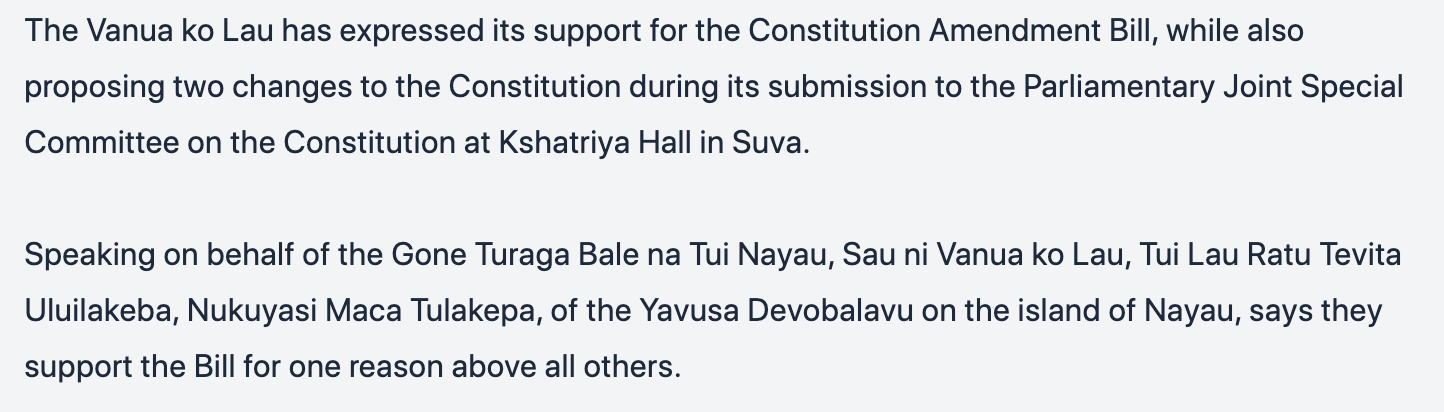
And to add insult to injury, one of the biggest chiefs – the Tui Nayau and high chief of Lau, Ratu Tevita Mara – is mounting a last-minute bid to also rob the minorities of the common identity we’ve enjoyed since the 2013 Constitution of being able to call ourselves “Fijian”.
Yes, despite the current draft 2026 Constitution so far retaining the common identity, the part Tongan son of the nation’s founder, Ratu Sir Kamisese Mara, wants that altered in the coming week to describe the minorities not as Fijians but Fiji Islanders.
And to think that some of us once saw Tevita Mara as a possible force for enlightened change and were urging him to enter politics to uphold the principle of a multiracial Fiji that was the bedrock of his father’s rule. Mara Junior has genuinely sunk to the occasion by wanting to strip non-indigenous people of their identity.
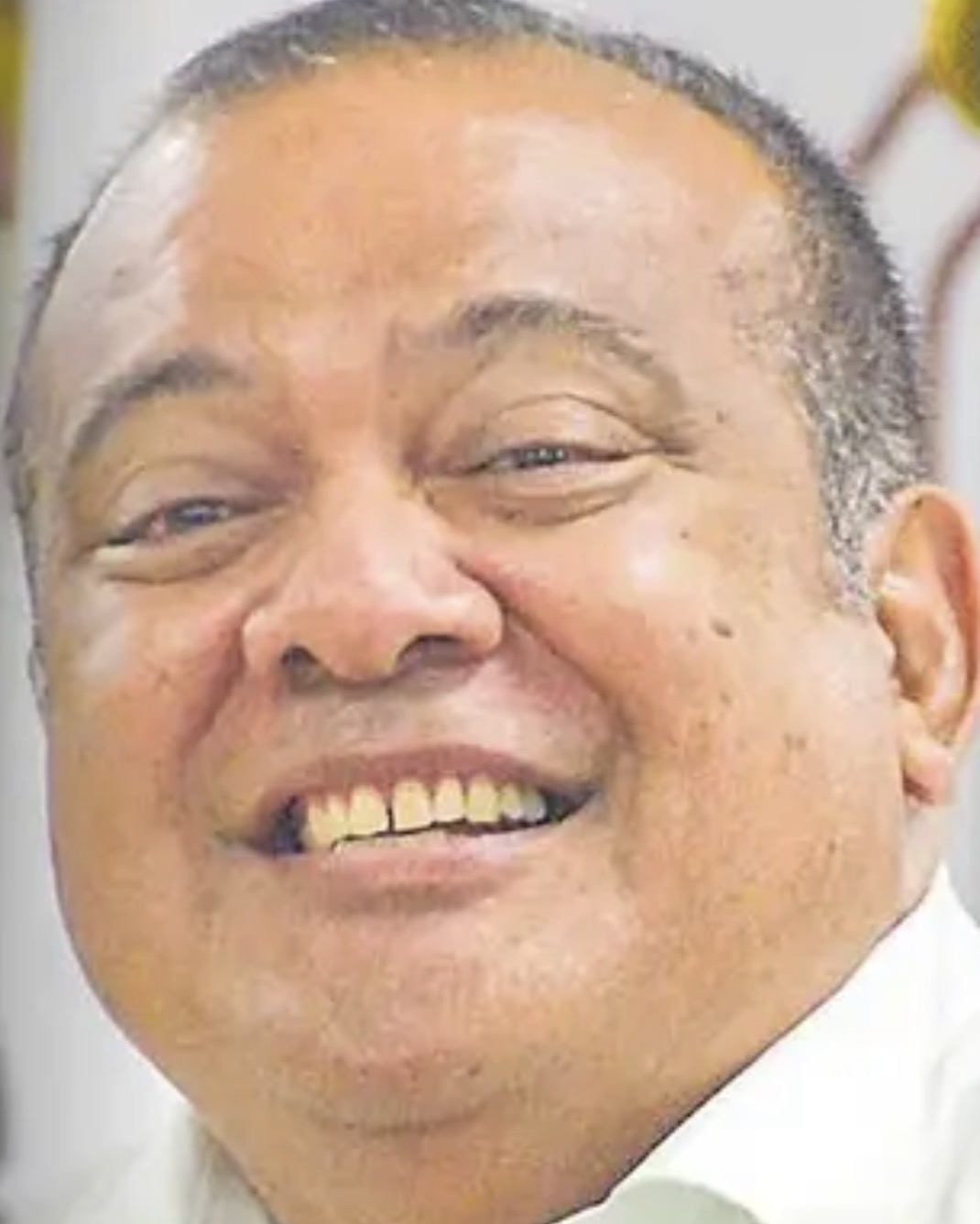
It is beyond belief. How many times do sensible people have to repeat that “Fijian” is an English word that it not indigenous and doesn’t belong to the iTaukei, let alone a part Tongan who fled to Tonga when he was facing sedition charges and escaped the law, only to return unmolested and try to marginalise non-indigenous Fijians.
Mara is a complete disappointment. No, make that a complete disgrace. But then we are going to see a great deal of disgraceful betrayal in the coming days from the Prime Minister down.
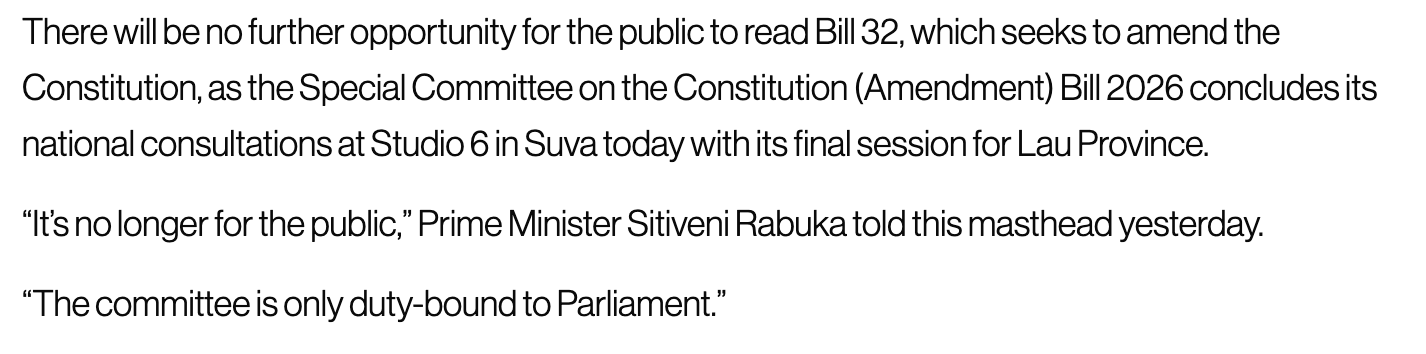
The universal cry in the country is for more time to be given to the people to consider the draft constitution. But we are to be ignored. The Snake says he has given us enough time to consider it and it is now for parliament to decide.
And watch, Fiji, how we are going to be betrayed by some of those we put in the parliament to keep the other bastards honest but who are proving to be even bigger bastards themselves.
Reports have it that both the NFP and SODELPA have issued written directives to their MPs to vote against Bill 32, the Constitutional Amendment Bill, when it goes to its third reading towards the end of next week. But some of them are simply going to defy that directive.
From the NFP, Pio Tikoduadua and Sashi Kiran are evidently going to vote with the Snake and so are “Blinky Bill” Gavoka and Ifereimi Vasu from SODELPA.
These MPs don’t think we have a right to more time to consider the new constitution. They are willing to defy their own parties and the people who put them there to give the Snake and the chiefs exactly what they want – a supreme law that has been foisted on the nation in the same way that the last constitution was foisted on us but that entrenches the power of the elite. And they call that an improvement? They call that good governance?
It is beyond depressing. We are surrounded by betrayal at every turn at the hands of a bunch of moral pygmies who haven’t the first idea about democracy. So when the election finally comes around, Fiji, please show them who is really boss and kick the bastards out.
This is hardly surprising.
The I Taukeis and their institutions have always been double or even multi faced and can never be trusted or taken at face value. Opportunism thrives and there is hardly any principles or values they can demonstrate. At the end of the day it is for them (not the nation) and, as many have said, they are safer with the devil you know, than the unknown. And in this case the devil is notorious for flip flops, lack of consistency and manipulation. He can be easily intimidated by the GCC and other chiefs, businesses and others with vested interest to yield to their wishes. Don’t be surprised if SODELPA joins the vote for the constitution in spite of the current posturing.
As always a reality check for other minorities, mainly Indo-Fijians. Their leaders should be working with liberal democracies and countries like Australia, Canada, India, NZ etc to not only raise this alarming issue of inequality and apartheid but also find ways of relocating affected people in a dignified and organised manner.
Rabuka is out to do, with a warped sense of legal justification, what he set out to do in 1987. Of course there are many levers the minorities have, through educational institutions and professional attributes etc. But do we ever expect that the well known legal firms, many owned by Indians, will start legal challenges and even take the issue up to the UN courts like ICJ to ensure justice and fairness?
The pretence of having a say is far more worse than actually not having a say.
The legacy of this new CON-stitution will have more baggage than the 2013 one.
Instead of solving the concerns of people not having a say, this new ill thought out and rushed CON-stitution creates a thousand times more concerns.
If I am to be relegated to being a second class citizen then I will return to my country of birth where I still have full citizenship rights.
When I arrive into Fiji on my many trips abroad I am always very proud to write “Fijian” in the nationality box on the arrival card. If I am no longer able to do this then why would I want to remain here.
If GD, allows, a long winded background to where we are now.
In 3 days, here we go again.
The Coalition Government has committed the same illegitimate process that the Twin Pot Dictators imposed on us in 2013. SHAME!!!
Not in the “INTEREST OF THE WELL BEING OF THE PEOPLE OF FIJI.”
Politicians and their “in house teams”
………………………………….
With the help of AI .
A bunch of questions asked and answered with data at its fingertips.
Professor Yash Ghai chaired Fiji’s Constitution Commission in 2012, which conducted extensive public consultations and produced a comprehensive Draft Constitution. However, the process was never implemented or enacted into law through a Constituent Assembly. [1, 2, 3]
What Happened to the Process?
The Draft (December 2012): Professor Ghai and the commission publicly released their draft constitution after receiving over 7,000 public submissions. [1, 2]
Rejection by Government: The Bainimarama-led military government rejected the Ghai Commission’s draft. [1, 2]
Dissolution: The Constitutional Commission was dissolved, printed copies of the draft were discarded/burned, and the planned Constituent Assembly process to debate and adopt it did not proceed. [1]
Replacement (2013): The government instead drafted and promulgated its own Constitution by decree in 2013, bypassing the Ghai implementation framework
July 18, 2012: The Constitutional Commission was established under Decree No. 57, with Professor Yash Ghai appointed as Chairperson. [1, 2]
August 3 – October 15, 2012: The commission conducted public consultations and received over 7,000 public submissions. [1, 2]
December 21, 2012: Professor Yash Ghai and the commission presented their draft Constitution to the President of Fiji, releasing it publicly against the interim military government’s wishes. [1, 2]
Interim Government Intervention (January 2013): Instead of allowing the planned public discussion and review of Ghai’s draft by a Constituent Assembly, the Bainimarama interim government altered the constitutional process decree. [1, 2]
Rejection (January 10, 2013): The government officially rejected the Ghai Commission’s draft constitution, dissolved the Constitutional Commission, and reportedly destroyed printed copies of the text. [1, 2]
Recent Developments (2026)
Revival in Debates: As Fiji’s coalition government and the Fiji Constitution Review Commission evaluate sweeping changes to or a replacement of the 2013 Constitution, political figures and civil society groups (such as UNITY Fiji’s Savenaca Narube and former Prime Minister Mahendra Chaudhry) have repeatedly urged drawing back upon the widely consulted 2012 Yash Ghai Draft Constitution as a benchmark for public legitimacy
Under the original 2012 framework set out by the interim military government, a Constituent Assembly was designed as the vital second stage of Fiji’s constitution-making process. Its sole purpose was to receive, debate, and formally adopt the draft constitution submitted by Professor Yash Ghai’s Constitution Commission. [1, 2]
However, the Constituent Assembly never actually met or functioned, as the Bainimarama government abandoned the assembly process and scrapped the Ghai draft altogether in early 2013. [1, 2]
The Proposed Makeup of the Assembly
Instead of naming individual people, the Fiji Constitutional Process Decree and the Ghai Commission’s recommendations outlined the organizational seats that would compose the assembly. [1, 2]
The 144-Member Structure: Professor Yash Ghai’s draft constitution recommended a massive 144-member body to ensure broad democratic representation across the country. [1]
The Intended Groups: Representatives were supposed to be chosen from designated sectors:
Registered political parties
Civil Society Organizations (CSOs) and non-governmental organizations
Faith-based organizations and religious groups
Trade unions and labor organizations
Business and commercial communities
Appointees from the interim military government [1, 2]
? Why the List Was Never Populated
The assembly collapsed before individuals could be appointed due to two specific developments: [1]
1. The Selection Clash: Under the government’s rules, Prime Minister Voreqe Bainimarama retained the sole authority to personally select and approve every single individual member from those sectors. Pro-democracy groups and the Ghai commission opposed this, arguing it stripped the assembly of independent legitimacy. [1, 2]
2. The Decree Repeal: When the military regime rejected the Ghai draft in January 2013, they enacted a strict new Political Parties Decree. When existing political entities struggled to instantly reregister under the new terms, the government used it as a justification to completely scrap the Constituent Assembly decree. No names were ever chosen, and the government finalized the 2013 Constitution via an in-house team instead. [1, 2]
The process designed by Professor Yash Ghai to bring his proposed 2012 constitution into action was structured around a formal step-by-step transitional road map. The caretaker government served as the final legal mechanism to bridge the gap between military rule and democratic legitimacy. [1, 2]
The Caretaker Process to Enact the Constitution
Under the Ghai framework, the transition of power and the enactment of the constitution was engineered to follow a strict legal timeline:
Step 1: Deliberation and Formal Adoption
First, the draft prepared by Professor Ghai’s commission was to be handed over to a widely representative Constituent Assembly. Once the assembly debated and formally adopted the final text, the constitution would be officially enacted, establishing the new legal and parliamentary structure of Fiji. [1, 2]
Step 2: Immediate Dissolution of the Military Regime
Upon the official “effective date” of the new constitution, the interim military-backed government was legally required to dissolve immediately. Commodore Voreqe Bainimarama and his military ministers would have been forced to step down from executive office. [1, 2]
Step 3: Appointment of the Caretaker Administration
Rather than leaving a power vacuum or allowing the military to run the country during the election cycle, a neutral caretaker administration was to be appointed: [1]
The Prime Minister & Cabinet: A non-partisan, neutral Prime Minister and a small caretaker cabinet would be sworn in to run day-to-day administrative operations. [1, 2]
The Military’s Retreat: The Republic of Fiji Military Forces (RFMF) would have its political and internal policing powers stripped away, returning exclusively to national defense. [1]
Step 4: Strict “Harm Reduction” and Neutrality Mandates
The caretaker government operated under precise legal limitations to ensure the election was completely fair: [1]
No Policy Shifts: The caretaker cabinet was prohibited from making major public appointments, passing new decrees, or altering structural laws. [1]
Financial Restrictions: They were barred from approving any significant unallocated public spending or signing long-term contracts. [1]
Oaths of Reconciliation: As a precondition for peace, the Ghai draft proposed that those seeking political transition or immunity from past actions would have to take a transparent Oath of Reconciliation and Allegiance. [1]
Step 5: Oversight of Free Elections
The primary mandate of the caretaker government was to manage the country for the six months leading up to the general election. It would act as a neutral custodian while an independent electoral commission prepared the country for a proportional representation vote with an expanded electorate. Once the new Parliament was elected, the caretaker government would dissolve, and the new constitution would be fully operational under a democratically elected leader. [1]
Why the Process Failed
The Bainimarama government vehemently opposed this caretaker transition sequence. They refused to surrender control of the state apparatus or submit the military to an independent caretaker executive during the campaigning window. In early 2013, the regime forcibly aborted the entire process, seized the documents, and avoided the caretaker process entirely by unilaterally imposing the 2013 Constitution—retaining complete control of the state until the 2014 elections. [1, 2]
The Fiji Constitution Review Commission (CRC) and the Constitution (Amendment) Bill 2026 (Bill No. 32) have reintroduced these exact caretaker protocols into Fiji’s active legislative reforms. [1, 2, 3, 4]
The inclusion of caretaker frameworks directly mirrors the principles originally advocated by Professor Yash Ghai in 2012, aiming to rectify the massive concentration of executive power that characterized the 2013 Constitution. [1, 2]
⚖️ The 2026 Caretaker Framework
Under Clause 115 of the proposed Constitution Amendment Bill 2026, a formal caretaker government mechanism is established to bind the executive branch. [1]
The Caretaker Window: The restrictions are legally triggered the moment the writ for a general election is issued and remain in effect until the next Prime Minister takes the oath of office. [1, 2]
Freezing Executive Power: During this period, the Prime Minister and Cabinet are strictly relegated to “caretaker” status. They are legally prohibited from taking major policy initiatives, making significant constitutional appointments, or entering into long-term financial commitments that would bind an incoming government. [1, 2]
Levelling the Playing Field: The explicit intent of mandating these conventions into the supreme law is to prevent the ruling political party from abusing state machinery, public resources, or major project rollouts to gain an unfair electoral advantage. [1]
? Complementary Reforms to Prevent Abuse of Power
To ensure the caretaker period cannot be manipulated, the Fiji Constitution Review Commission Report 2026 pairs the caretaker rules with other structural safeguards: [1, 2]
Electoral Law Protections: Under Clause 96, the bill prohibits the enactment of major new election laws within nine months of an election window. This stops a sitting government from altering the rules of the race right before voting begins. [1, 2]
Cabinet Size Caps: Unlike the 2013 Constitution which left Cabinet size entirely to the Prime Minister’s discretion, the new draft places a strict constitutional cap on Cabinet size (limiting it to the PM and up to 14 Ministers) to prevent the expansion of state ministries for political patronage. [1, 2]
Predictable Parliamentary Terms: The reforms make election timelines more predictable by defining the exact expiration of the parliamentary term, removing the strategic advantage of surprise snap-elections. [1]
Civil society groups, such as the Centre for Democracy & Dialogue (CDD), have publicly welcomed the implementation of these caretaker conventions as a massive progressive step forward for Fiji’s democratic architecture. They argue these measures finally provide the long-overdue institutional guardrails needed to protect citizens against the historical abuse of state power during election cycles
Under the Constitution (Amendment) Bill 2026 (Bill No. 32), the government has proposed replacing Fiji’s 2013 single national open-list proportional system with a Mixed Member Proportional (MMP) electoral system. [1, 2, 3]
The proposed model combines local, constituency-based voting with a national party list to balance local accountability with national proportionality. [1, 2]
?ᄌマ The Proposed Parliament Structure
Instead of the current unicameral system, the new framework shifts to a bicameral legislature. [1]
1. The House of Representatives (55 Seats)
The lower house would consist of 55 seats divided into a hybrid model: [1]
33 Constituency Seats: Elected directly by voters using a First-Past-The-Post (FPTP) system.
Under this system, Fiji’s single national constituency is abolished.
The country will be mapped into distinct local boundaries, including 5 specifically designated maritime constituencies for Rotuma, Yasawa, Kadavu, Lomaiviti, and Lau. [1, 2, 3]
22 Party-List Seats: Allocated proportionally to political parties based on their overall percentage share of the national vote. [1]
The 5% Threshold: To qualify for any proportional party-list seats, a political party must clear a minimum 5% threshold of the total national vote. [1]
2. The Senate (19 Seats)
The bill proposes re-establishing an upper house composed of 19 members appointed by the President to review legislation. [1]
?ᄌマ Changes to the Ballot and Voting Experience
To resolve long-standing public confusion surrounding candidate number-only grids, the Fiji Constitution Review Commission Report 2026 and recent amendments seek to simplify the process: [1, 2]
Two-Vote System: Voters would use two separate ballot systems: one to vote directly for a local constituency candidate by name/photo, and another to vote for their preferred political party. [1]
Visual Aid Overhaul: A revised ballot paper format is introduced to include explicit candidate names, photographs, and party symbols rather than just a grid of multi-digit numbers. [1, 2]
?ᄌマ Process to Application
Before this system can formally apply to the upcoming general election, it must successfully navigate two final hurdles: [1]
1. Third Parliamentary Reading: The Bill passed its second reading on October 2, 2026. It must secure a final two-thirds majority vote in Parliament during its third reading. [1, 2]
2. National Referendum: If approved by Parliament, the new electoral framework will be put to the citizens of Fiji in the country’s first-ever national referendum (slated for December 2026) for formal voter ratification. [1, 2]
A Critical Practical Catch Regarding the Next Election
While a successful referendum officially legalizes the MMP system, it creates an intense operational conflict with the immediate election timeline: [1]
The Implementation Date: The 2026 Bill states that the new constitutional provisions are slated to officially enter into force by a default date of March 31, 2028 (unless brought forward by Cabinet). [1, 2]
The Next Election Window: According to the Electoral Commission, the current parliamentary term mandates that the next General Election must take place between August 7, 2026, and February 6, 2027. [1]
Because redrawing 26 local boundaries, setting up the new list system, and updating voter rolls cannot realistically happen in the weeks between the December 9 referendum and the February 2027 election deadline, legal and political analysts note that the upcoming election will likely still be conducted under the old 2013 proportional rules. The successful MMP system would then fully govern the subsequent parliamentary cycle moving forward.
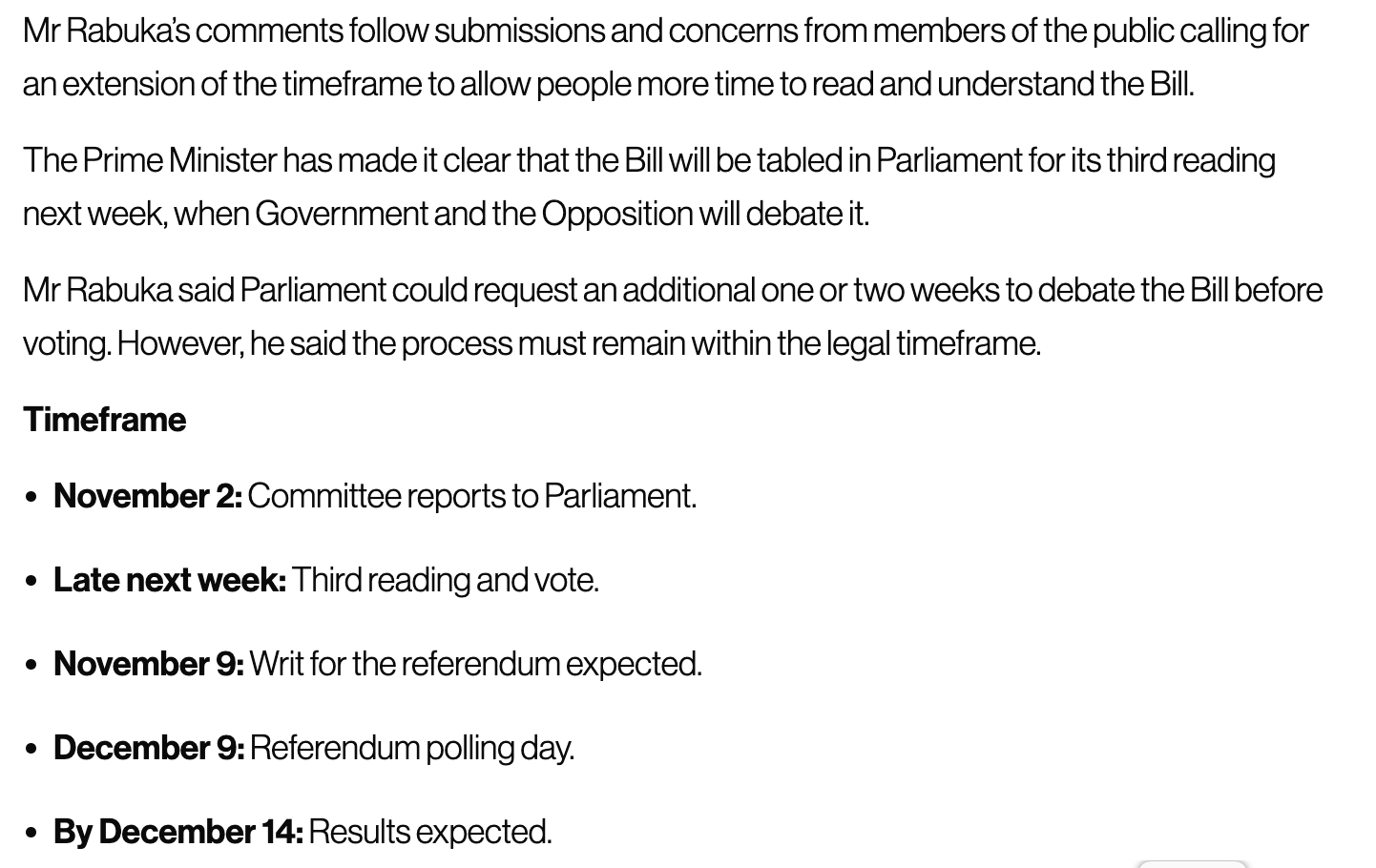
The third reading and vote for Bill No. 32 (the Constitution Amendment Bill 2026) is scheduled for late next week (the first week of November 2026). [1]
The exact timeline provided by the Special Committee and government reports includes the following milestones:
November 2, 2026: The Special Committee on the Constitution (Amendment) Bill formally reports its consultation findings back to Parliament. [1, 2]
Late next week (approx. November 5–6, 2026): Parliament will conduct the official third reading and hold the crucial vote. The bill requires a strict two-thirds majority to pass. [1, 2]
November 9, 2026: If the third reading is successful, the writ for the national referendum will be officially issued. [1]
December 9, 2026: The national referendum polling day
The 2013 Constitution of Fiji says absolutely nothing about caretaker status. It contains no articles, clauses, or provisions that restrict the power of the Prime Minister or Cabinet once an election is called. [1, 2]
Because the proposed 2026 Constitution is slated to fully govern only the subsequent parliamentary cycle (with a default commencement date of March 31, 2028), the upcoming general election—mandated to occur between August 2026 and February 6, 2027—will be conducted entirely under the existing 2013 legal framework. [1, 2]
The practical implications of the 2013 text regarding caretaker rules during this transition period involve distinct procedural realities:
? 1. Continuous Executive Power
Under the 2013 rules, the sitting government does not step down or lose its executive authority when the Writ of Elections is issued. The Prime Minister and Cabinet continue to exercise full, unrestricted governing powers throughout the entire campaign period. They retain the legal right to pass policies, allocate funds, and make appointments right up until a new government is sworn in after the election. [1]
⚖️ 2. Political Ethics vs. Hard Law
Because there are no legally binding caretaker rules in the active 2013 framework, any restraint shown by the government during the upcoming election window is purely a matter of political ethics. As noted in local legal and political analyses, political leaders have historically had to call on the sitting administration to voluntarily go into a “caretaker mode” as a matter of good democratic practice, since the supreme law itself fails to enforce it. [1, 2]
?ᄌマ 3. The 2027-2028 Constitutional Gap
This dynamic has triggered significant debate among local legal experts and former parliamentarians. Because the upcoming early-2027 election will take place under the 2013 rules, the government that takes office in 2027 will initially wield the concentrated executive power granted by the 2013 document. They will only be legally bound by the new caretaker restrictions, the reduced Cabinet caps, and the Mixed Member Proportional (MMP) system once the 2026 Constitution officially comes into effect on March 31, 2028. [1, 2, 3, 4, 5]
The active 2013 Constitution of Fiji provides absolute continuity for the sitting government during a national emergency, granting expansive powers to the executive branch with minimal structural disruption. [1, 2]
Under Chapter 9 (Emergency Powers, Section 154) of the 2013 framework, the mechanism for continuous governance during exceptional situations operates through specific parameters: [1, 2]
⚡ Executive Control Over Emergency Declarations
The Trigger Mechanism: The Prime Minister holds the unilateral power to formally declare a State of Emergency in Fiji (or any part of it). [1, 2]
The Condition: This requires a recommendation from two specific individuals: the Commissioner of Police and the Commander of the Republic of Fiji Military Forces (RFMF). It can be enacted if there are reasonable grounds to believe the safety or security of the nation is directly threatened. [1, 2]
Rule by Regulation: Once declared, the Prime Minister has the explicit constitutional authority to personally write and enforce emergency regulations to effectively deal with the situation. [1, 2]
?ᄌマ Continuous Parliamentary Oversight
Unlike historical crises where emergencies dissolved democratic structures, the 2013 text ensures the legislative branch remains active to validate continuous governance: [1, 2]
The Approval Window: If Parliament is sitting when the Prime Minister declares an emergency, the declaration must be referred to Parliament for confirmation within 24 hours. If Parliament is not sitting, the Speaker must summon members to seek confirmation within 48 hours. [1]
The One-Month Block: The emergency and its extraordinary regulations only remain valid if a majority of Parliament votes to confirm it. Once approved, it lasts for one month and requires a fresh parliamentary vote to be renewed for subsequent months. [1]
? Why This Matters for the 2027–2028 Gap
Because the proposed 2026 constitutional reforms will not come into play until their default commencement date of March 31, 2028, the sitting government retains these exact 2013 emergency powers during the upcoming general election cycle.
If a national emergency or severe security situation occurs during the election window, the 2013 text allows the incumbent Prime Minister and Cabinet to continue wielding full executive power and running the country, completely unhindered by any of the caretaker restrictions or independent Council checks introduced by the 2026 Bill. [1, 2]
An organized crisis was engineered previously by Rabuka.
Marches, riots and prisoners released.