
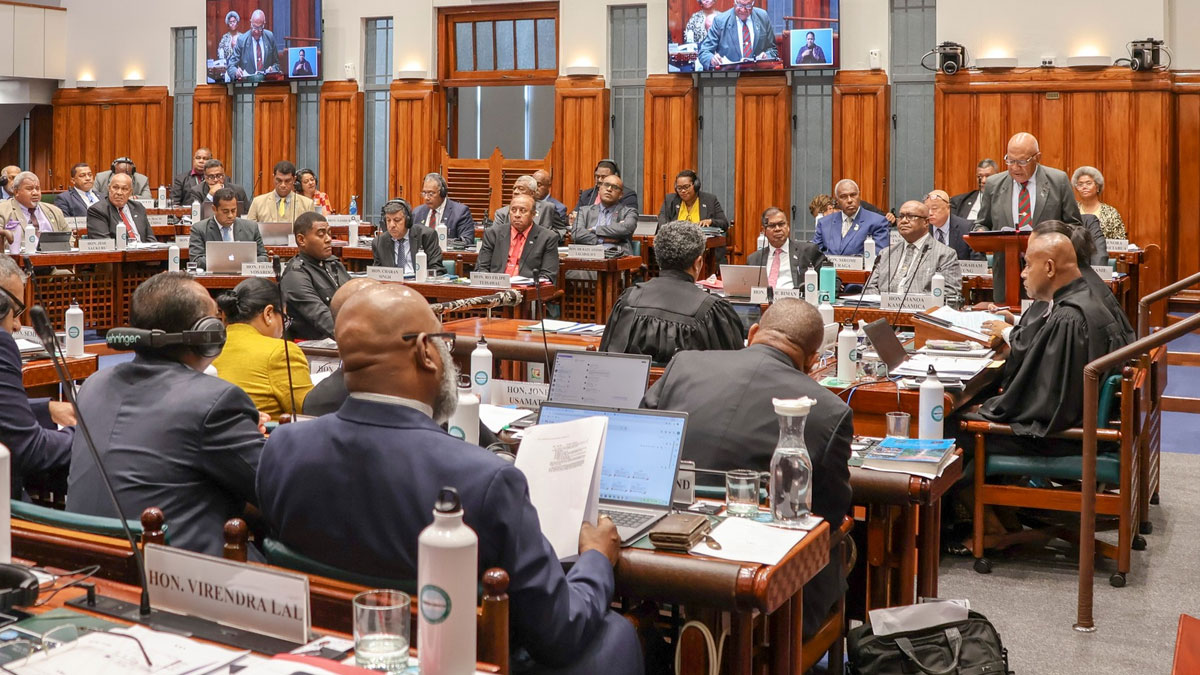
Parliament is the supreme authority in any democracy – the place where the elected representatives of the people gather to make the laws that govern our lives and that we are obliged to obey for the common good. Yet what happens when certain of those elected representatives don’t get what they want because they can’t persuade their fellow MPs to vote with them to alter a particular law?
In any other democracy, nothing changes until they can get the numbers. But not in Fiji under the Coalition government, which barely scraped into office at the December 2022 election with one vote on the floor of the parliament yet behaves as if it won a huge majority and has an overwhelming mandate to enforce its will.
The government lost its bid to change the 2013 Constitution in the parliament on Tuesday night. Its Bill to alter its provisions was defeated. Yet we now have the profoundly disturbing spectacle of those who lost expressing their determination to overturn the result by ignoring parliament altogether. And getting what they want through a hand-picked head of the judiciary specifically installed to deliver their program, including their desire for constitutional change, whatever the parliament decides.
That is the real threat to democracy in Fiji, not the preposterous claims that democracy is threatened because they couldn’t get the numbers required. Bypassing the parliament isn’t democracy. It is the antithesis of democracy. Because it says that the will of the people doesn’t matter and other means are necessary to achieve the government’s agenda.
We now know from the indigenous supremacist who is the Minister for Justice, Siromi Turaga, that cabinet will decide tomorrow to refer the 2013 Constitution to the Supreme Court for an opinion on whether it can be changed without the Coalition being bound by the vote of MPs on Tuesday night. What happens next will depend on how the Chief Justice and head of the Supreme Court, Justice Salesi Temo, decides to handle the matter.

Salesi Temo is a government stooge. He was confirmed as Chief Justice by the Prime Minister on Christmas Eve 2024 a day after a tribunal of three High Court judges exonerated and reinstated the DPP, Christopher Pryde. Since then, Salesi Temo has kept Christopher Pryde from taking up his position by again threatening to suspend him for misbehaviour on the same evidence of financial misconduct that was rejected by the Tribunal.
Temo is also refusing to heed the advice of the New Zealand Kings Council, Professor Philip Joseph, that he has the power to suspend the FICAC Commissioner, Barbara Malimali, when there is clear evidence that she has been intimidating witnesses at the David Ashton-Lewis Commission of Inquiry into her appointment. She even sacked her chief investigator midway through the COI in a clear case of contempt of the proceedings. What has happened? Nothing. Because Barbara Malimali is there to ensure that FICAC investigations into a slew of government ministers never see the light of day.
Now Salesi Temo is to be given the task of making a pronouncement on the Constitution. And guess what Siromi Turaga and the rest of the gaggle of anti-democrats in this government are expecting him to do? To say that what happened in the parliament on Tuesday night doesn’t matter. The Constitution can be changed anyway and if some indigenous extremists like Niko Nawaikula get their way, maybe even abolished altogether.
The eyes of the nation will be glued to the rogue Chief Justice – who has a history of defying the Constitution – to see what he does. Will he hear the case himself and do what he did with Frank Bainimarama and Sitiveni Qiliho? Declare them guilty and send them to jail by overruling one of his magistrates? Be afraid, Fiji. Be very afraid. Because this is the nightmare scenario. Of Temo and Temo alone giving the green light to alter the supreme law.
Or will he take a more acceptable path for those looking for proper process to be followed? And that is to set up a panel of judges not including himself to advise on the legality of changing the Constitution. In the same way that Salesi Temo did when three Supreme Court judges ruled that the Judicial Services Commission’s choice of John Rabuku to be acting DPP was unlawful because the Constitution specifically prohibits anyone found guilty of professional misconduct from holding the position. (Not surprisingly, Salesi Temo has since said that he wants that provision changed).
We are in very dangerous territory, Fiji – a government that doesn’t accept its defeat in the parliament in a vote that it thought it would win but didn’t. And that now wants to use the Chief Justice it specifically installed to do its bidding to bypass parliament and give it the legal ruling it is seeking.
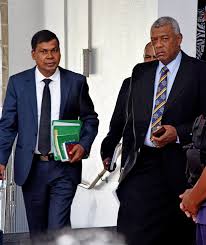
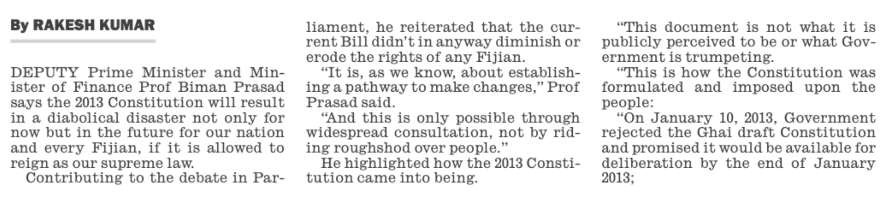
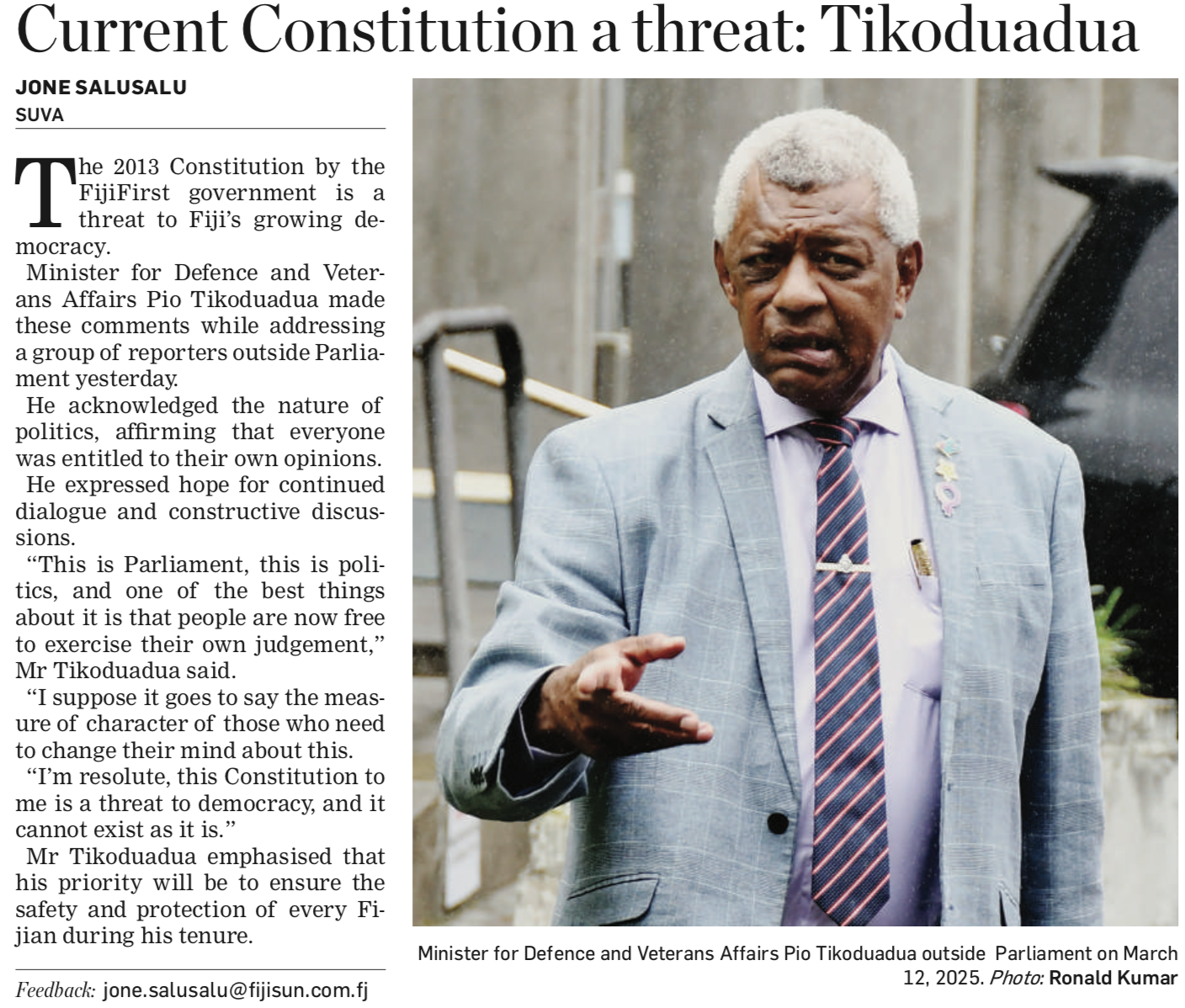
For Grubsheet, the saddest spectacle of all is the near hysteria that is emanating from the NFP, who many Fijians voted for to keep the bastards honest but have become some of the biggest bastards themselves. Take a look at the outrageous comments below from the NFP leader, Biman Prasad, and the NFP’s Pio Tikoduadua about the 2013 Constitution being a threat to democracy when on any reading of its contents, it is not.
Biman Prasad had no problem contesting three elections (2014, 2018 and 2022) under the 2013 Constitution and happily swore to defend it. That Constitution propelled him into parliament and into power. How can that be a threat to democracy? It is abject nonsense from a man who stands accused of abuse of office yet succeeded in beating a FICAC charge against him by engineering the removal of the former deputy FICAC Commissioner, Francis Puleiwai, just as she was about to have him charged.
The man is a total charlatan whose continued betrayal of the minorities has been breathtaking – remaining silent when the Prime Minister endorsed the right of iTaukei to refer to the minorities as “vulagi” – visitors in their country of birth. And remaining silent now in the face of repeated calls for him to reassure the minorities that the common and equal citizenry and the common identity are non-negotiable and will not be altered in any constitutional change.
Yet saddest of all is the spectacle of Pio Tikoduadua railing against the 2013 Constitution as a threat to democracy when he was part of the team that introduced it and never uttered one word of opposition against its contents. Tikoduadua was Frank Bainimarama’s permanent secretary in the lead-up to 2013, entered parliament at the 2014 election as a minister in Bainimarama’s government and sat there mute enjoying the perks of office until he fell out with the FijiFirst leadership and defected to the NFP.
His hypocrisy in now attacking the Constitution which he enabled and benefited from when it suited him has disgusted many of his friends and supporters, Grubsheet included. We looked to Pio most of all to keep the bastards honest, to uphold the law and especially the equal opportunity provisions and the right of everyone to be called “Fijian”.
All that is now at risk. If the Coalition gets its way and the threshold in the parliament is reduced to the level of the numbers it already commands in the House and the need for a referendum of voters is abolished, no part of the Constitution is safe. At any time, a bill can be introduced and another clause can be altered. And because we know that Rabuka and his grisly gang are intent on re-imposing indigenous supremacy, the minorities are in clear and present danger if these changes go through.
The failure of Pio Tikoduadua and Biman Prasad to comprehend that threat and stand up for the minorities who elected them is a betrayal of historic proportions – one that would have the great NFP figures of the past – AD Patel, Sidiq Koya, James Madhavan and Jai Ram Reddy – spinning in their graves.
They must pay for their treachery by being removed from the parliament altogether at the next election. Because they have failed their most basic duty of all to fend off the barbarians at the gate and protect the multiracial ideal. Tragically, they are now barbarians themselves. And the most appropriate punishment is for the dogla (traitors) to pay for their treachery with their political lives.
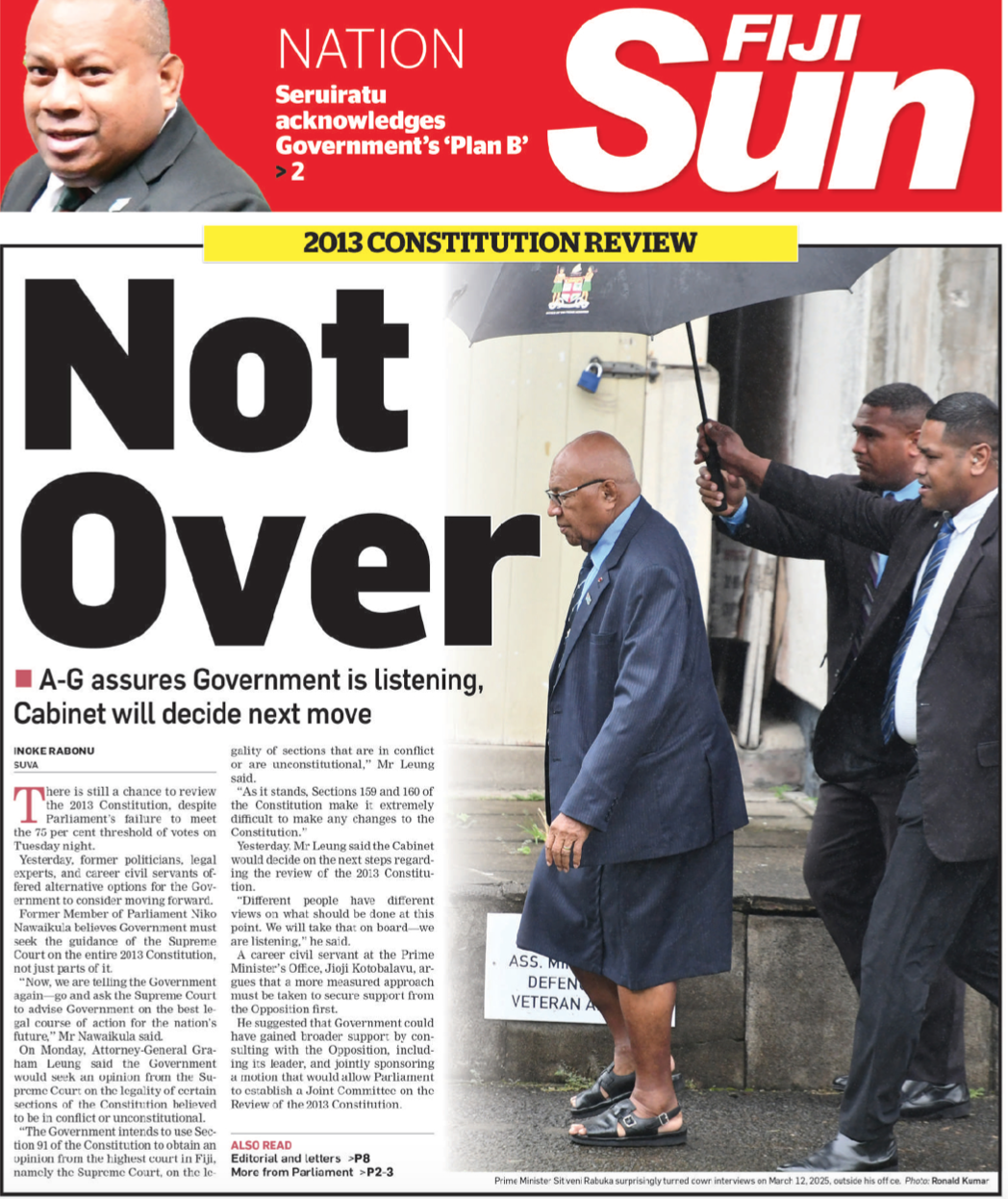
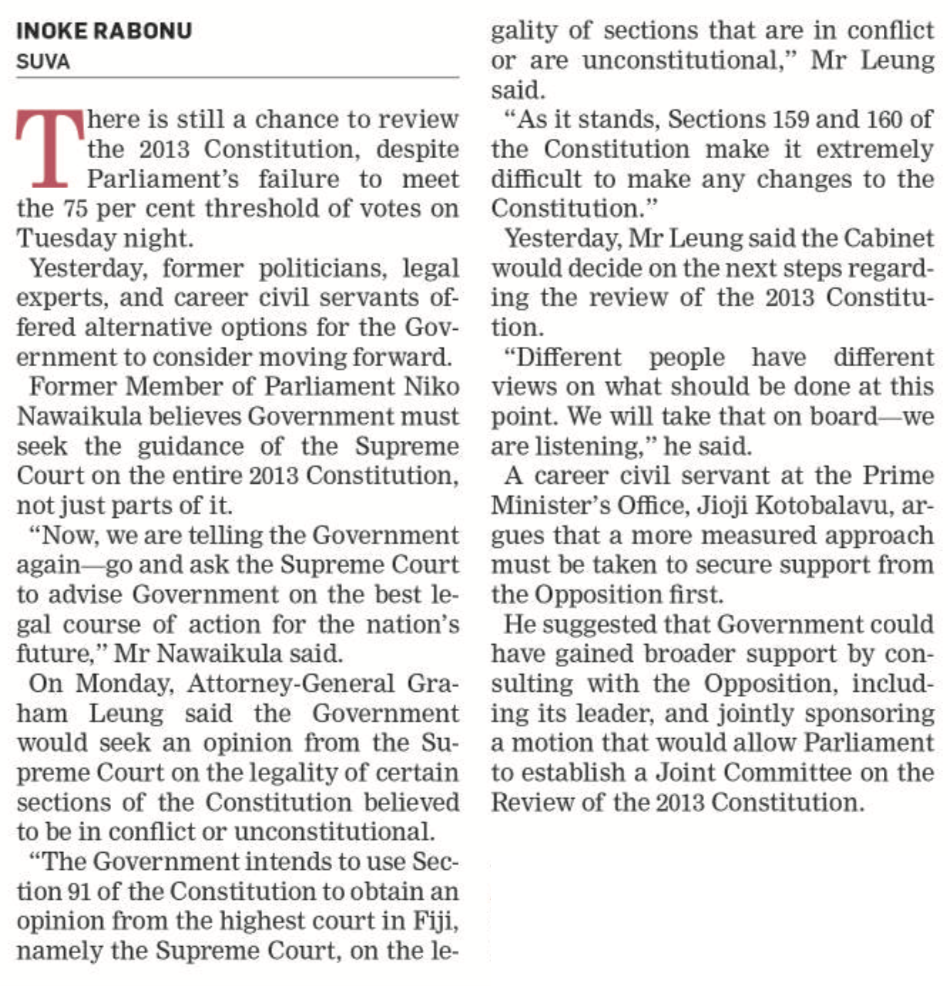


And betrayal by the bastards we elected to keep the bastards honest.





So the AG issues the barest of reassurances about the rights of the minorities.
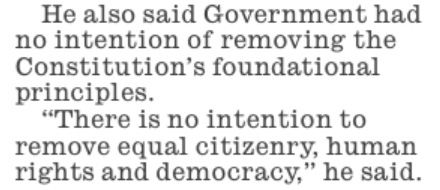
But what about the common identity? The right of everyone to call themselves Fijian? Or are we to revert to the 1997 Constitution of being referred to as “Fiji Islanders”?
Graham Leung specifically doesn’t say. And because we know that’s precisely what they want to do, say “no” to change, Fiji, until we all get the appropriate assurances.
These people are asking us to trust them when history tells us that we can’t.
Oh and throw the bastards of the NFP out of parliament altogether come election day.
—————–
POSTSCRIPT:
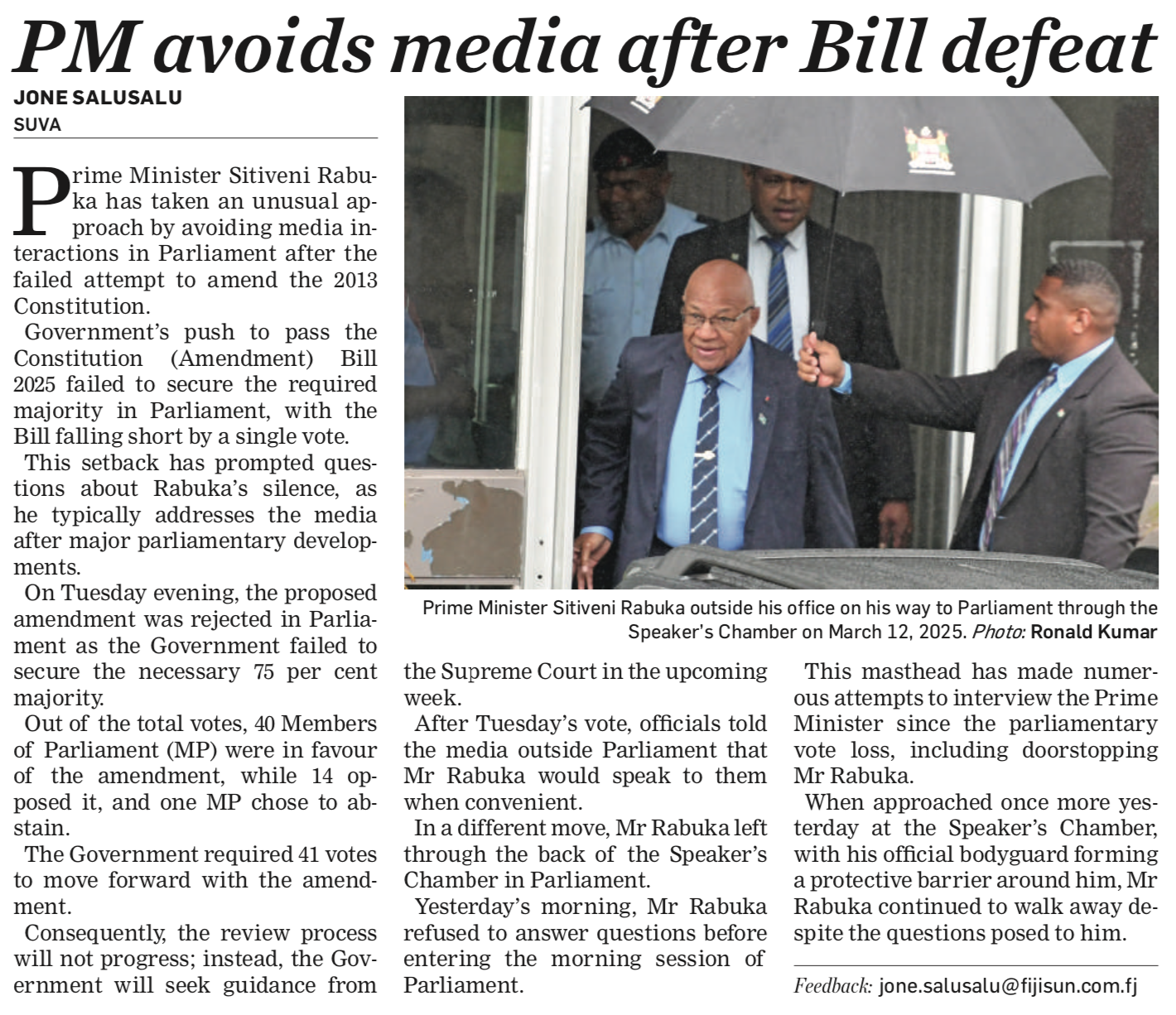
Suddenly, the Prime Minister is no longer available to the media. Is he smarting about Tuesday night’s defeat? Or is he trying to avoid being questioned about his gold Rolex? (see previous story)

What a bunch of sore losers.
Temo will give them what they wanted.
Where’s Jone Kalouniwaiwai hiding?! Isn’t it his mandate to protect the constitution?
Like Jai Ram Reddy betrayed the Indo-Fijians in introducing a racist 1997 constitution, Biman is hell bent on repeating history. And like what happened in 1998, we shall see NFP going into oblivion next year.
The main change they want to bring is the disproportionate voting back. Because they know under current electoral system, they stand no chance of winning next year.
A jurist once posed an intriguing question to his students following the narrow defeat of Quebec’s secession referendum—by less than a percentage point. He asked: Can it be argued, in this case, that a red light signals green for those advocating a different outcome?This raises the question of what the legal framework permits. If the next steps remain within the bounds of the law, then is it fair game for the majority to explore alternative avenues? Our recent history has shown that when some fail to achieve their desired outcome, they may resort to extreme measures—even treason. However, democracy is more than just institutions; it is not merely about winning or losing, but about the integrity of the process itself. This leads to the fundamental question underlying this document: Were the people who should have been directly involved truly and expressly included in its formation?Are we witnessing democracy in action, or something else? Only time will tell
The coalition is an absolute mess and nothing less. They have walked over everything and everyone for their own benefit. There is nothing to show for their overall success so they are desperate to show the Constitution change as a win. That is also going to take time. Come 2026, that might just be the only show pony that they can speak about.
I am glad that another journalist wrote the report and not Movono. Movono’s reporting is poor. Her biases have been exposed time and time again.
Where is the guardian of the constitution and its people as Fiji falls…still in reconciliation process? – disgrace to the uniform.
They keep flipping the narrative to insist the constitution didn’t develop through consultation with the people, and that any constitution needs to come from the people. Yet it is they who are trying to get around the people and their parliament.
If they truly wanted this to be about the people, they would have been transparent about which changes they are proposing from the outset, and embarked on a widespread education program about what these changes mean for the people, before taking it to a Parliamentary vote and referendum.
Precisely. Very well put.
Absolutely! The irony is glaring. They claim to champion the people’s voice, yet they sidestep transparency and public consultation at every turn.
If they genuinely wanted this process to be about the people, they would have laid out their proposed changes clearly from the start and engaged in real, widespread education as you rightly pointed out.
Instead, they push an agenda without full disclosure, leaving citizens in the dark. A truly democratic process requires honesty, not manipulation. Let them all rot in hell.
Exactly. Before they were elected they were always shouting about transparency and accountability. There was so little transparency with this process. And now Rabuka is taking the “right to remain silent” regarding the infamous Rolex watch. Who is his communications advisor? Do they know that the “right to remain silent” comes from the 5th Amendment of the US Constitution, where a person is protected from being compelled to give testimony that would incriminate themselves in a criminal case? The implication is that Rabuka has something to hide that is criminal in nature! If that is not the case then what a communications flub!
Unfortunately, Fiji is going down the same path as the USA. The newly crowned King of America, facilitated by the Supreme Court has enabled Trump to carry out his corruption, with his followers and rich friend doing it in full view of the people with no shame and no accountability. It has become normalised in just six weeks.
The so called, Fiji government, is now doing their dirty work with no one in a position to hold them to account, whilst they ride roughshod over the people who they were elected to represent.
Even the hardened Republicans in America are seeing what happens when democracy is eroded and they have given the ultimate power to rule, to the person they made their President.
Exactly what Temo will do.
The only diabolical outcome ever was Biman’s birth.
I do not understand why it is so difficult for them to tell the voters which parts of the Constitution they want amended.
Voters will be more receptive to the idea of change if they are upfront about it.
The amendment Bill may have even passed in parliament the other day if they were more transparent about the changes they want.
Their action is making the people trust them less. Their support is already going down the gurgler.
Why won’t they tell us? Because what they have in mind is truly diabolical – to carve up the level playing field enshrined in the 2013 Constitution that protected the minorities and impose the tyranny of the majority. Again.
Next will be more rights for the iTaukei and the minorities reduced to second class citizens – “Fiji Islanders”, not Fijians – picking up the tab for it all with their taxes and paying on top of that to use the qoliqoli – to fish, swim or surf. The agenda of 1987 completed.
Everyone has been led to believe that the secular state is safe but it isn’t and neither is any existing constitutional protection. Because all it will take is the majority Rabuka already has in the parliament to alter any clause at all with the threshold reduced to two thirds and no referendum of voters. And the NFP thinks that’s OK.
We are entering a new dark age in which the only comeuppance will be members of the minorities who can leave heading for the exit and the tax base being reduced to the point where basic government services become more dependent on borrowings and aid.
There is little appreciation of just how vulnerable the economy is. We had record outflows of capital in January and have just seen Australia give Biman another $76-million in budget support (ie a donation not a loan) on almost the same day that Sitiveni Rabuka said Fiji wasn’t a beggar nation. Sorry but what exactly are you if you have to seek charity from a wealthier neighbour because you can’t make ends meet?
So the iTaukei may get their “indigenous rights” but wind up as beggars – singing, dancing and serving drinks to foreign visitors with their “bula smiles” until those visitors stop coming because of an extreme weather event, global conflict or civil unrest.
And after that…anarchy. The strong preying on the weak. The have-nots taking from the haves. And the end of any notion of a sovereign nation being able to stand on its own feet as investors flee because law and order has broken down and the criminal justice system cannot be trusted to deliver justice without fear or favour.
The attitude of many iTaukei is that they can always return to their teitei. Or if they have power and influence, sell themselves to wealthy locals or outsiders for a gold Rolex or wads of cash and maybe buy a flat in Sydney or Auckland to escape to if things really go pear-shaped. Yet as usual, it will be the poor left behind who suffer the most. Because that’s the experience in every other third world hellhole and Fiji will be no exception.
And instead of our elected representatives spending their time working out how to bolster investor confidence, diversify the economy, tackle crime and the drugs crisis, fix our crumbling infrastructure and get assistance to those who need it most, while stressing the critical importance of national unity and Fiji as “one nation”, they are obsessed with constitutional change and creating division.
As if altering anything in the Constitution is going to make a jot of difference to the lives of their long-suffering constituents when they can’t even get access to reliable water and power and young Jone and Mere are being preyed on by the local drug dealer. It is negligence on an industrial scale. And for that negligence, Fiji is going to pay a terrible price.
Or until the tourists stop coming because of the greed of landowners overcharging based on the qoliqoli.
The ethnonationalists need saving from themselves.
Well come the 2026 elections, the country will be hard-pressed to find candidates!!! The law is a farce and the judicial head a rogue. With the stubbornness of the govt itaukei members to accept a parliamentary defeat, I doubt they’ll accept an election defeat and especially the likes of Mr Chaudhry winning, although he’s what the country sorely needs… The coup cycle will repeat, sadly…. Sorry for the rain on this parade ☔ ….
Try asking any minister on the government side, yes because they are all ministers or a supporter of the coalition as to which part of the Constitution they want changed and surprise yourself. They have no idea. They simply cant articulate it. Baseline, most of them are not literate but even those who know how to read and write aren’t educated.
It seems the only thing they want to change now is how much power the politicians hold. If that’s not a red flag for the masses, i dont know what is. But then again it’s easier to brainwash the poor and uneducated.
“The attitude of many iTaukei is that they can always return to their teitei.” May I add -under the protection of a vulagi God. They are very special people – the iTaukei. They know what to do in their own land and they can live off the land – no one else can live off the land like they can. Only they have rights, we all should be thankful they have allowed us to stay in the country. Do your business and pay your taxes, but stay away from politics and any decision making positions. They are entitled to free money because that is their god-given right as land owners.
No other people are as special in their own land in any other country. Only the iTaukei are special people in their own land. The only people in the world who are that special. They are unique.
Rabuka and his government would be wise to accept the current Constitution.
The Constitution – as I eluded to previously – delivered 3 elections where the winner was installed peacefully & is a tick for the Constitution working.
What no one can control is the unforeseen element that sours government, like lack of integrity or skulduggery.
Once installed, a government appoints who they want into positions of power and this can be used as a tool to get around Constitutional matters if the person appointed is not completely impartial.
If Constitutional change is required in the future, I feel a PM who instigated 2 coups nor anyone associated with that period are the right people who can to bring about Constitutional change because it makes the county nervous as a trust deficit that lingers .
Dada Steve Amin… came to power undemocratically, wextreme nationalist and lascivious! So sounds familiar, being afraid is warranted. Once Asians were expelled from Uganda, it’s economy collapsed. Is Fiji heading the same way?
It is enabled by the triumvirate of Kiran, Ali and Temo?
NFP, were never for Indians…they have always been a party of self interest first.
Labor party has always been there for vulagis, it needs a refreshing of leadership bringing in young blood with mr Chaudhry as a mentor. Mr Chaudhry had his reputation badly damaged by colluding with India and accepting funds personally.
Any changes to constitution requires a referendum ie a vote of the people not motherhood statements of assurance and grandstanding that we saw Ms Kiran make in parliament in mediocre Hindi during the debate. She has a personal grievance with the Constitution because she was not on the team at the time so cannot embelish her profile with another “do good” activity for the good of Fijians.
I dont understand why all the enuchs in government have suddenly started clamouring that the 2013 constitution was “thrust” onto the people of Fiji.
GD – you, in your professional capacity, saw a number of things during your tenure with the FFP government. The former AG has is on record stating that the 2013 constitution was formulated through a detailed series of consultations throughout Fiji with people in Fiji. Can you (if allowed) elaborate on whether this happened and what the general feedback from the people was at the time?
If this is the case, why are the people suddenly all asking for a new constitution? As far as I know, a constitution isn’t something you can order through a drive-through and just drive out with it.
Problem with the eunuchs is literally is that they see everything, they observe everything and take copious notes but lack the feel of the essence just like in the King’s harem.
This is a schoolyard brawl between the leaders of Fiji First and the Coalition Govt and some of their supporters who are part of the support crew with a grudge. Escalated to a street fight. The aim is not good governance. It is purely personal revenge using the mechanics of the State.
Government took a bill to Parliament and it was defeated.
Next step, dissolve parliament and fresh elections to be held.
That would be the proper thing to do, call an election.
But this government wants to change things through the back door. We all know what type of people enter through the back door – snakes.
The CJ is legendary at entering through the backdoor, the snake that he is.
And snakes do not provide any warning. The people of Fiji like to enter thru the back door, because this is their country!!!!
Surely Temo won’t be the only one deliberating on the request for an opinion under Section 91 of the Constitution? The Supreme Court is more than 1 judge, right? Won’t we have a similar scenario as the Rabuku request?
That is up to Temo.
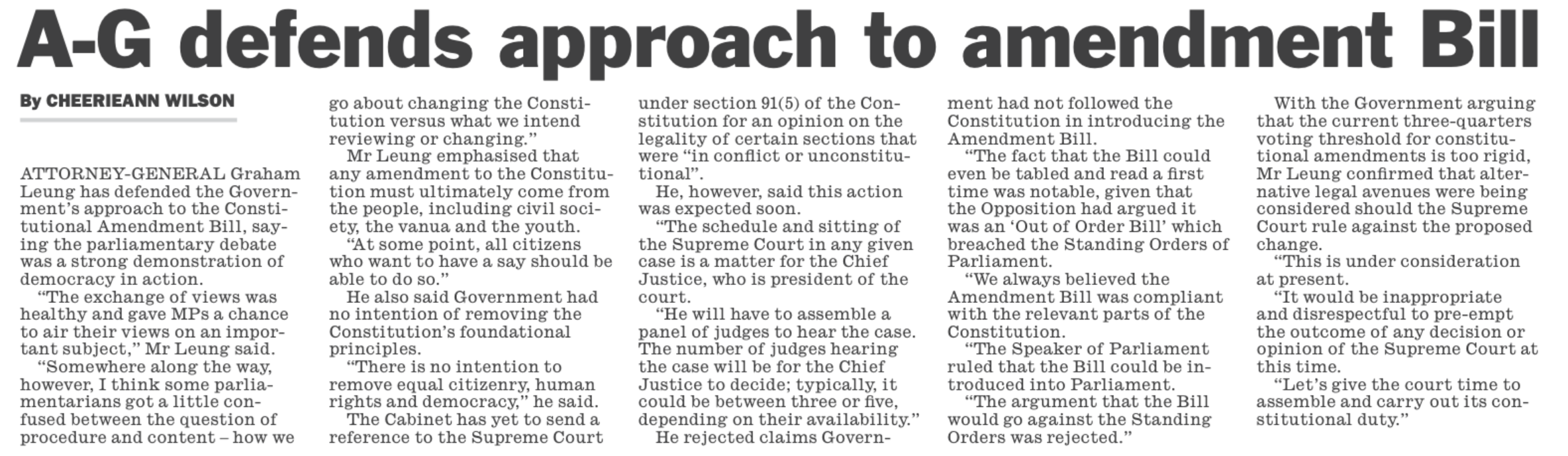
From the AG in the FT article “A-G defends approach to amendment Bill” today:
“The schedule and sitting of the Supreme Court in any given case is a matter for the Chief Justice, who is president of the court.He will have to assemble a panel of judges to hear the case. The number of judges hearing the case will be for the Chief Justice to decide; typically, it could be between three or five, depending on their availability.”
So Temo could really decide that only 1 judge will sit ie himself?
Interestingly, below is the list of current Supreme Court judges:
https://judiciary.gov.fj/courts/supreme-court/#judges
In the end, this whole thing is about racism. What is shocking (not any more) is that the many Indo doglas are aiding and abetting in the process to save their backsides. Not only those in parliament but the ones outside parliament as well. Fiji is doomed and it is not just the vulagi that will be affected. It is mainly the iTaukei.
What have the coups of 1987 and 2000 achieved for the iTaukei. How many promises were made to them. After almost 40 years, where are they in the food chain?
And it is the same person making false promises. What has he done in the last 2 years?
Are they all blind, deaf or simply dumb? The people in Fiji are the dumbest in the world – no questions. Simple explanation for this – they are racists.
The key figures like Rabuka, Biman, and others fought three general elections under the 2013 Constitution, never attempting to change it despite having the option to protest or abstain. Now, after gaining power with a slim majority, they suddenly push for constitutional changes that may marginalize Indo-Fijians and other minorities.
Graham Leung’s proposal to refer the constitution issue to the Supreme Court raises the question: Where were the critics of the constitution during the previous years? Their new push for change amidst other urgent government challenges appears self-serving. Despite assurances that key provisions like equal citizenry, common identity, and secularism won’t change, many fear Rabuka and his supporters will undermine these values.
Figures like Biman, Agni, Sashi, Charan, Sachida, and Shalen are backing Rabuka without guaranteeing protections for Indo-Fijians. Rinesh and Kirpal quickly distanced themselves, sensing the negative impact on minorities.
Meanwhile, Biman and his colleagues argue that the opposition’s actions undermine democracy while pushing to change a constitution that protects democratic principles. Infact, it Rabuka and his troop who are undermining democracy.
Indo-Fijians and other minority groups should demand clear assurances from Biman and his team on these key provisions. With the judiciary potentially compromised, it’s crucial for these communities to stay alert and voice their concerns about any constitutional changes that doesn’t follow the process stated in Chapter 11 of the 2013 Constitution.
The big question: Is it the fear of losing the next general election making Rabuka, Biman, and their Coalition government so desperate to change the constitution to their advantage? Something to think about.
The recent attempt by Fiji’s Coalition Government to amend the 2013 Constitution by lowering the parliamentary threshold for changes – from a 75% supermajority to two-thirds – represents a concerning erosion of democratic safeguards. While proponents argue the current amendment process is overly rigid, the methodology and implications of this reform effort risk destabilizing Fiji’s governance, economy, and international reputation.
Undemocratic Process and Disregard for Public Mandate
The government’s approach bypassed meaningful public consultation, a critical flaw given Fiji’s history of top-down constitutional impositions. Political commentator Steven Ratuva emphasized that constitutional changes must involve “widespread consultation” to avoid being driven by “political emotion” or narrow interests [2]. Yet, the bill advanced through parliamentary maneuvering rather than inclusive dialogue, relying on shifting alliances with opposition MPs like Sachida Nand and Shalen Kumar[1][7]. This tactic mirrors the very criticism leveled against the 2013 Constitution’s origins, which Prime Minister Sitiveni Rabuka himself condemned as lacking a “participatory democratic process”[4]. By replicating this exclusionary approach, the government undermines its own legitimacy and the principle of popular sovereignty.
Risks of Volatile Governance and Institutional Weakness
Lowering the amendment threshold risks enabling frequent, partisan revisions to the constitution. As Ratuva warned, an overly flexible constitution could invite “volatility” and empower ruling coalitions to manipulate foundational laws for short-term gains [2]. Fiji’s history of four coups and four constitutions since 1970 highlights the dangers of instability [2][5]. The defeated bill’s additional proposal to eliminate mandatory referendums further centralized power, stripping citizens of a direct voice in constitutional matters [4][7]. Opposition MP Rinesh Sharma rightly argued that without referendums, amendments risk ignoring “the collective voice of all Fijians” [7]. Such a system entrenches political elites rather than empowering citizens.
Economic and International Repercussions
A perception of constitutional fragility could deter foreign investment and damage Fiji’s economy. Investors prioritize stable legal frameworks, and arbitrary changes to governance rules raise red flags. Internationally, Fiji’s classification as a “military dictatorship” in the Democracy-Dictatorship Index already tarnishes its standing [6]. Successive governments’ struggles to establish durable democratic norms – exemplified by the 2013 Constitution’s contested legitimacy – have long strained relations with democracies like Australia and New Zealand. Should Fiji proceed with reforms perceived as self-serving, it risks further isolation in forums like the UN, where equitable governance and anti-authoritarianism are increasingly emphasized [3].
Path Forward: Consensus Over Expediency
For Fiji to avoid repeating cycles of crisis, any constitutional reform must prioritize transparency and broad consensus. The government’s failure to secure a 75% majority for its bill – falling short by one vote – demonstrates the necessity of cross-party collaboration [1][4]. As Attorney-General Graham Leung noted, the constitution must be a “living covenant” reflecting evolving public will [7], but this requires mechanisms ensuring amendments serve national – not partisan – interests. Lessons from the Deuba Accord of the 1990s, which emphasized inclusive dialogue during constitutional reviews [5], remain relevant today.
Fiji stands at a crossroads: it can either deepen democratic resilience through participatory reform or entrench a legacy of instability. The latter path jeopardizes social cohesion, economic prosperity, and its role in the global community. The international democratic community, including Pacific partners, should advocate for processes that elevate public trust over political expediency.
Refs & illuminating reading
[1] https://maitvfiji.com/it-ends-here-fiji-speaker-says-after-parliament-voted-against-bill-to-amend-fiji-constitution/
[2] https://www.rnz.co.nz/international/pacific-news/544322/expert-urges-consultation-as-fijians-face-political-overload-amid-constitutional-amendments
[3] https://press.un.org/en/2024/ga12635.doc.htm
[4] https://www.rnz.co.nz/international/pacific-news/544528/fiji-government-fails-to-secure-support-to-make-changes-to-constitution
[5] https://constitutionnet.org/sites/default/files/Fiji%20USIP.doc
[6] https://en.wikipedia.org/wiki/Democracy-Dictatorship_Index
[7] https://www.fijivillage.com/news/2013-Constitution-Amendment-Bill-defeated-x8rf54/
[8] https://www.tandfonline.com/doi/full/10.1080/00223344.2023.2271124
WAG THE DOG :
They Kept You Busy With The WAQAVUKA CONSPIRACY Just Long Enough To Get Charlatans Elected In 2022
_________________________________
Governments around the world have long used diversion tactics to shift public focus from pressing national issues to sensationalized or emotionally charged distractions. This strategy, often referred to as “wag the dog” or “bread and circuses,” manipulates public perception to maintain control. For instance, in the United States, political leaders frequently steer public discourse toward culture wars—such as debates over gender identity, immigration, or book bans—while economic inequality, healthcare crises, and political corruption remain largely unaddressed. Similarly, in India, the ruling party has often leaned on religious and nationalist rhetoric to overshadow concerns about unemployment, inflation, and civil rights. These tactics work by exploiting the public’s emotions, creating division, and ensuring that citizens are too distracted or divided to scrutinize governmental actions that may be detrimental to their long-term welfare.
A similar pattern is evident in Fiji, where the coalition government has stirred public anxiety over constitutional amendments without clearly outlining what changes are being proposed. By labeling the existing constitution as a threat to democracy without specifying which provisions need alteration, the government keeps citizens engaged in heated debates and political speculation rather than focusing on pressing economic and social issues. This uncertainty fosters fear and division, diverting attention from governance failures or controversial policies that might otherwise face public scrutiny. The vagueness surrounding the proposed amendments raises questions about transparency and intent—whether the government truly seeks democratic reform or is using the constitution as a smokescreen to consolidate power or mask deeper administrative shortcomings.