
Any iTaukei nationalist/supremacist who was looking to Sitiveni Rabuka and his government to abolish the common and equal citizenry, the common identity and the secular state is going to be bitterly disappointed. And it remains to be seen how they will respond.
- The common and equal citizenry – first introduced by Frank Bainimarama and Aiyaz Sayed-Khaiyum in the 2013 Constitution – remains at the core of the nation’s supreme law (providing Rabuka can get the two thirds majority in the parliament to take the new draft to a referendum) .
- The common identity – everyone “Fijian” – also remains and the government has removed any doubt about that by ignoring the recommendation of the Constitution Review Commission that further consultations be held on whether only iTaukei should be entitled to call themselves Fijian. In fact, a great many of the CRC’s recommendations have been junked.
- The secular state remains, though not in name. The very term “secular state” seems to have been a red rag to a bull for the Christian majority – often mistakenly referred to as the “circular state” – so they just don’t call it that anymore. But the requirement stays that all religions be treated equally and the state remains neutral on matters of religion.
So guess what, Fiji. Rabuka and his gang have been forced to embrace the core principles of the 2013 Constitution imposed by Frank and Aiyaz. And in the case of the common identity, have shut the door firmly on any further discussion about it when the CRC had left it open.
Many iTaukei nationalists/ supremacists will be dismayed by all of this. They wanted iTaukei rights to be enshrined in the supreme law as having more status than the rights of the minorities. They wanted exclusive use of the term “Fijian”. And they wanted a Christian state.
They’re not getting any of it. Which naturally begs the question: What the hell was all this about? Why are the central provisions of the hated 2013 Constitution still the benchmark for the supreme law? What was the point of change?
The answer to that is in the “bad news” category of what’s in the new draft constitution.
- The power of the chiefs has been enshrined in the supreme law and they have a great deal of influence, including in the choice of the newly-restored senate – the right to choose 14 of the 23 senators -and being able to select the President and the newly-resurrected vice president.
- So it is good for the chiefs and the hereditary privileges of an elite that owes its status to an accident of birth is reinforced. No matter how badly individual chiefs behave, they would have the legal right as a collective – the Great Council of Chiefs – to lord it over others and a disproportionate say in the nation’s affairs and direction.
- It is also good for the nation’s crooks. Why? Because FICAC is abolished. The corruption watchdog isn’t just going to have its teeth removed, it is being put down altogether. Which at a time of unprecedented lawlessness, is a national disgrace and will allow the elite unprecedented opportunity to get away with corrupt conduct.
- It is also very bad for the nation’s children. Because the new draft Constitution specifically allows them to be beaten. Yes, corporal punishment is restored, which is great news for those who like to take a cane or strap to young people but again keeps them in line through fear. And whether that will produce better behaviour is highly questionable.
A lot more to come but here’s the good news for the minorities…
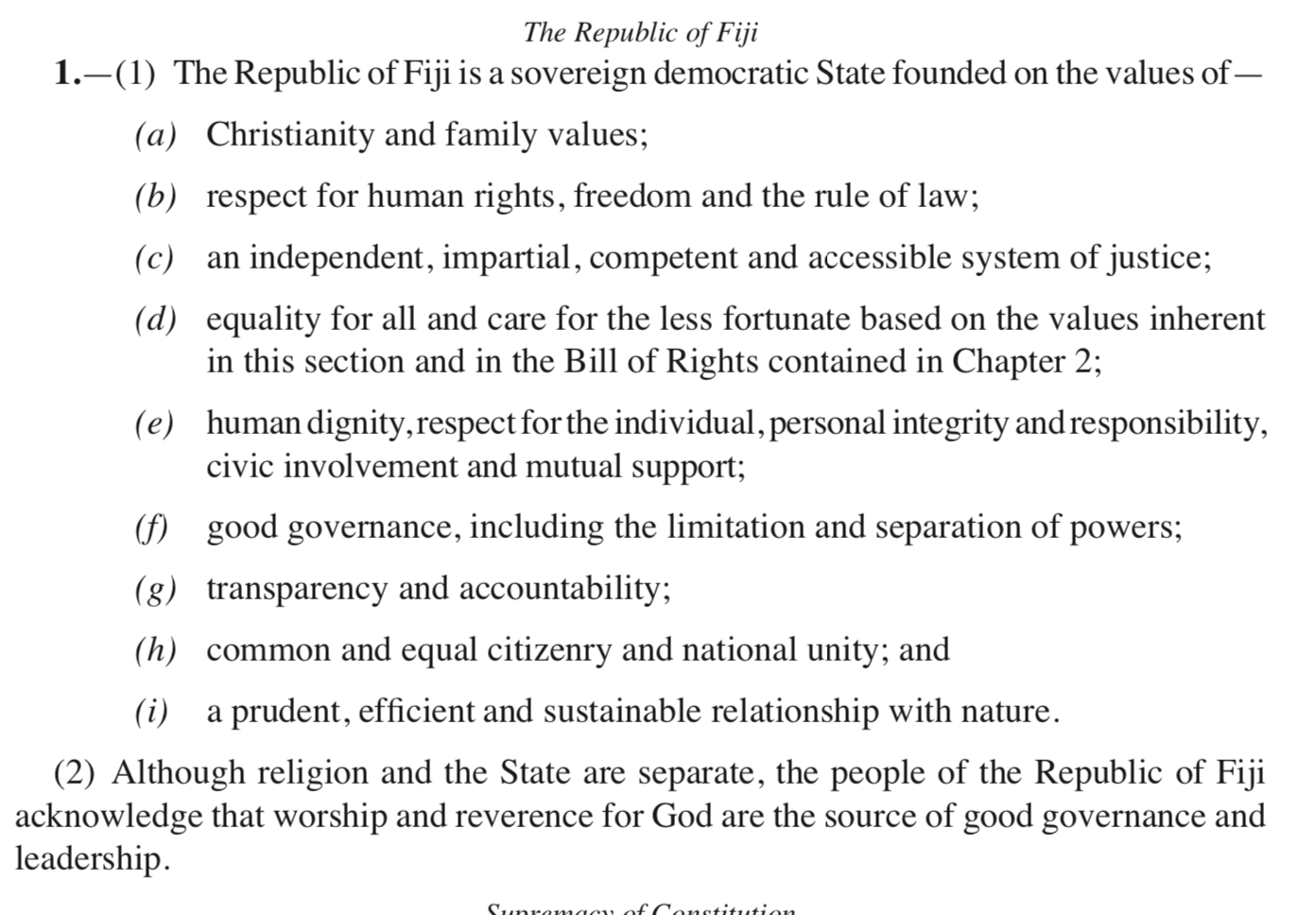
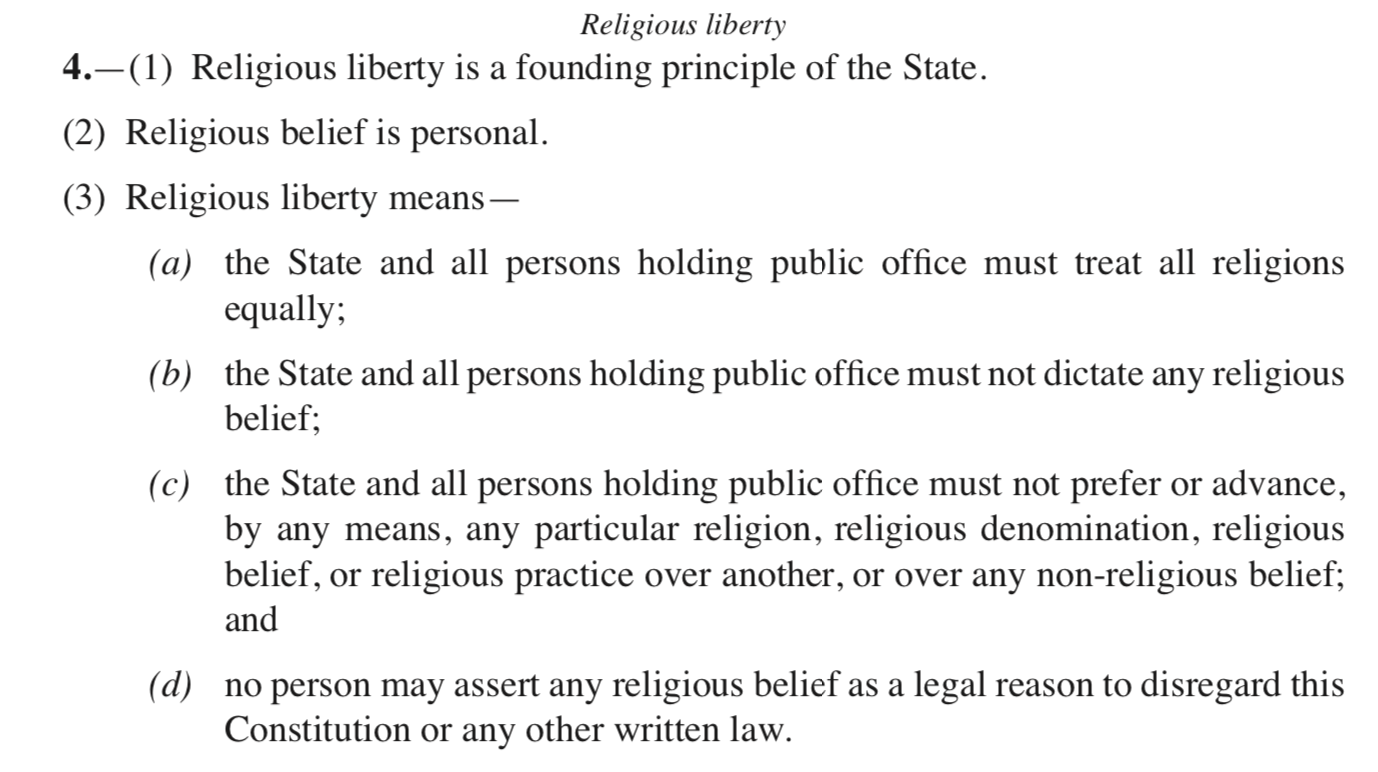


The collective sigh of relief will be palpable. The current basic rights of the minorities remain – the right to equality, the right to belong and the right to practice their own beliefs.
As for standards of governance, that is another matter altogether.
More to come.
__________________________
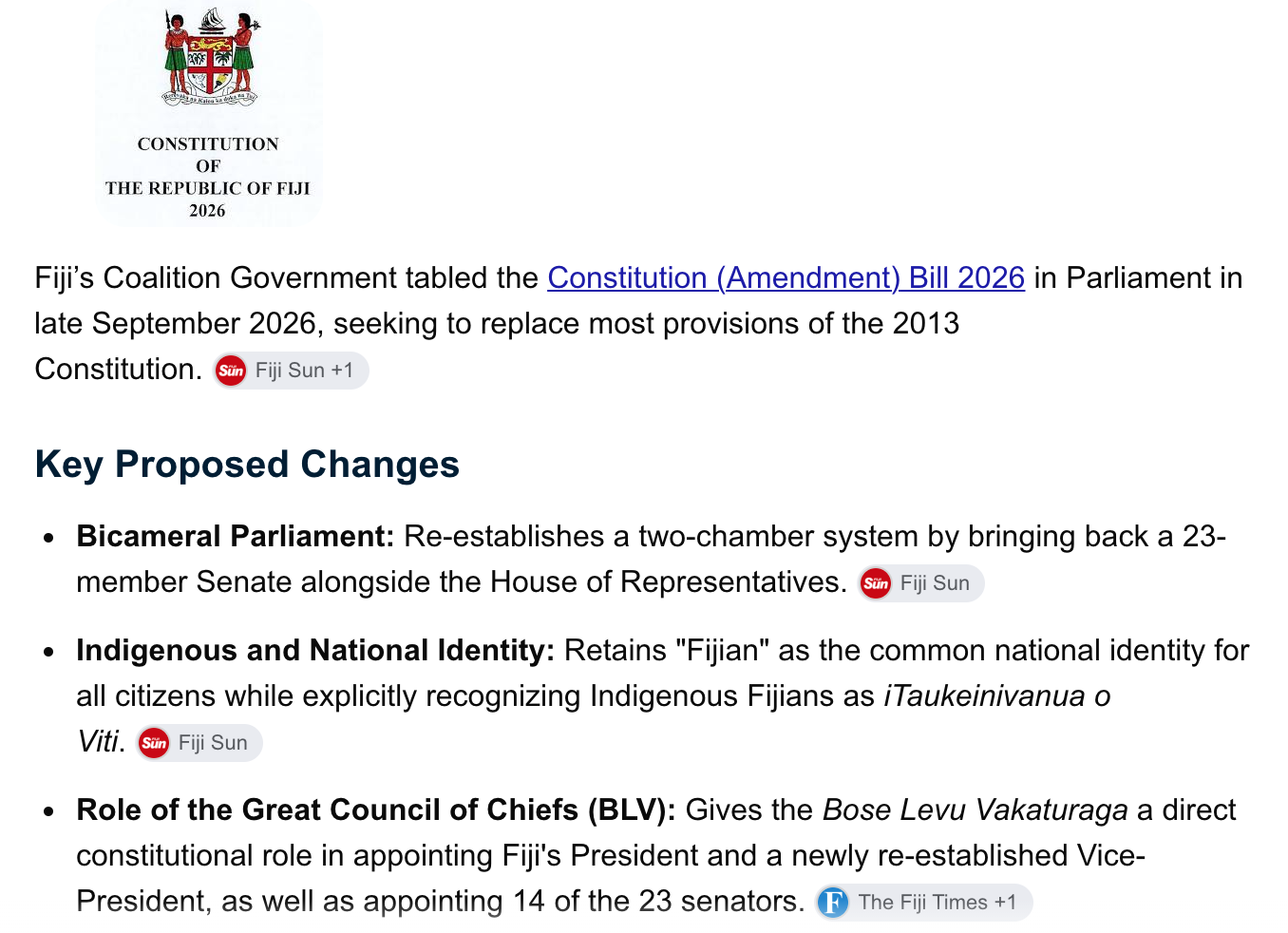
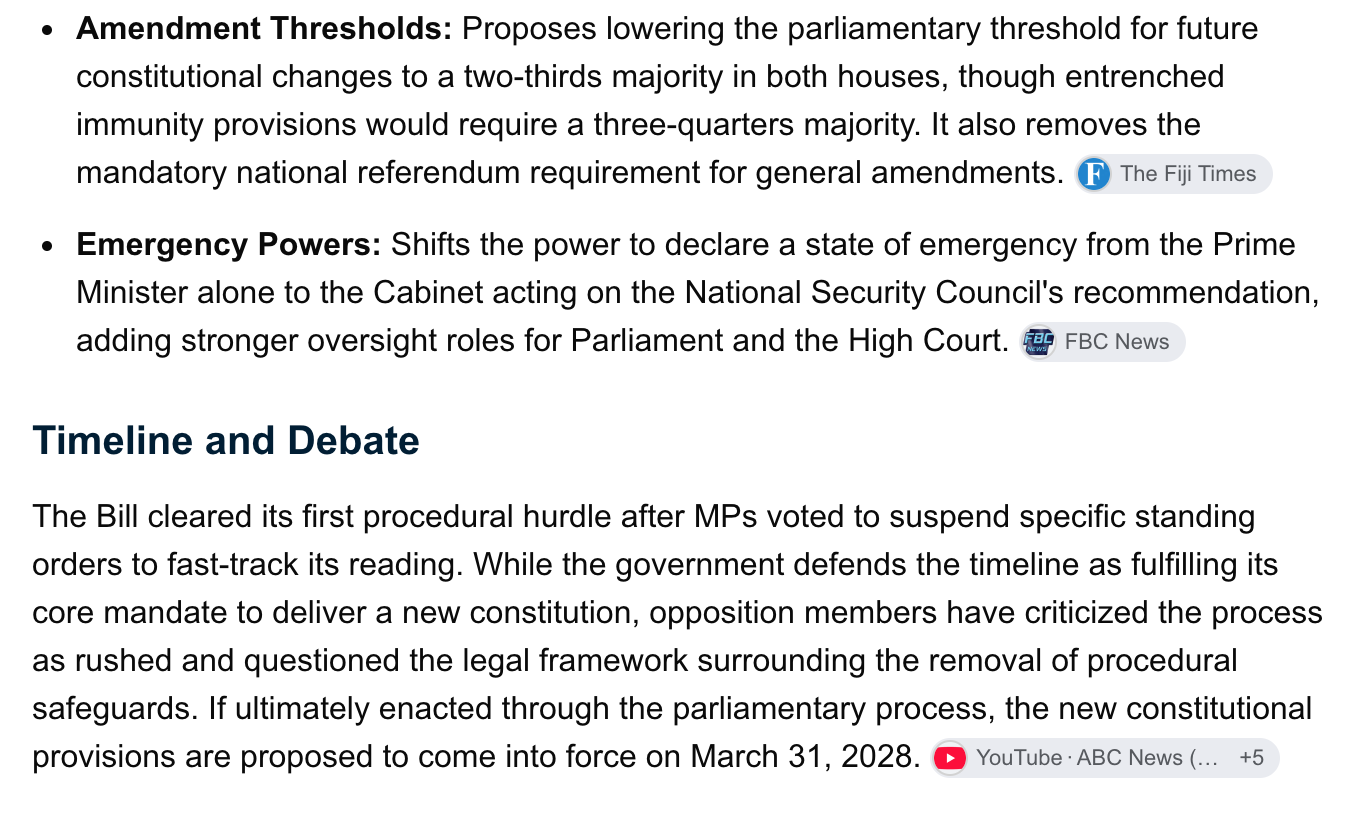
The Google AI overview as of this morning, bringing together the various strands being reported elsewhere.
___________________
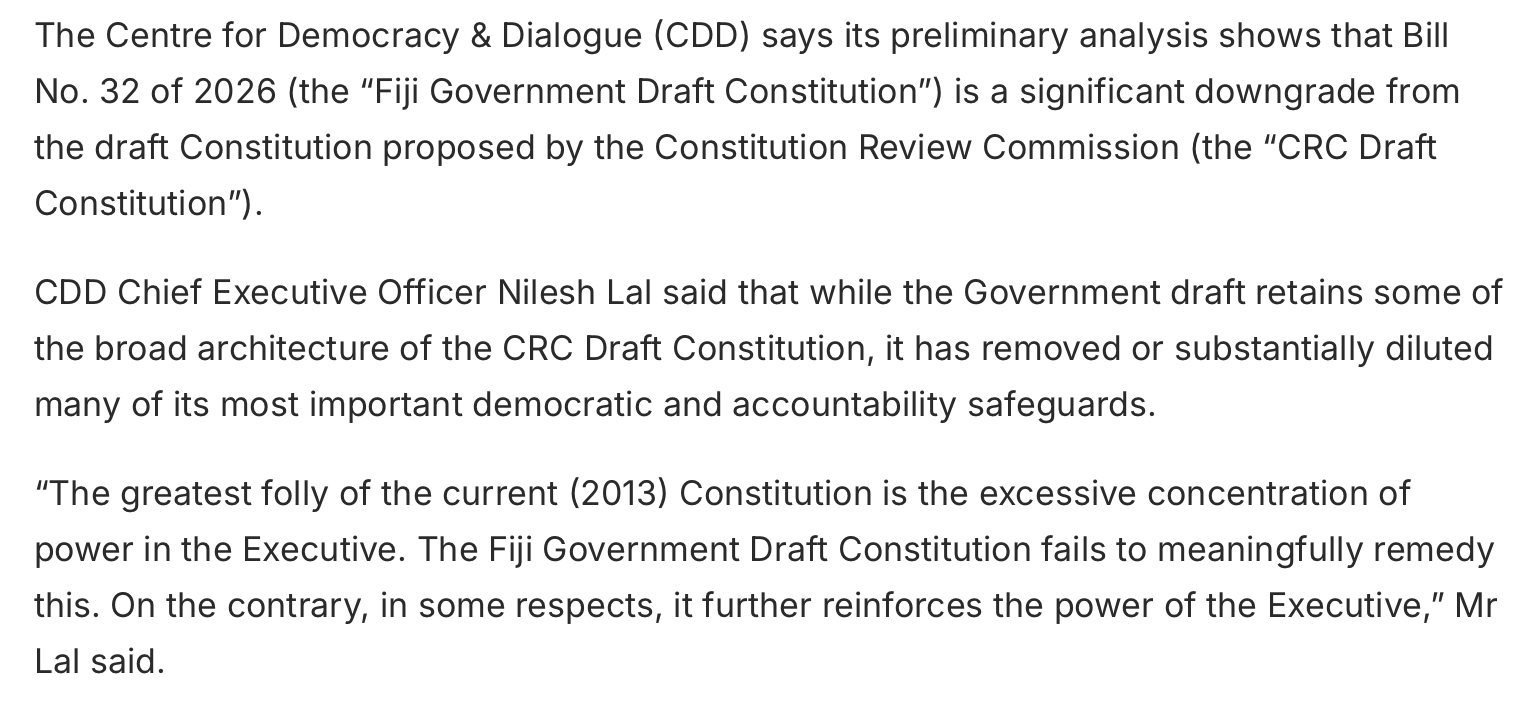
Reaction to the new draft is still coming in. But the Centre for Democracy and Dialogue – formerly Dialogue Fiji – isn’t impressed by many of its provisions.
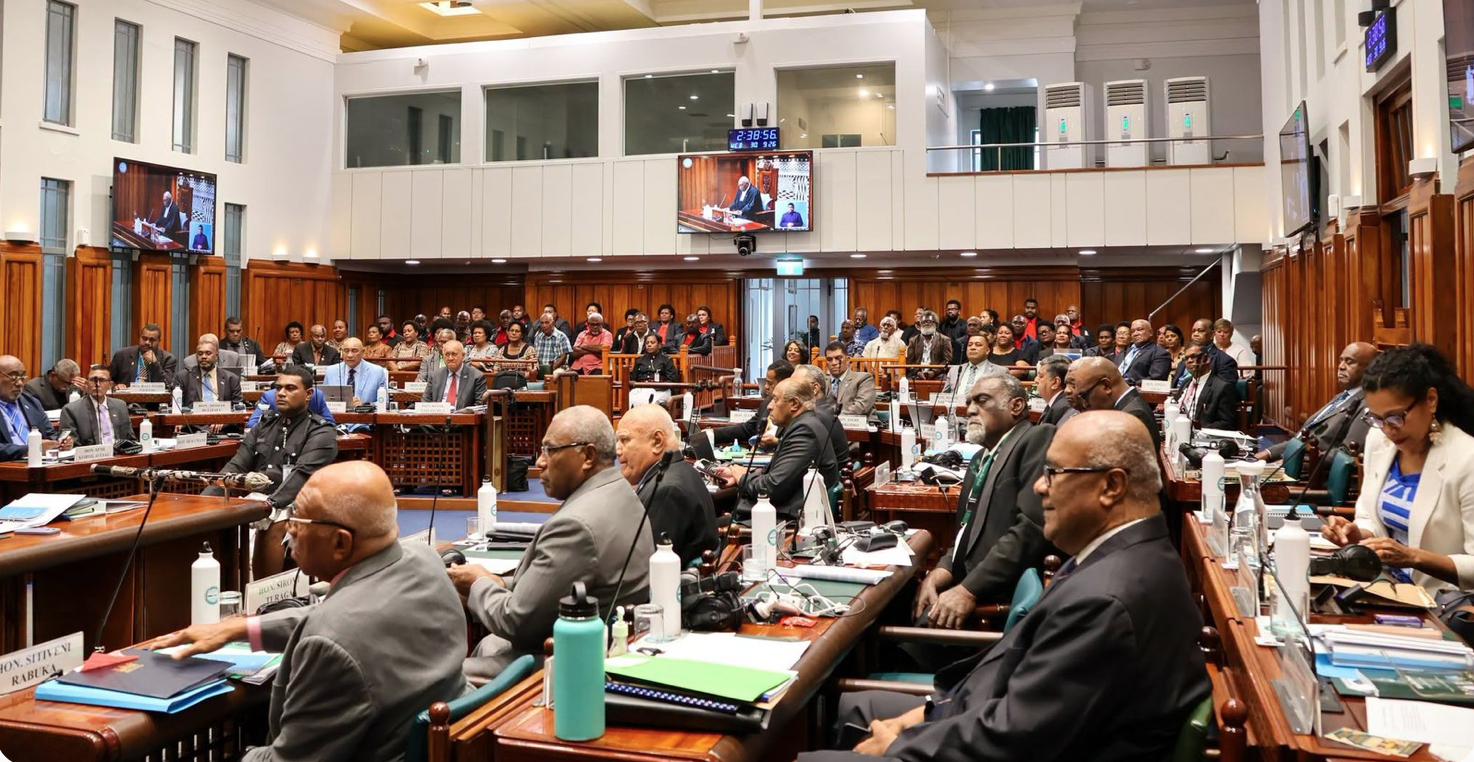
It was crowing that the Constitution Review Commission had accepted 17 or its 20 recommendations. But that was before cabinet’s shadowy subcommittee got its hands on the document and unilaterally altered it.
Who are these individuals? According to the CDD, the same kind of faceless people who drafted the 2013 Constitution. And they call this an improvement? More transparent and accountable?
Yes, Fiji. The more things change, the more they stay the same.
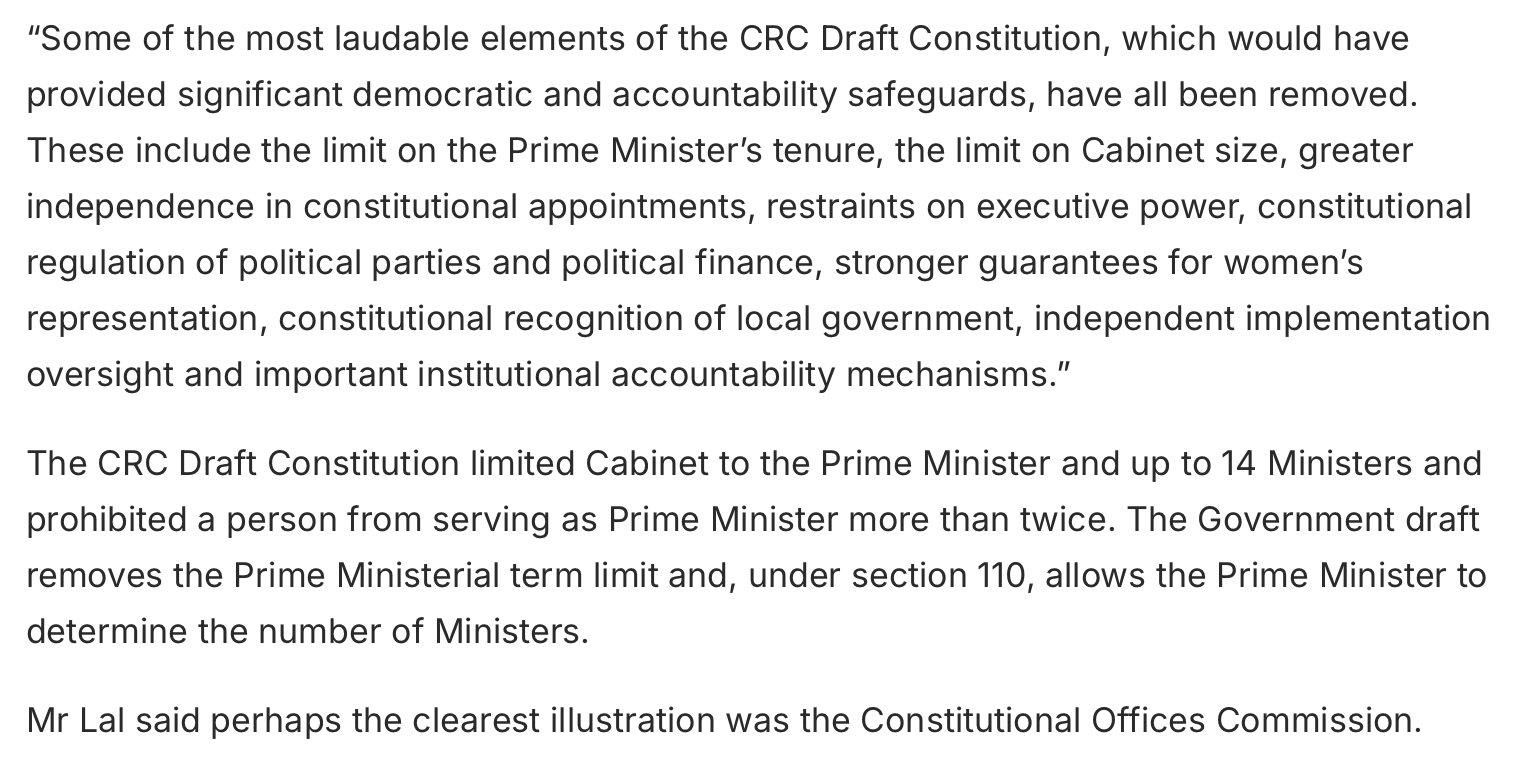
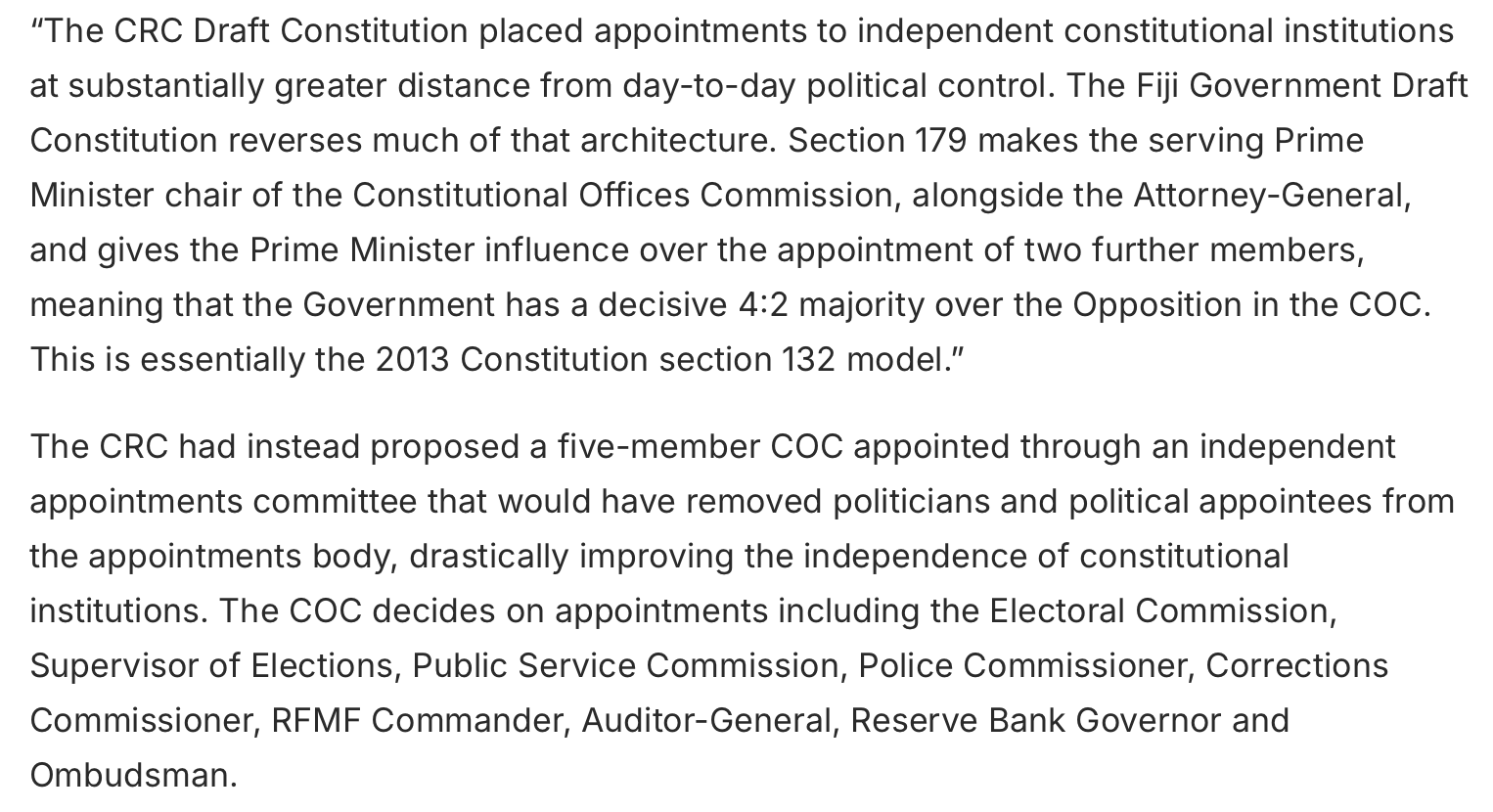
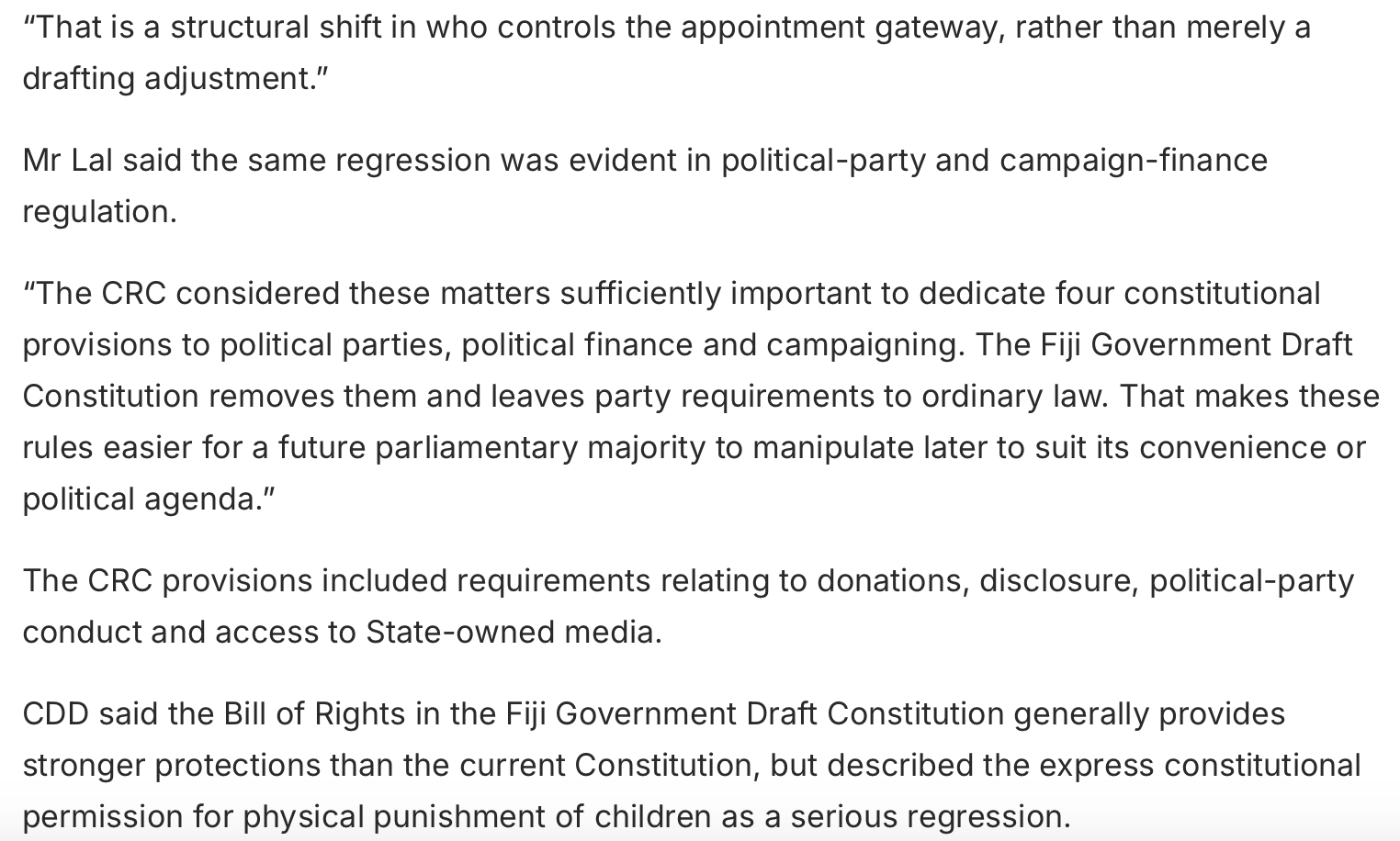
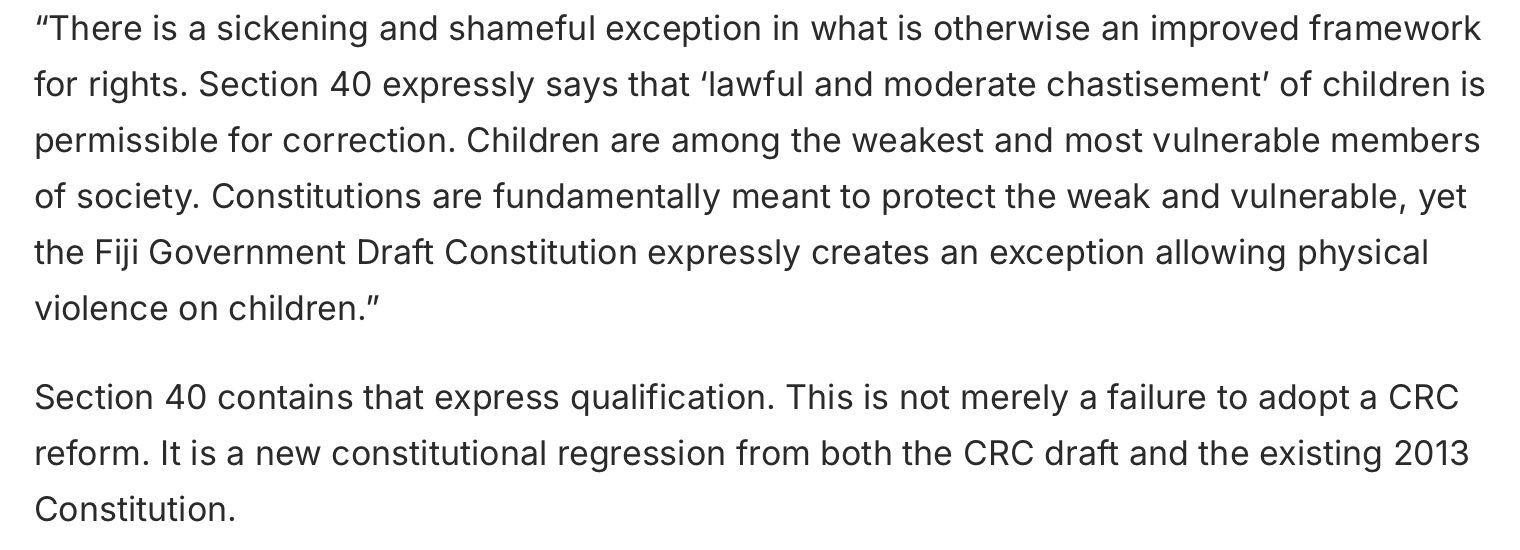

There are others hidden away, but designed to reinforce indigenous supremacy.
Remember the ‘qoliqoli’ bill that brought about Qarase’s downfall. Here it is in an expanded form.
Qoliqoli ownership would extend to the exclusive economic zone.
So the non i taukei fishermen can now be harassed up to 300 miles beyond the coastline.
*BLV: It gets its own chapter and advises the President on 14 of 23 senators.
And the President/VP will be appointed by the BLV!
“*BLV: It gets its own chapter and advises the President on 14 of 23 senators.
And the President/VP will be appointed by the BLV!“
Important note: All of the appointees to senate and state house will exclusively be from among themselves.
At least a silver lining. Thanks to the pressure applied by Grubsheet and the likes of Centre for Democracy and Dialogue.
But what hell is wrong with our media?
I looked up the dailies for some analysis but their front page is on the stolen cocaine. Ok, that’s important, but surely not more important than the constitution review and the forthcoming election?
I’m not really from the media so someone please enlighten me.
I recall Grubsheet described, Fred Wesley, Vijay Narayan and Stanley Simpson not so much the swinging dicks of Fiji media as they might see themselves, but stupid dicks as they appear quite dumb and intellectually bereft.
I see more of a drab grey than silver lining for reasons already mentioned.
I also think they are in the process of achieving the same outcome as the 2013 Constitution did with regards to not feeling like a “people’s constitution.” The cloaks and daggers and rushed through approach has eroded the little confidence and trust people had in this government.
The way Rabuka has slid this in at the last minute (and potentially what happens from hereon) still leaves the nation open to more unrest and doesn’t close the chapter on “forced constitutions” like many had wanted.
Re FICAC
Policy Commitments: Under frameworks like the United Nations Convention Against Corruption (UNCAC), member states are obligated to maintain independent anti-corruption bodies (Articles 6 and 36). Adherence to UNCAC principles often serves as a prerequisite or benchmark for direct budget support.
Navigating Donor Relations: While FICAC was created domestically to project an image of anti-corruption enforcement, Bainimarama’s administration continuously pointed to FICAC and UNCAC ratification as proof that Fiji was fulfilling good-governance standards required to regain international credibility and secure development loans. For instance, FICAC cooperated with lenders like the Asian Development Bank (ADB) to investigate specific project allegations (such as in the ADB-funded Water and Sewerage Project).
Let’s see if the donor support continues.
The likes of cash strapped businesses like Motibhais, Punjas, Vinod Patel, Damodars etc, they are all set for life. Opportune time for Indo Fijians to think about their future in Fiji. If they are able to, they need to sell up, pack up and start moving out, stop investing, stop complaining
Hi Retesh, Thats a very good thought but what about the poor indians without any skills. No problem for trade, skilled and educated people. These people cannot migrate.
Most of the business sector is not interested in politics and the wellbeing of the nation. They are only interested in themselves.
In Fj the vote is now firmly entrenched in the Itaukei camp . Indian votes don’t threaten the majority they are only a convenient partner in some sort of coalition at best. Even so those parties that were once Indian domains are now being filled with “Fijian” members.
NFP… still largely a numbers party. Filling the vote and making up the numbers. Labor has been crippled by the demise of the Sugar industry. Indian votes no longer carry a significant majority of “single party vote status”. The “Fijian” moniker and the depletion of a solid primary industry reliance on a single demographic has resulted in this shift. Passive voters are now conditioned to sit there and complain on a screen. Not much else happens.
Most of the Indian voters who aren’t business people or industrial entrepreneurs can no longer rely on a party to carry their hopes. They are now just “employees” who get smacked around by the system.
Whilst the constitution has dampened the racial divide on a top line level , it has exacerbated the divide as Indians no longer have a consolidated vote to support.
This was always the real intention of Constitutional change. I – Taukei now have a platter to feast from and waste. It is theirs to lose and if they take that approach they drag the entire country down with them and the rest of you will be helpless to salvage anything from it. It’s risky …indeed.
A Senate is important as it needs people that can articulate and navigate sensible progress. A Senate with a GCC majority could stall that process to some extent. I imagine a lot of nonsensical debate in that upper house in future.. Not much else.
It used to be a place where people from a range of backgrounds, well qualified , more often than not gathered, to talk, discuss and sensibly debate issues of importance.
It’s absolutely imperative that qualified young Fijians head off shore . If you are there already, learn all you can. Don’t give up hope. If you aren’t there yet go now! Get exposure in an environment that further broadens your horizons. Return to FJ some day and make a difference. That’s the only hope FJ has now.
Unfortunately the older generation cannot offer you much more. They are slow in an age of AI, not as nimble. Unable to adapt to or make sense of the pace of change within which they exist. Clinging to antiquated and unsuitable habits. Set in their ways. This creates friction. The complacency stalls healthy progress, innovation, dynamism. For a country with so much to offer the world it is an unfortunate reality.
A small country needs to think smarter not harder. That’s the only way forward….
I think instead of FICAC, DPP can conduct prosecution whilst specialised unit in Fiji Police Force can investigate corruption cases.
Khaiyum weaponised FICAC and that’s the reason people don’t have much faith in it.
Founding ‘Christian values’ as the first character of the state – articulated in the text’s main body, and not in the preamble where ‘Christian values’ are typically celebrated in Pacific Island constitutions – and the recall of the 1997 caveat that ‘worship and reverence of God are the source of good governance…’ has opened up a few significant holes in the fence separating church and state.
If this goes through as-is, it will be now more due to judicial decision-making, rather than clear written constitutional guardrails, that determine Fiji’s future legalities about religion and state.