
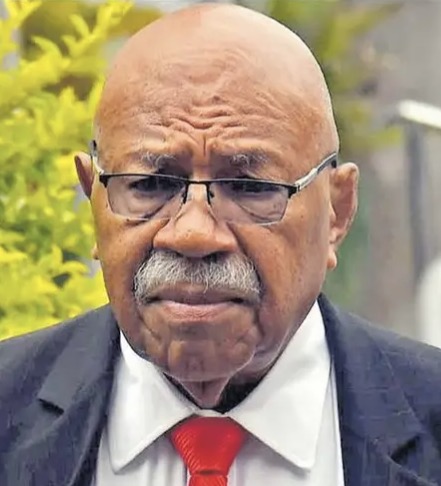
Make no mistake, Fiji. Sitiveni Rabuka‘s last-minute decision yesterday not to proceed with this week’s vote in the parliament on the new constitution isn’t for the reasons he gave – to provide more time for public consultations and take the pressure off parliamentary officials.
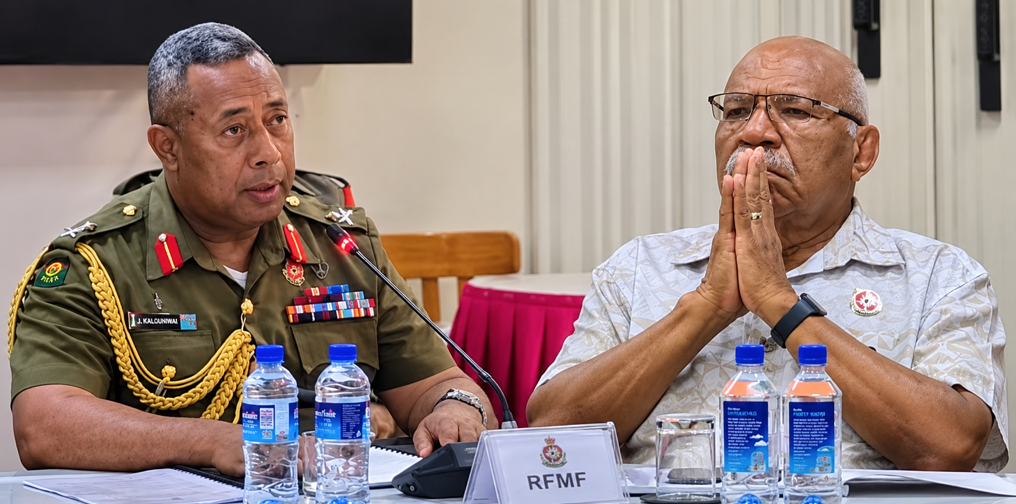
It is to work out how the hell he is going to deal with the demand by the RFMF Commander, Major General Ro Jone Kalouniwai, that the Prime Minister remove the immunity provisions of the draft that protect him from ever being prosecuted for his two coups in 1987.
You won’t see any of this in the Fijian mainstream media because they haven’t got the guts to report it. They have supinely published Rabuka’s risible official reasons for his back-flip when he was so adamant on the weekend that the vote would proceed. Yet here’s what’s really happening.
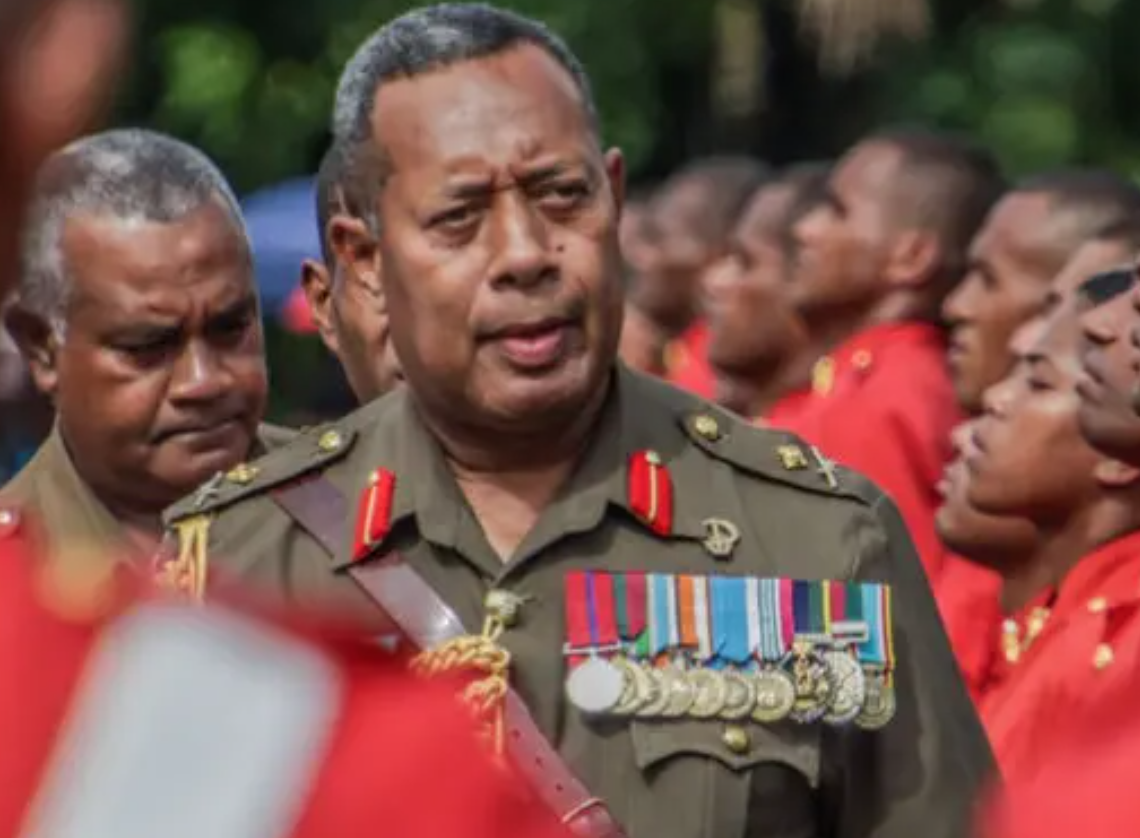
The RFMF Commander is reported to be adamant that he will not back off on his demand that the Chapter 14 immunity provisions in the draft constitution be removed. And yes, it is a demand, not a suggestion that can be fobbed off or ignored. And that demand is non-negotiable.
And there’s a further demand that is non-negotiable – the removal of the provision in the draft that provides for the abolition of FICAC. It isn’t going to happen as far as the RFMF is concerned. The corruption watchdog stays.
Faced with this, Sitiveni Rabuka had two choices. Ignore the RFMF Commander’s demands and take him on or buy himself some time to try to negotiate his way out of the impasse. He has chosen the latter, sugar-coating it for a gormless media by trying to cast his back-flip as an act of statesmanship rather than the act of a cornered rat.
Let’s also be clear. If the immunity provisions go, Sitiveni Rabuka will be the most vulnerable he has ever been in the 39 years since he staged his two coups in 1987. The immunity clauses in successive constitutions have provided him with protection from prosecution but that would be gone.
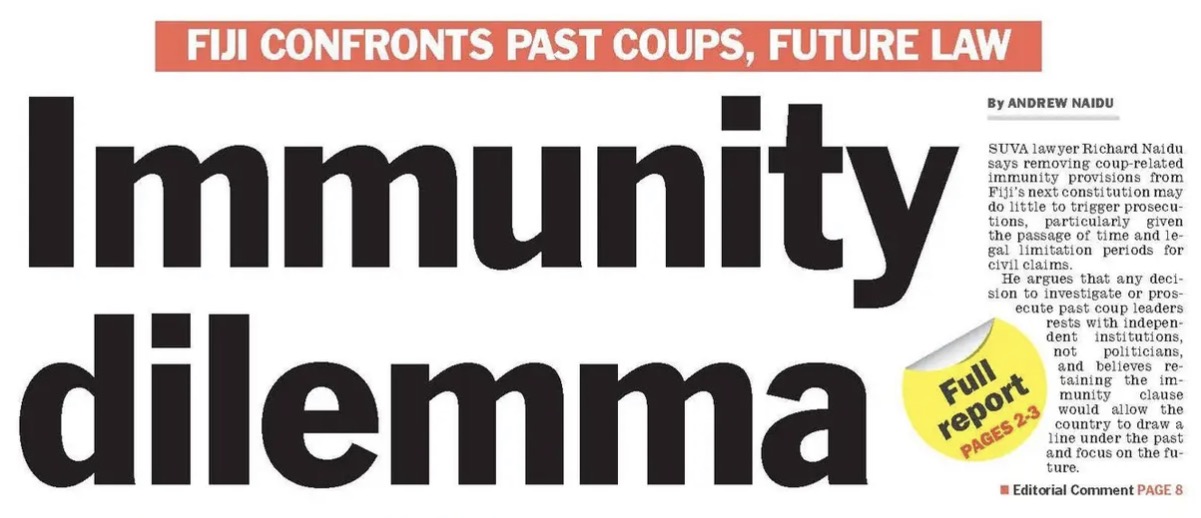
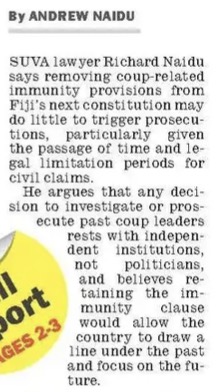
Today’s Fiji Times front page has their resident lawyer, Richard Naidu, saying it would be unlikely, given the passage of time, that Rabuka and Frank Bainimarama would be held to account for their actions in 1987 and 2006 respectively. Oh really? Then why do the immunity provisions exist? Why not just drop them altogether?
FACT: The passage of time doesn’t matter. Rabuka committed treason in 1987 by removing a democratically-elected government at gunpoint. And the thing about treason – according to a senior lawyer Grubsheet has consulted – is that it doesn’t go away.
With the immunity provision in the supreme law gone, Rabuka is liable to the charge for life. As is Bainimarama and those other ministers in the Rabuka government who assisted either of them, though it is less likely that those “merely following orders” would be prosecuted.
The point is that even if Sitiveni Rabuka wins the next election, and the next, removing the immunity provisions poses a clear and present danger to himself if a government were to ever come to power which happens to agree with Kalouniwai that coup-makers must face justice.
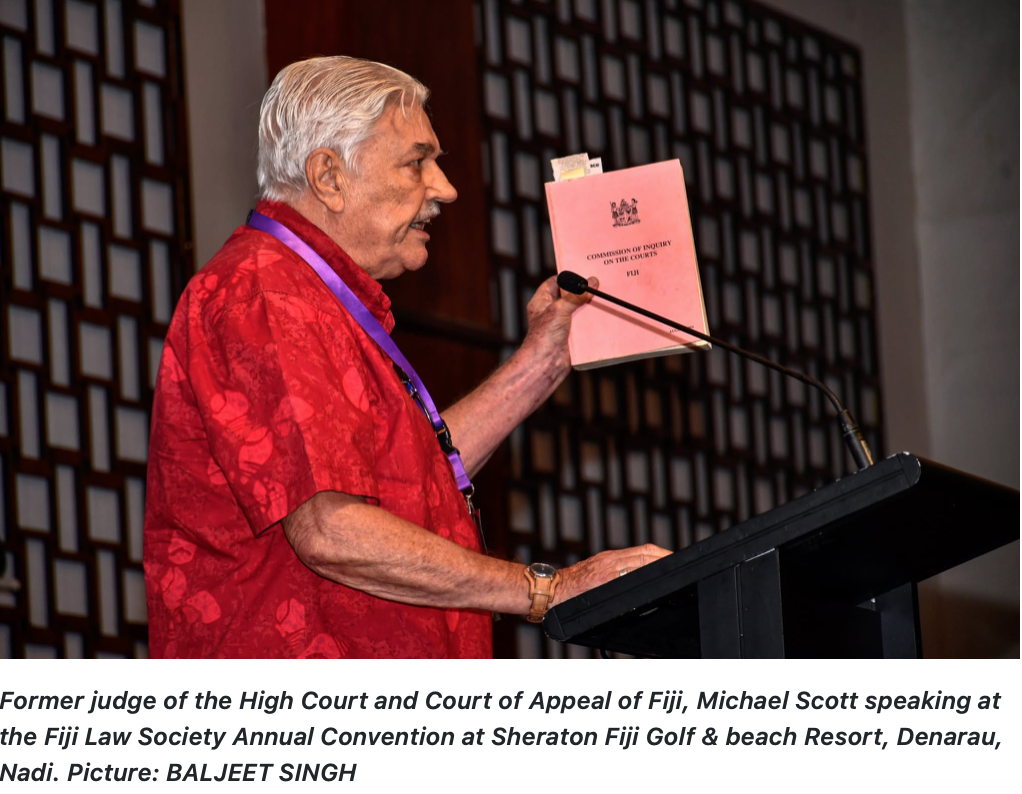
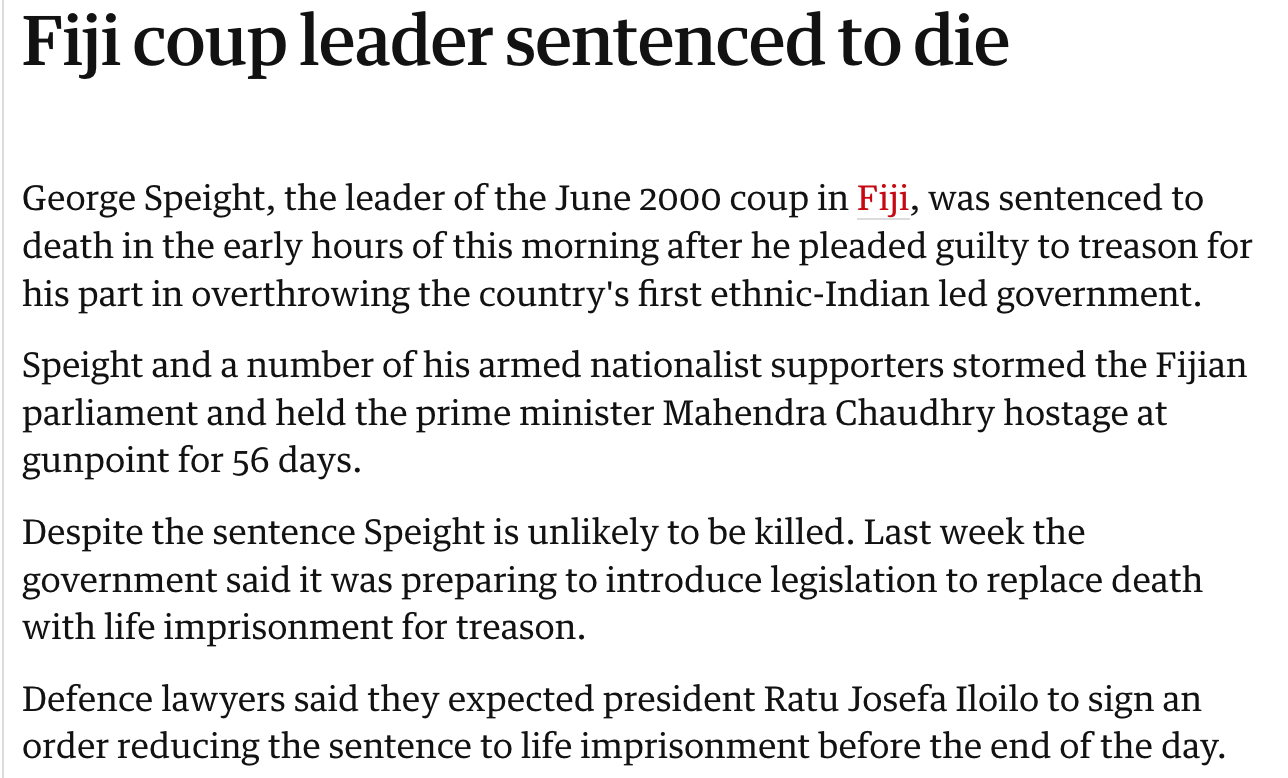
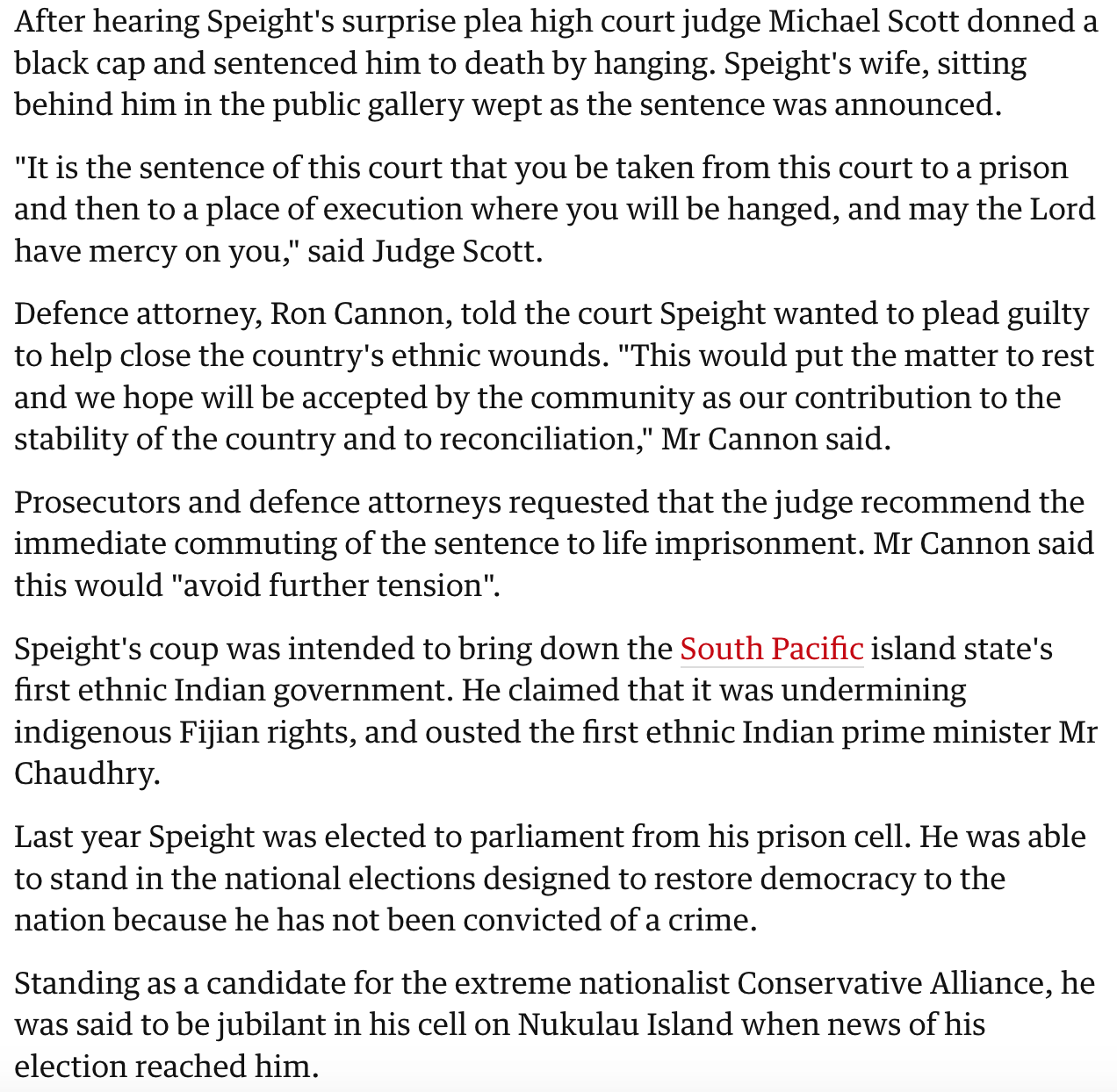
Just ask George Speight, who wasn’t covered by any immunity and was sentenced to death for treason by hanging for his role in the 2000 rebellion but had it subsequently commuted to life imprisonment. That sentence was passed by the former judge, Michael Scott, who is now in the headlines for exposing the “shameful national scandal” in the judiciary under the Chief Justice, Salesi Temo. (see article below)
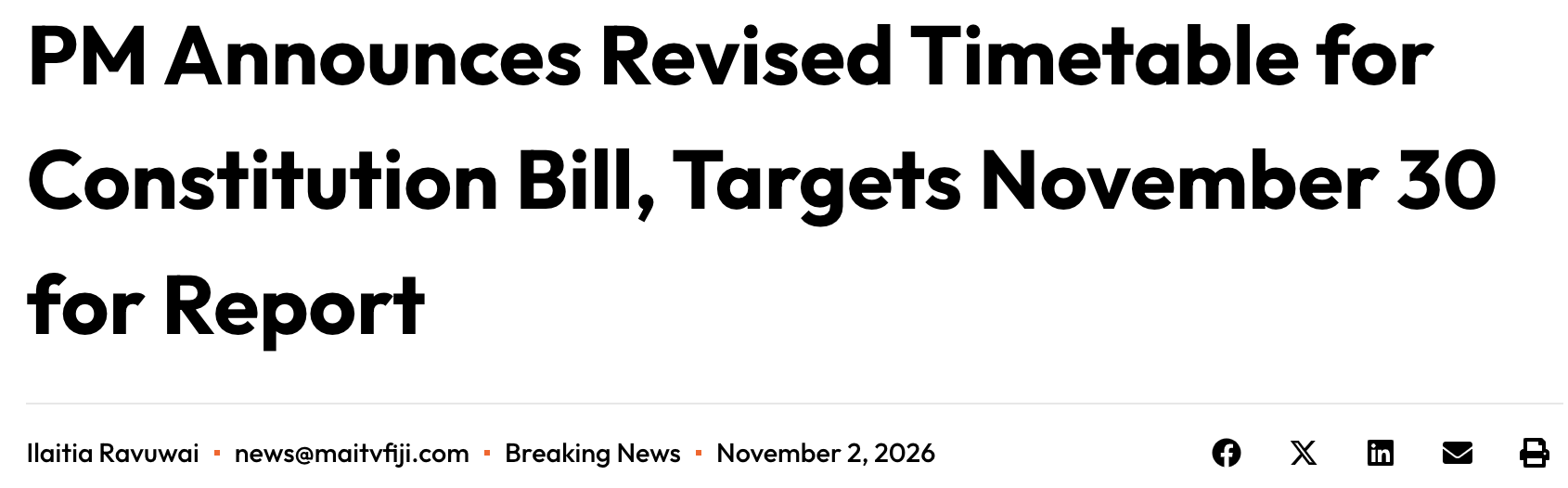
So the Prime Minister is in a terrible bind. He has kicked the issue forward for a month and says he now intends to proceed to the third reading of the Constitution Amendment Bill on November 30. Yet unless Commander Kalouniwai backs down, nothing will have changed by then. And the word from the Commander is that he isn’t going to back down. On the removal of the immunity provisions or his insistence that FICAC stays.
All of which raises a delicious irony. That the 2013 Constitution, with its immunity provisions, is suddenly Sitiveni Rabuka’s best friend and he had better hope that it remains in place or he is hopelessly exposed.
Ergo. Don’t be in the least bit surprised if November 30 produces another delay and the whole immunity “dilemma” – as the Fiji Times terms it – is again kicked into touch. Yes, the distinct possibility that nothing happens until after the election, which Kalouniwai also won’t allow to be delayed – no third reading, no referendum and no new constitution until Sitiveni Rabuka can be sure that he can save his own butt.
That’s the real state of the nation right now, Fiji. Ain’t it grand? Yet anyone who genuinely cares about democracy ought to be grateful that Jone Kalouniwai has finally taken a stand. Why is he doing so now? Well that’s a story all in itself.
The Commander will be hearing the same rumours as Grubsheet as to why the immunity provisions of this constitution don’t just cover past events, they cover the actions of any public official until after the new constitution takes effect on March 31 2028. It is allegedly to cover the butts of Rabuka and the President, Ratu Naiqama Lalabalavu, for what they are said to be planning to thwart the coming election.
Incredibly, those actions are rumoured to be the following:
1/ That if any referendum is passed in December, the President plans to bring forward the start date of the new constitution to December 24, not the end of March 2028, and delay the election for two years.
2/ That if the referendum is lost, they will engineer a state of emergency to also delay the election. Yes, a naked lunge for power on the part of the PM and his chief to remain in power as long as possible.
Are those rumours true? Let’s all hope in the national interest that they aren’t. But the bottom line is this: Were the new constitution to come into force with the immunity clause still in it, the President and Prime Minister would be protected legally from any action they take all the way to the end of March 2028.
If Commander Kalouniwai has his way, it isn’t going to happen. And his stand deserves to be supported by any Fijian who genuinely cares about the national interest rather than the crude manipulation of the state by the duumvirate from Cakaudrove.
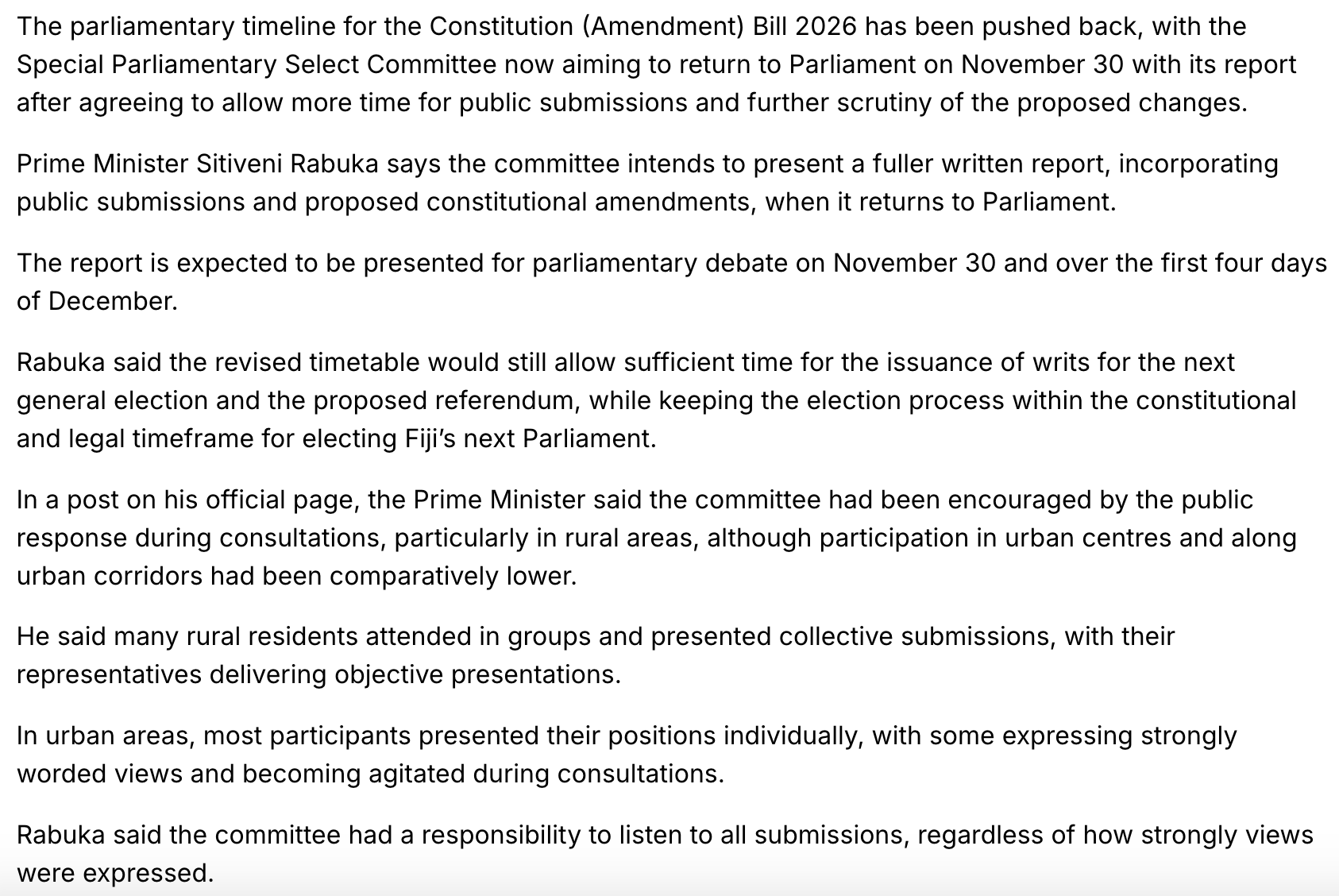
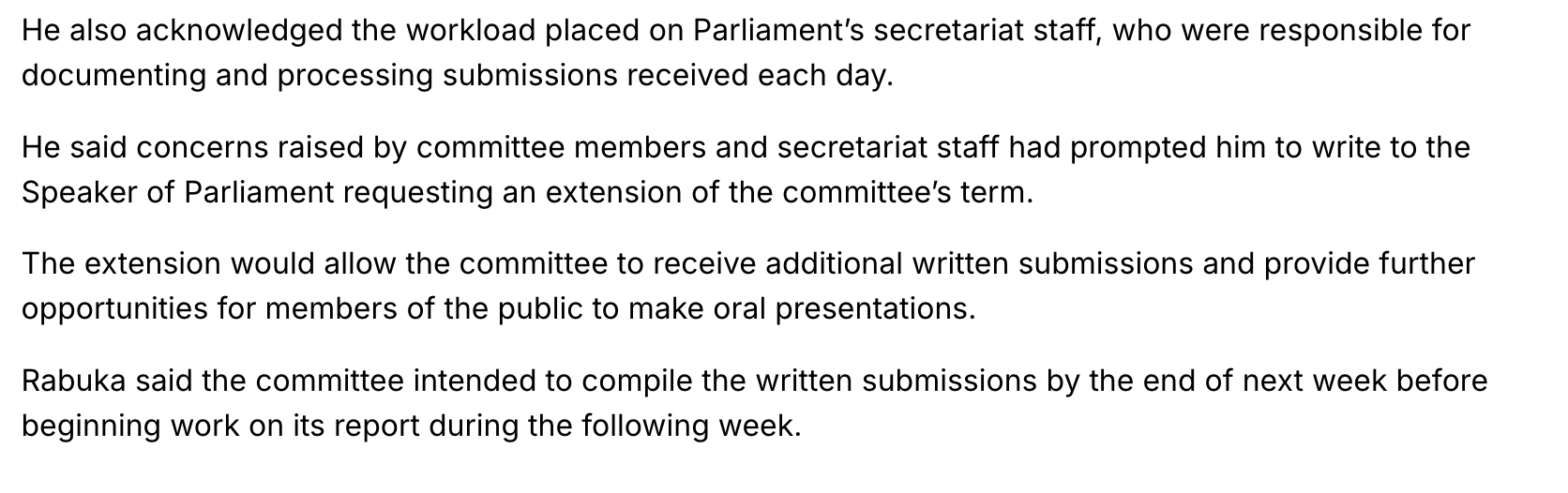
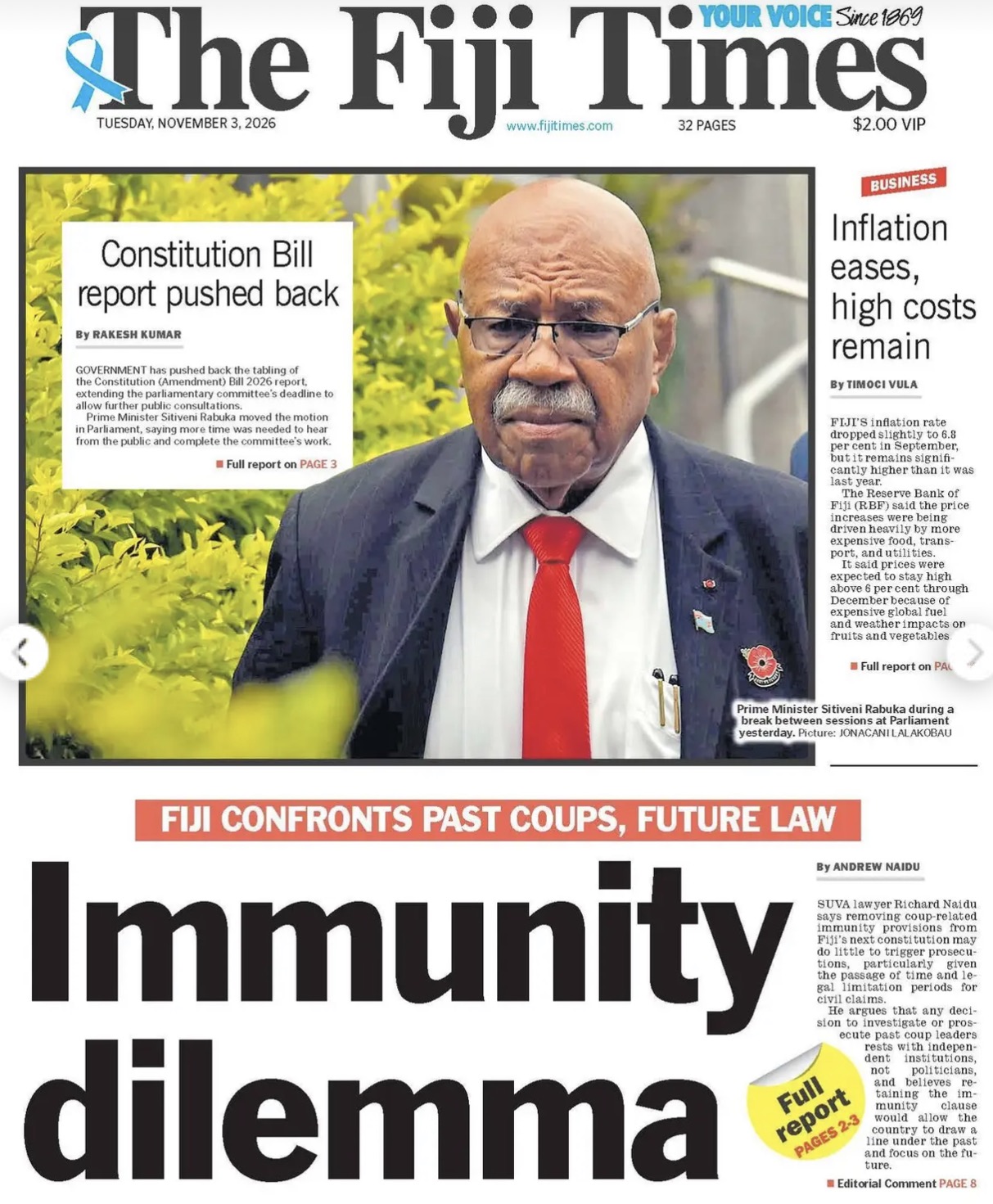
Pretending to be cooperative but desperate behind the scenes…



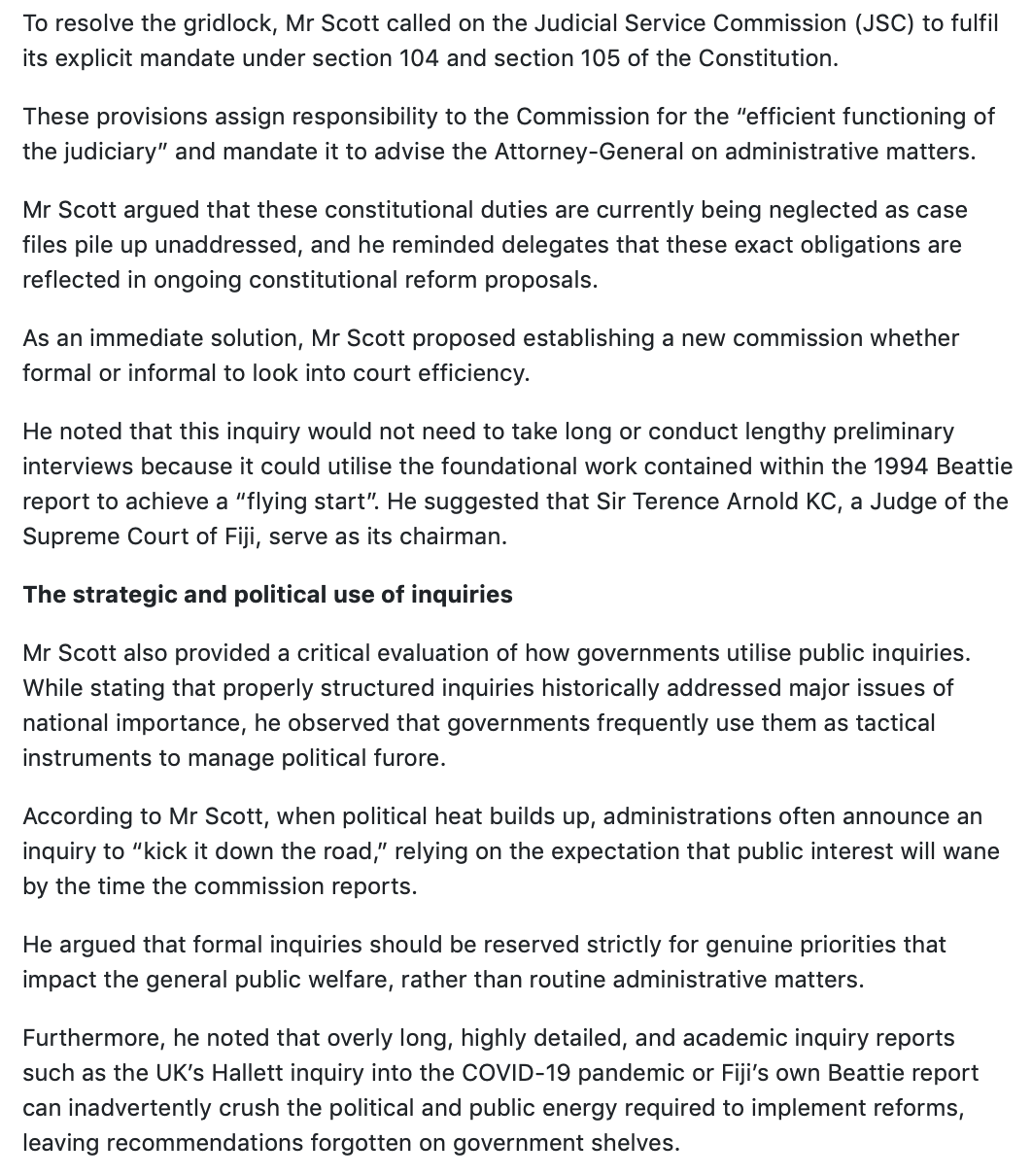
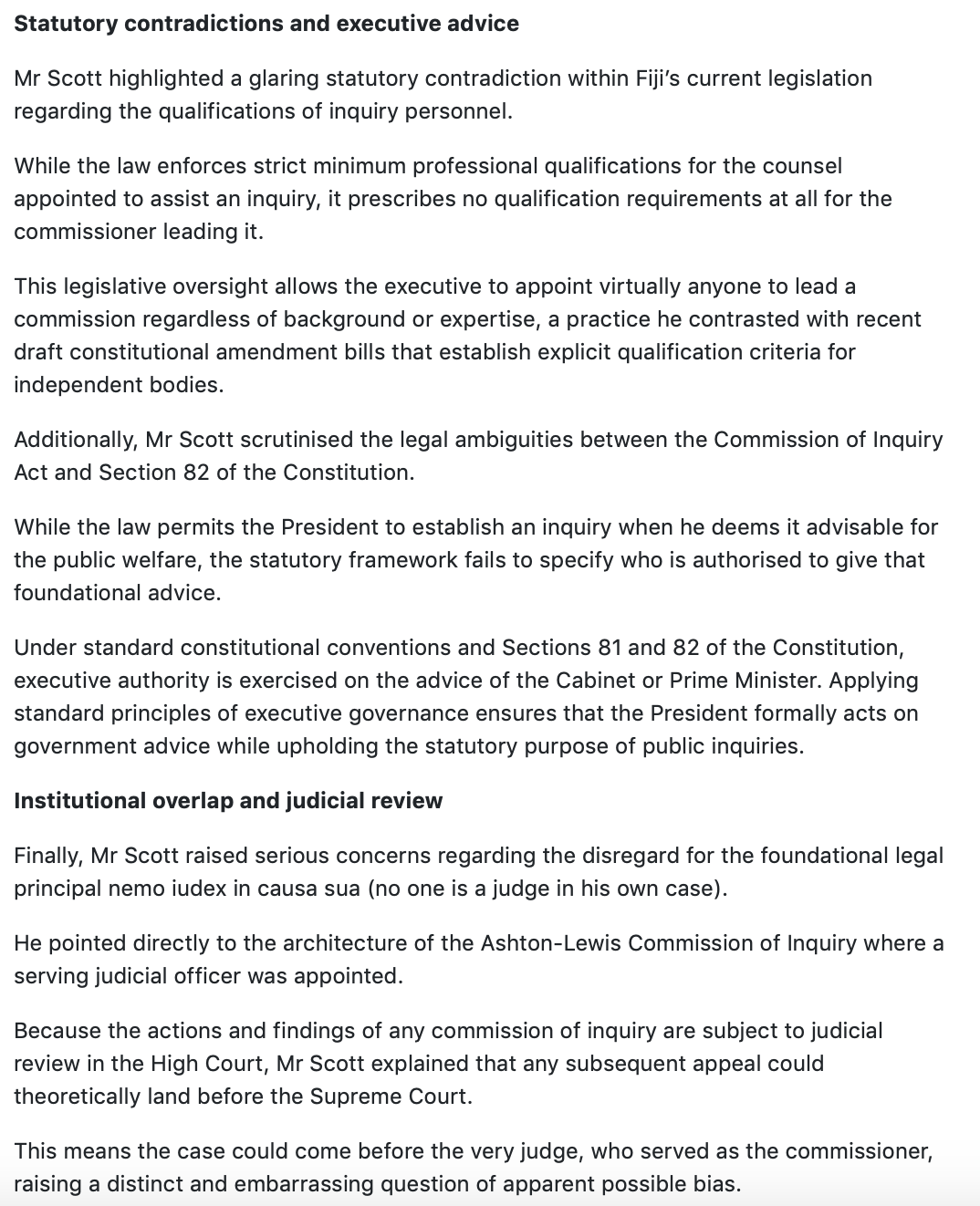

Who is Michael Scott? From the archives of the Guardian newspaper in February 2002.
Once again, Rabuka’s legal advisers did not focus on this immunity clause and the implications it would cause if the RFMF got involved.
Whether Rabuka regrets the decision of interfering with the 2013 constitution is something we cannot establish without his own statement, but the implications of the immunity provisions have become a major issue in the current constitutional debate.
Snake self entrapped and slithered into self-check mate.
Now the learned Commander has his critical thinking back, and the snake is slithering into his hole to desperately work on his next move and narrative flip, the media need to realise they are in a stronger position than ever to let the people know what is going on.
The media need to draw on the Commander’s strength to release their fear-based style of reporting. They also need to stop reporting what politicians say, focus on the reading between the lines, and assisting readers join the dots of what’s going on behind the scenes. I understand the fear is about funding, and being sued – so it’s easier to only ever report quotes. But as Graham would know, there are ways to raise hidden agenda’s and unspoken intentions/plans in ways that aren’t defamation.
I really hope some of the media read Graham’s excellent articles and can find the courage to start taking a leaf out of his book. Thanks Graham!
The RFMF commander is correct in insisting the immunity clause and FICAC remain. No one in parliament has stood up for FICAC.
Rabuka is a despicable corrupt human, much like his high chief President Lalabalavu.
Wonder if Pio Tiko and Sashi is also being counselled by the RFMF.
Says a lot about Fiji politics when the military has to step in to do the opposition’s bidding.
Rabuka effed up in more ways than one. There were far more important issues at stake than the constitution review or the COI. Stanley Simpson is on point:
“FICAC Inquiry Made a Mockery of Judicial Process, Says Simpson
The Commission of Inquiry (COI) into the appointment of former Fiji Independent Commission Against Corruption (FICAC) Commissioner Barbara Malimali became a public spectacle that undermined confidence in Fiji’s legal and administrative institutions, says Fijian Media Association (FMA) General Secretary and Mai TV Director Stanley Simpson.
Speaking at the Fiji Law Society Convention in Nadi over the weekend, Simpson reflected on the inquiry and the difficulties journalists faced covering a process marked by controversy, secrecy and public speculation.
He said what should have been a serious legal process quickly became a source of public uncertainty, particularly after the events surrounding Malimali’s appointment and arrest in September 2024.
Simpson recalled that Malimali was arrested by FICAC officers shortly after arriving at the commission’s headquarters on her first day as commissioner.
The incident triggered a series of developments, including an urgent press conference by then Attorney-General Graham Leung and the eventual resignation of Acting Deputy Commissioner Francis Puleiwai.
It also raised questions about the circumstances surrounding Malimali’s arrest and whether the investigation was being handled appropriately.
“Ordinary people asked the obvious question: Was this a legitimate investigation into abuse of office, or was it a calculated political attempt to block pending charges against high-profile political figures?” Simpson told convention delegates.
In October 2024, the Prime Minister established a Commission of Inquiry to investigate the circumstances surrounding Malimali’s appointment.
However, Simpson said expectations of transparency were quickly challenged when the inquiry proceeded behind closed doors, excluding the media and members of the public from the hearings.
He said journalists were left relying on information circulating outside the proceedings, creating an information vacuum that was increasingly filled by social media commentary, leaked recordings and claims that newsrooms struggled to independently verify.
Simpson said this made reporting particularly difficult, as information was circulated online before journalists could properly check and confirm its accuracy.
He also recalled the uncertainty surrounding the inquiry, including when senior officials such as the Police Commissioner and Military Commander were called to Government Buildings.
The controversy extended to the removal of then Attorney-General Graham Leung, who was informed of his dismissal through a text message while on official business in Hong Kong.
Simpson also questioned the financial cost of the inquiry, saying expenditure had exceeded $2 million.
He questioned the use of public funds on the process at a time when Fiji was facing major challenges, including the drug crisis, rising HIV cases, pressure on health facilities and the increasing cost of living.
The inquiry’s outcome later raised further questions about its legality and conduct.
On August 14, 2026, the High Court declared the Commission of Inquiry report null and void in its entirety.
Justice Dane Tuiqereqere ruled that the commission had no legal authority to continue its work beyond January 31, 2025. The court also found serious breaches of natural justice and identified a reasonable apprehension of bias in the conduct of the inquiry.
The State was subsequently ordered to meet the successful applicants’ legal costs.
For Simpson, the outcome raised broader questions about the impact of the inquiry on public confidence in Fiji’s institutions.
He said the experience highlighted the importance of transparency and accountability, particularly when legal processes involve public institutions and taxpayer funds.
Reflecting on the way the inquiry was conducted, Simpson said it had fallen short of what the public should expect from such a process.
“It made a mockery of how a COI should be run,” he said.
He also expressed concern about the online commentary surrounding the inquiry, including criticism directed at senior judicial figures.
“At one point, I actually saw people questioning the Chief Justice of Fiji online in leaked videos. I mean—what in heaven’s name is this? The Commission of Inquiry essentially turned into one of those fights we see on Chat Fiji.”
Simpson urged the legal fraternity to reflect on the lessons from the inquiry, stressing the importance of transparency, compliance with statutory deadlines and responsible use of public funds.
He said legal processes should serve the interests of the people and maintain confidence in the justice system, rather than become consumed by internal disputes and institutional battles.”
This apologia for the inaction of the media is a disgrace in itself. I would be a lot more impressed with Stanley Simpson if he wasn’t on the government drip and accepting public funds for Mai TV, which on the age-old basis of “he who pays the piper calls the tune”, tells us just who Simpson’s ultimate master really is.
His attack on the COI is especially disgraceful. This was a Supreme Court Commission of Inquiry that ought to have been supported. Instead the media has done everything possible to subvert it, choosing to side with Stanley Simpson’s friends like Manoa Kamikamica – the two are regularly spotted together in various social settings – or the friends of the Fiji Times luminaries such as Wylie Clarke.
And then there is his willingness to side with the Resnicks at Fiji Water rather than question the appropriateness of billionaires extracting tax concessions from the Coalition government while they extract a precious natural resource and avoid the corporate tax that any other business in Fiji pays.
Simpson is a poseur and not a journalist’s rear end. His crocodile tears when the media restrictions were lifted remain as a permanent reminder of his shocking betrayal of his ultimate duty to the Fijian people. Because he has led the media in an even more insidious campaign of self-censorship and selective reporting in favour of a corrupt government that is worse than its predecessor. Utterly scandalous and unforgivable.
His comments on the attacks on the Chief Justice are simply unbelievable. Fancy taking Salesi Temo’s side when he is not only demonstrably incompetent to have allowed a backlog of 20,000 cases to develop and allowed $50-million worth of seized cocaine to disappear from under his very nose.
His conduct in telling Francis Puleiwai – the then deputy head of FICAC – that no case she brought would ever be heard by any court in Fiji – was rightly found by the CoI to be a prima facie case of perverting and obstructing the course of justice. What happened is all on tape. It cannot be denied. Yet no media organisation in Fiji has reported the details. And Simpson has the gall to attack the CJ’s critics!
The same goes for Simspon’s failure to report on and publish the finding by the PAP, counter-signed by the Prime Minister, finding Lynda Tabuya guilty of a “sex and illicit drug scandal” and stripping her of her deputy leadership of the PAP. It is all there in black and white and cannot be disputed. But Simspon and his cronies simply turned a blind eye to the letter and it still hasn’t been published by the mainstream media in Fiji.
And now guess what? Stanley Simpson – along with the likes of Vijay Narayan – are taking public money from Lynda Tabuya as Information Minister in the form of “public service broadcasting” payments. Anywhere else, this would be called corruption – buying off the media – but not in good old Fiji.
They can delude themselves that they are ethical journalists but they are not. And the least they could do is remain silent while they take their money rather than use public forums to try to rewrite history and justify their appalling lack of regard for their ultimate masters – the Fijian people.
The PM is now caught in a situation of his own making.
I doubt neither he nor any other member of the Government will be able to articulate any arguments to change the stance of the FRMF. They appear resolute in their insistence that the Immunity Chapter be removed.
The comments of Richard Naidu are not relevant. His suggestion that Rabuka and Bainimarama and those other ministers in the Rabuka government who assisted either of them may not be prosecuted due to age and length of time since events don’t reflect that Treason has no expiry date.
What can Rabuka do now? Given his past I suspect he will wait until November 30 and move to have Parliament pass the revised constitution with some amendments, but the Immunity included, if he has the numbers. If passed, that will put the RFMF into a position of challenging the elected Parliament.
A passed vote will see the probability of the Referendum and General Election being held together. With the Referendum becoming the dominant campaign issue and could see some parties advocating a ‘No’ vote.
If the Parliament does not pass it then Rabuka’s only choices are a General Election or if rumours are to be believed he and the President will collude to engineer a state of emergency and stall an election.
It will be an interesting month ahead!
So, it took the threat of a coup (read between the lines of what the RFMF submitted to govt) to get the snake to change his decision?
There is no evidence that Kalouniwai has threatened a coup. He has merely said that the RFMF wants the immunity provisions of Chapter 14 removed and FICAC retained. And you can extrapolate whatever you want from that.
The question is this: Why would Kalouniwai risk a loss of face in Rabuka telling him neither is going to happen? And the answer to that is he wouldn’t. Has he done it intending to just meekly cave in? Again he wouldn’t.
Which leaves us all to speculate precisely what he would do if Rabuka rejects his demand. And that’s where history comes in – the miscalculation Laisenia Qarase made in 2006 when he ignored Frank Bainimarama’s demand to drop the Qoliqoli Bill.
It doesn’t mean that Kalouniwai means to imitate Bainimarama. It is merely the possibility that he might that hangs in the air like a persistent fart in a tiny room. And it was enough to persuade Rabuka that this is an exercise in brinkmanship he doesn’t want or need right now, especially when it is only the People’s Alliance that is determined to push this constitution through before Christmas.
So we now have an extra month in which Rabuka will try to get the RFMF back on board. But if they are making the removal of the immunity and the retention of FICAC non-negotiable, what chance do you think there is of that?
Answer. Someone is going to lose face and Kalouniwai is determined it won’t be him. So we have a stalemate just like there was between Qarase and Bainimarama in 2006 and it is going to be a fascinating few weeks.
Will we know the outcome after a rugby match? I recall the last coup occurred after a rugby match between the RFMF and the Police. Anyone reading this know if there’s a match scheduled soon?
Something to ponder – let’s say the bill passes the third reading, which day will the subsequent referendum take place?
Will it be rushed through to avoid the automatic trigger, dissolution of parliament on December 24 so that the original time table and “plans” are still on track
Also worth considering why the bill to change the constitution was introduced months before the election and not earlier?
Was it because it was left this late for the precise reason of what has been speculated- to extract an extra two years at the end of the current term?
For a nation plagued with a drug and HIV crisis and associated crime and cost of living problems, surging on inward remittances and hand outs from other counties, one can only wonder what the governments’s priorities are apart from self indulgence and self preservation.
Sometimes we see the slithery manipulator.
Sometimes we see the thug. Now he’s threatening NFP and SODELPA that if they don’t vote for the bill, they lose their Cabinet positions.
It’s getting harder by the day for the average Fijian not to see him as a dictator.
We are witnessing political death throes as legitimacy, control, and internal cohesion are waning.
A relic of the past is about to falter as the voting population demands modern, progressive and equitable leadership for all.
The G11 have a political future when they abandon their support and position for PAP.
Won’t be long now.