
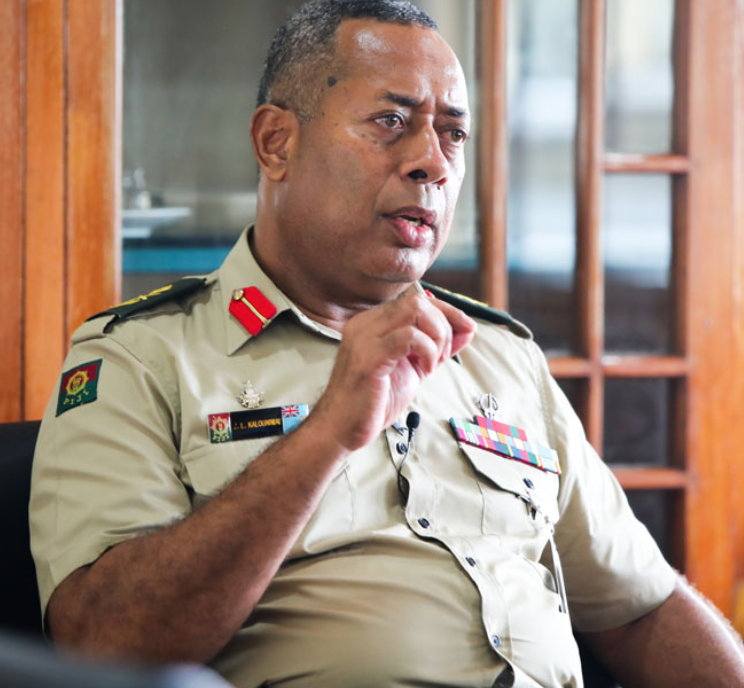
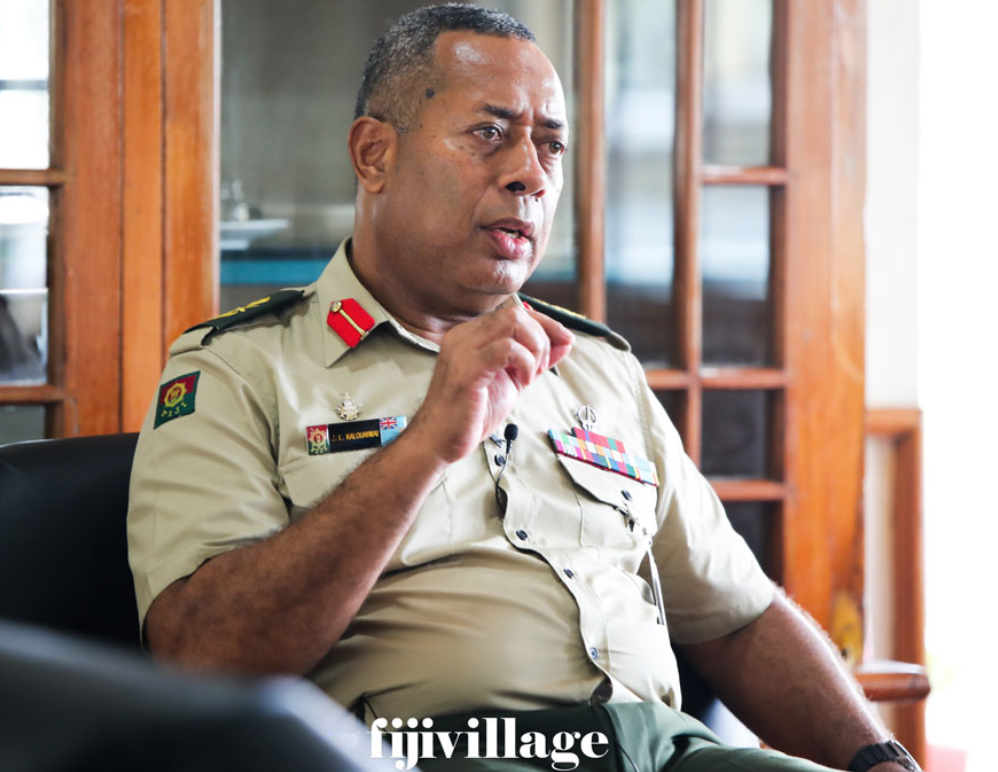
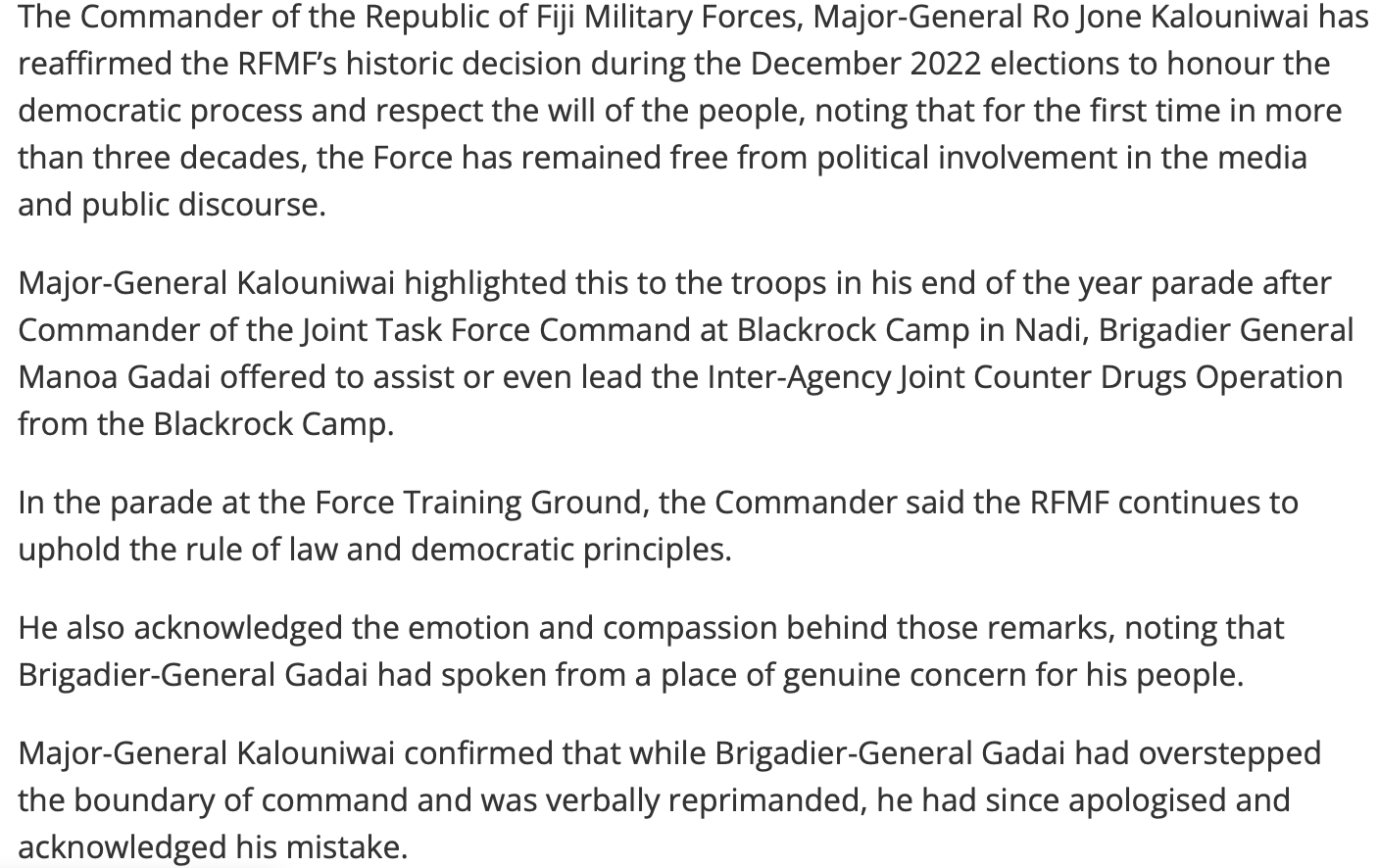
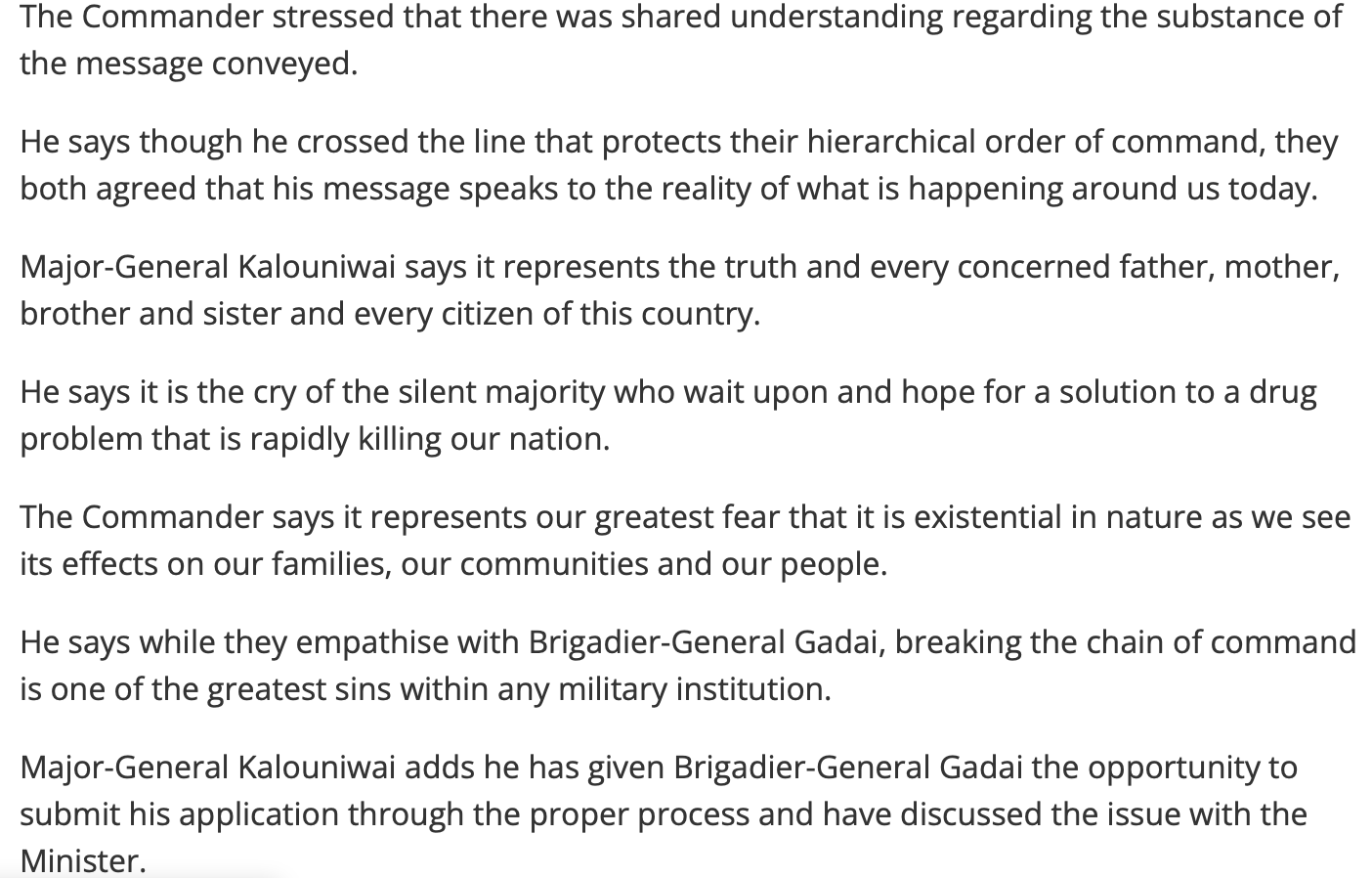
The Commander of the RFMF, Major General Ro Jone Kalouniwai, has confirmed a showdown with one of his most senior officers, Brigadier General Manoa Gadai, by announcing that he has reprimanded Gadai for calling for an increased role for the RFMF in combating the drug trade.
It is a double-edged sword for Kalouniwai. He is clearly trying to assert his authority amid reports of a split in the military over Gadai’s extraordinary email last week in which he offered to lead the drugs fight from his Joint Task Force Command post in the West. Yet in confronting Gadai, the RFMF Commander clearly risks exacerbating division in the ranks over what Gadai’s supporters see as Kalouniwai’s failure to demand stronger action against the drug barons corrupting the nation and its security forces.
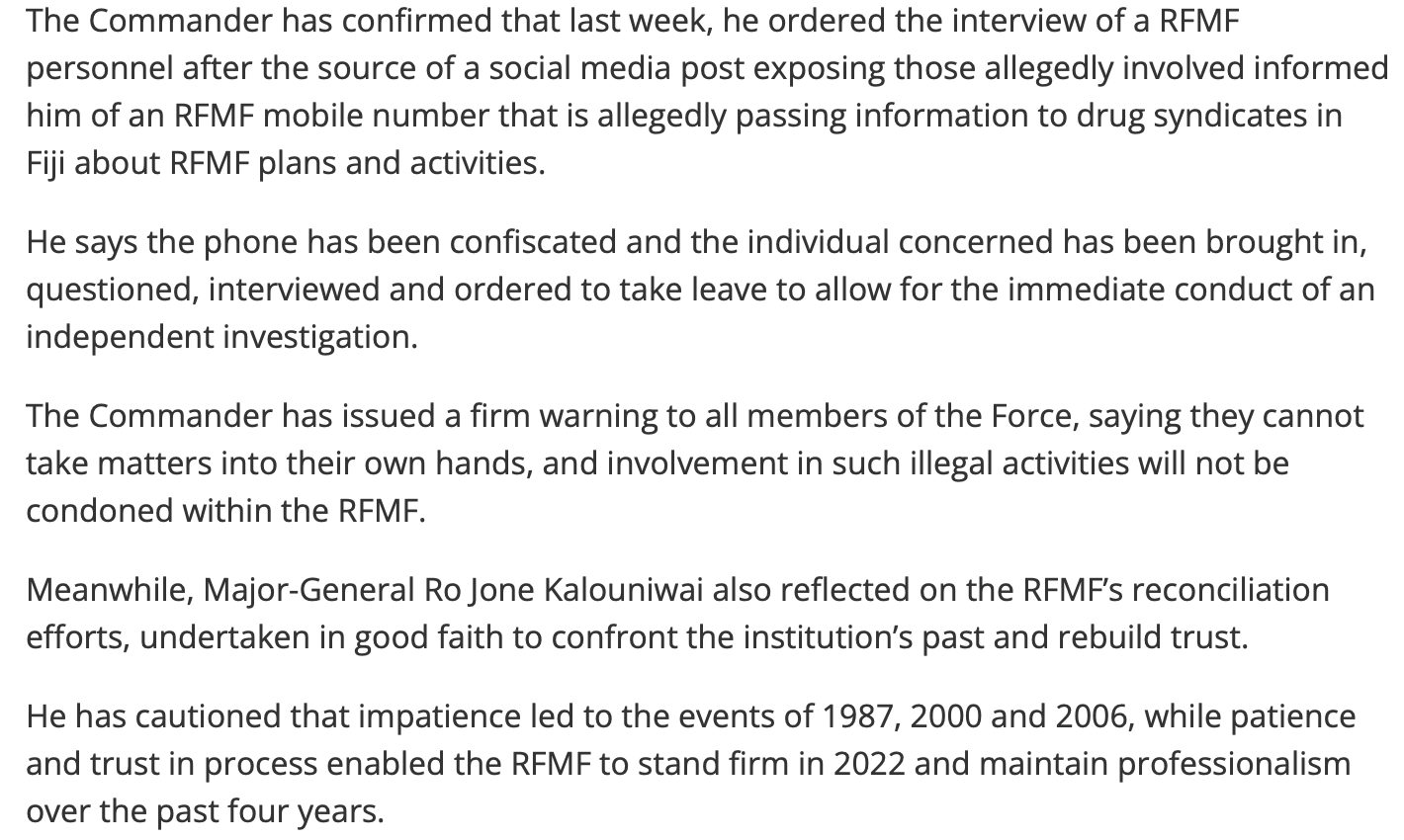
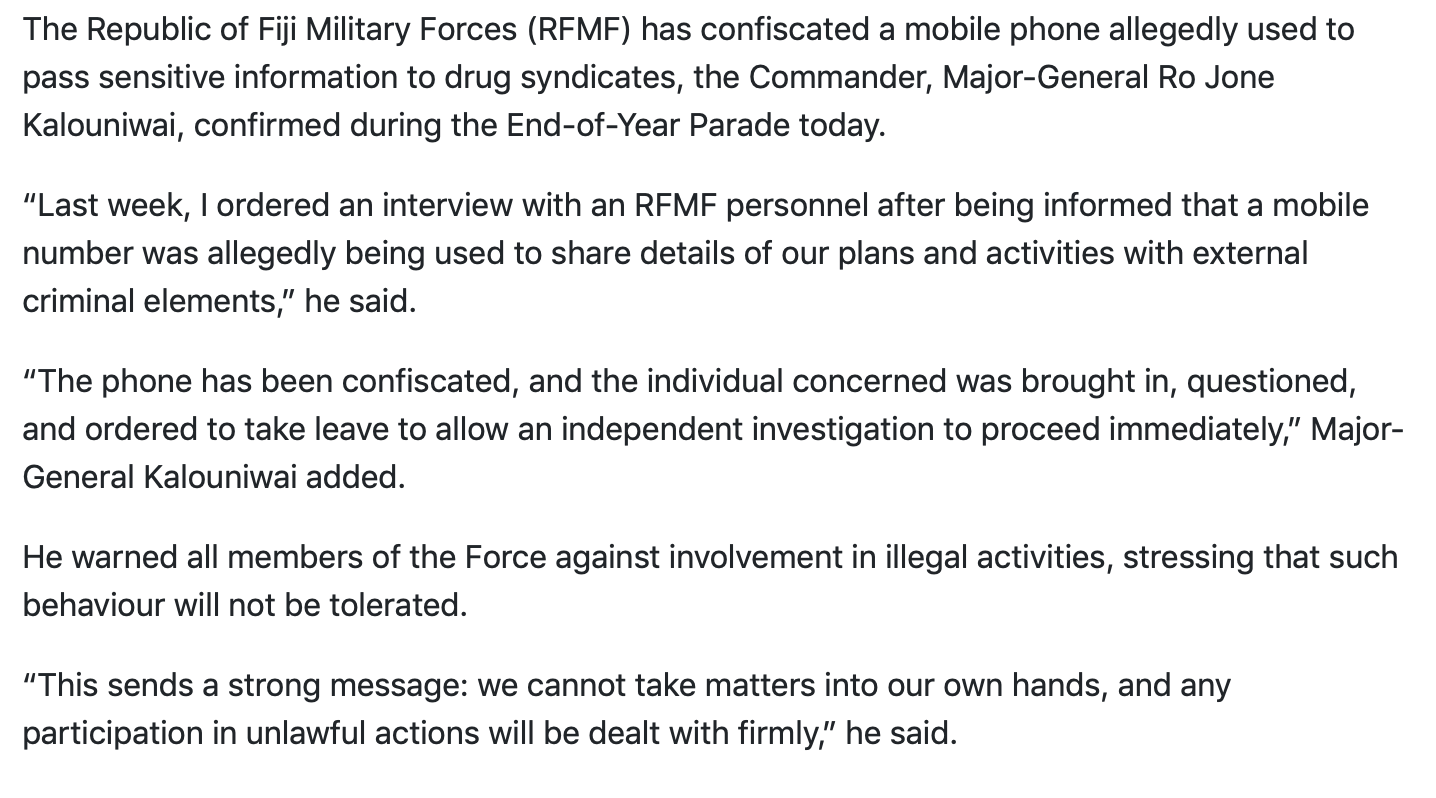
That corruption has now extended to the military itself with Kalouniwai’s admission that he has had to discipline one of his own soldiers for passing confidential information on anti-drug operations to ” external criminal elements”. (see below)
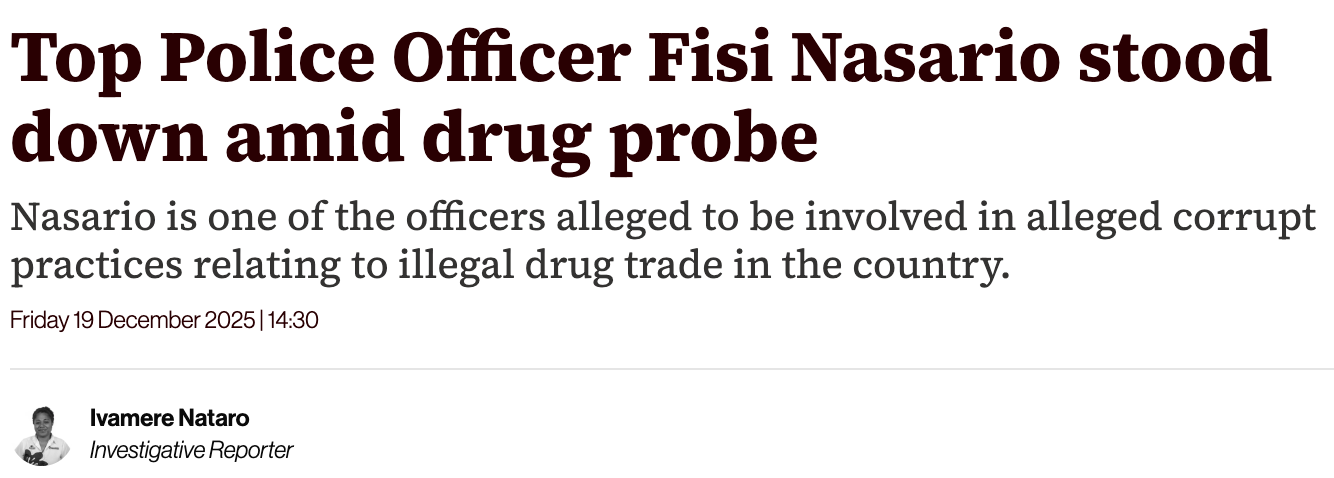
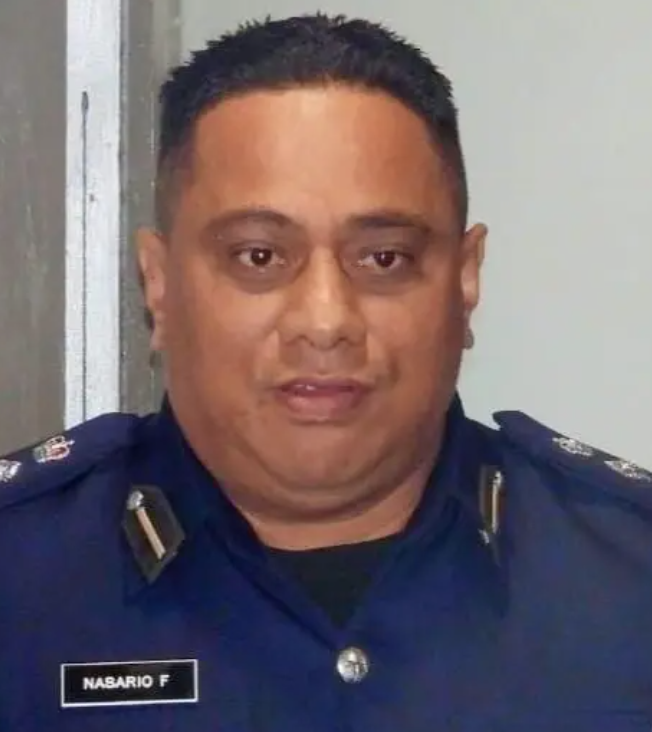
It also comes as the allegations of police involvement in the drug trade by the Sydney-based whistle-blower, Alexandra Forwood, have claimed their first scalp – the suspension of one of the nation’s most senior police officers, Fisi Nasario, the Head of the Serious Organised Crime and Intelligence Department (SOCID) (also see below)
The RFMF Commander says Brigadier General Gadai has “apologised and acknowledged his mistake” in sending the following email 10 days ago to much of the establishment, including politicians and the media, in response to group correspondence from Alex Forwood.
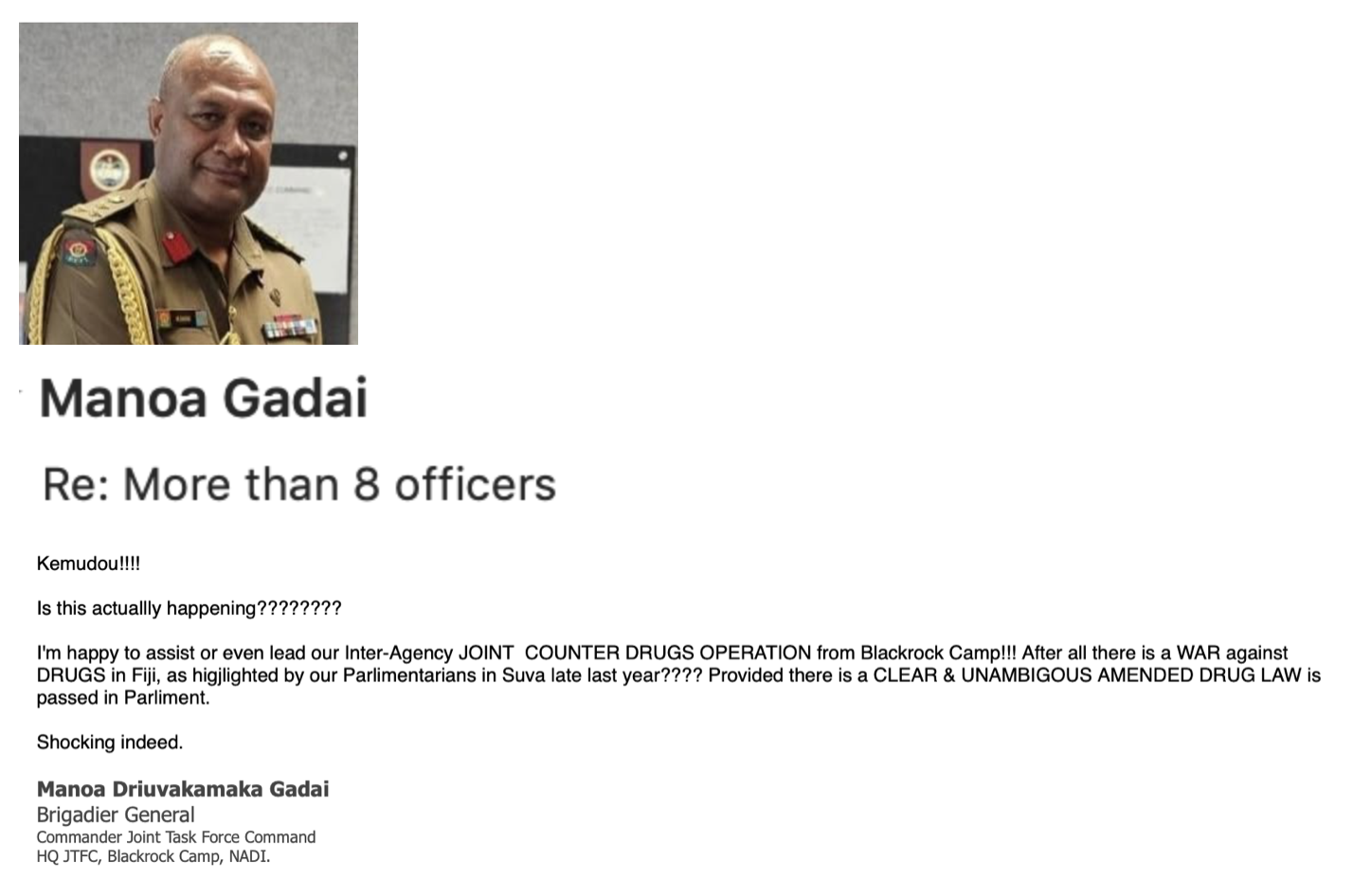
Shocked then but supposedly repentant now?
The Brigadier General may have apologised to his Commander but was that apology genuine? Has the challenge to Kalouniwai’s authority been suppressed? We shall see.
We know that Gadai’s supporters are genuinely upset with Kalouniwai. And now that the corruption of the police by drug barons has extended to the military, the pressure on the Commander has suddenly got a lot greater.

—————————-
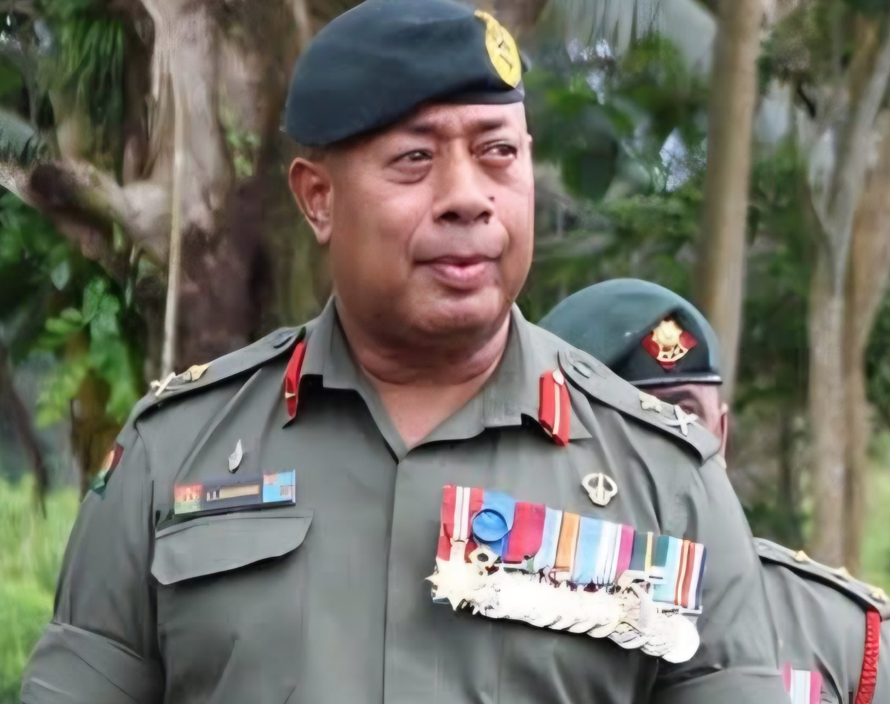
Rats in the ranks of the RFMF…

————–
…just as the crisis in the Fiji Police worsens.

NOTE TO READERS:
To be read in conjunction with our previous articles. And don’t miss the comments, which are reflecting support for Manoa Gadai and criticism of Commander Kalouniwai.
There are no divisions in the military. All are behind the Commander
Gadai made a mistake and apologised for it.
Move on folks.
That is just not true and you know it. Unless you are deliberately here to engage in spin.
At no stage in his comments does the Commander say that the RFMF is unified under his leadership. He can’t say it because it is not.
But you are in Sydney and I am in Fiji. My brother is a soldier.
The Commander does not have to say that the RFMF is unified because it is.
It has not broken apart under Kalouniwai as you wish it to be so.
I don’t wish anything to be so other than for the nation’s institutions and offices of state to function properly. And the proverbial Blind Freddy knows they are not.
Move on ARMY VET, the subtext is painfully obvious. Loyalties are divided among the rank.
Kalouniwai doesn’t want a repeat of 1987, where RABAKU unceremoniously dumped his senior officers to execute his coup.
The fact that you are coming out and saying this is an indication that not all is well. History repeats itself and it most certainly will again. The first round of coups were racially motivated against Indians. The subsequent take over in 2006 was a tussle between itaukeis – so will the future ones. It’s no longer about Indians, it’s a fight to grab power within the itaukei elite with RFMF heavily involved.
Only time will tell whether you are lying about no rift within the RFMF.
The respected Commander RFMF could have perhaps managed his communication differently whilst asserting his authority.
There was NO need to belittle the good Brigadier Gadai in public whilst acknowledging his genuine concerns on drugs.
This has the potential to create more rift. Rabuka made it worse by sensationalizing it through his FaceBook post last night. Anyways, hope it remains stable.
U.S. Army General Douglas MacArthur was relieved of command by President Harry Truman in 1951 for publicly contradicting and criticizing official policy during the Korean War. This incident arose amid escalating tensions in the conflict, where MacArthur’s insubordination not only challenged presidential authority but also risked broader geopolitical escalation.
MacArthur publicly disagreed with Truman’s limited-war strategy in Korea, that aimed to contain the conflict and avoid a wider war with China or the Soviet Union. Instead, he called for a far more aggressive approach, including bombing bases in Manchuria, blockading China’s coast, and potentially expanding the war into Chinese territory. Such proposals directly contravened the administration’s policy of restraint, that was designed to prevent the Korean War from spiraling into World War III, and MacArthur’s outspokenness fuelled domestic political divisions at a time when unity was critical.
MacArthur’s actions not only embarrassed the administration but also violated the fundamental U.S. constitutional principle of civilian supremacy over the military, as enshrined in Article II of the Constitution, that designates the president as commander-in-chief.
President Truman relieved MacArthur of command, stating, “I fired him because he wouldn’t respect the authority of the President. I didn’t fire him because he was a dumb son of a bitch, although he was.” This action established the unforgiving principle that public dissent from the chain of command is intolerable, reinforcing the necessity of military subordination to civilian leadership to maintain national security and democratic governance. Truman’s decision, though controversial at the time and sparking widespread public backlash including calls for his impeachment, has since been vindicated by historians as a pivotal defense of constitutional order, preventing potential military overreach that could have undermined U.S. foreign policy.
This historical precedent underscores the gravity of recent actions within Fiji’s Republic of Fiji Military Forces (RFMF) involving Brigadier General Manoa Gadai and Major General Jone Kalouniwai. Brigadier Gadai, as Commander of the Joint Task Force at Blackrock Camp, made unauthorized public statements offering military leadership in the national drug enforcement efforts, proposing a greater role for the armed forces in civilian law enforcement without prior approval through proper channels. While his concerns reflected genuine alarm over the escalating drug crisis—described by RFMF leadership as an existential threat to Fiji—these statements bypassed the chain of command and risked blurring lines between military and civilian responsibilities.
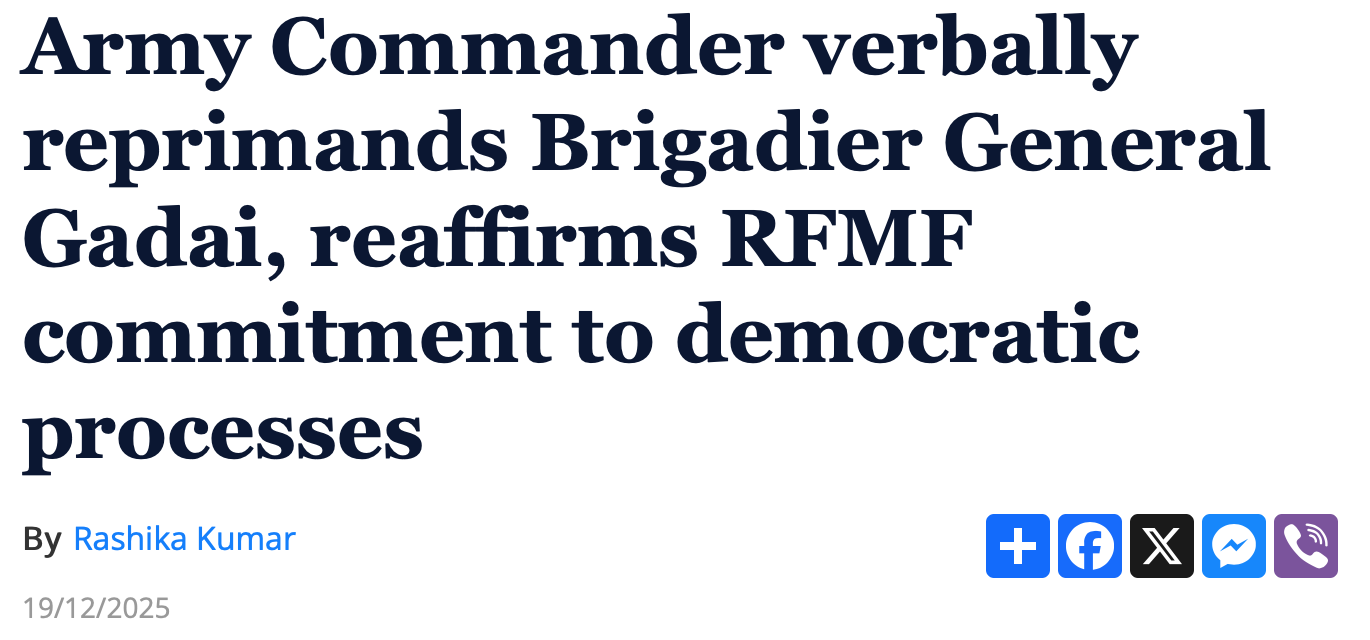
In response, Major General Kalouniwai publicly addressed the matter, confirming a breach of protocol and a verbal reprimand, while endorsing the underlying message and noting Gadai’s subsequent apology. However, by handling this disciplinary issue in a public forum during the RFMF’s end-of-year parade, the Commander himself aired internal matters externally, potentially amplifying perceptions of division at a sensitive time.
These events violate core principles of subordination and good order, essential for military effectiveness in ensuring unified action and preventing operational confusion. As upheld in Parker v. Levy (1974), a landmark U.S. Supreme Court case, the military may punish speech that undermines obedience, holding personnel to stricter standards than civilians under the Uniform Code of Military Justice. The Court affirmed that such speech could impair discipline and loyalty in ways that civilian free speech protections do not fully extend, given the armed forces’ unique hierarchical needs.
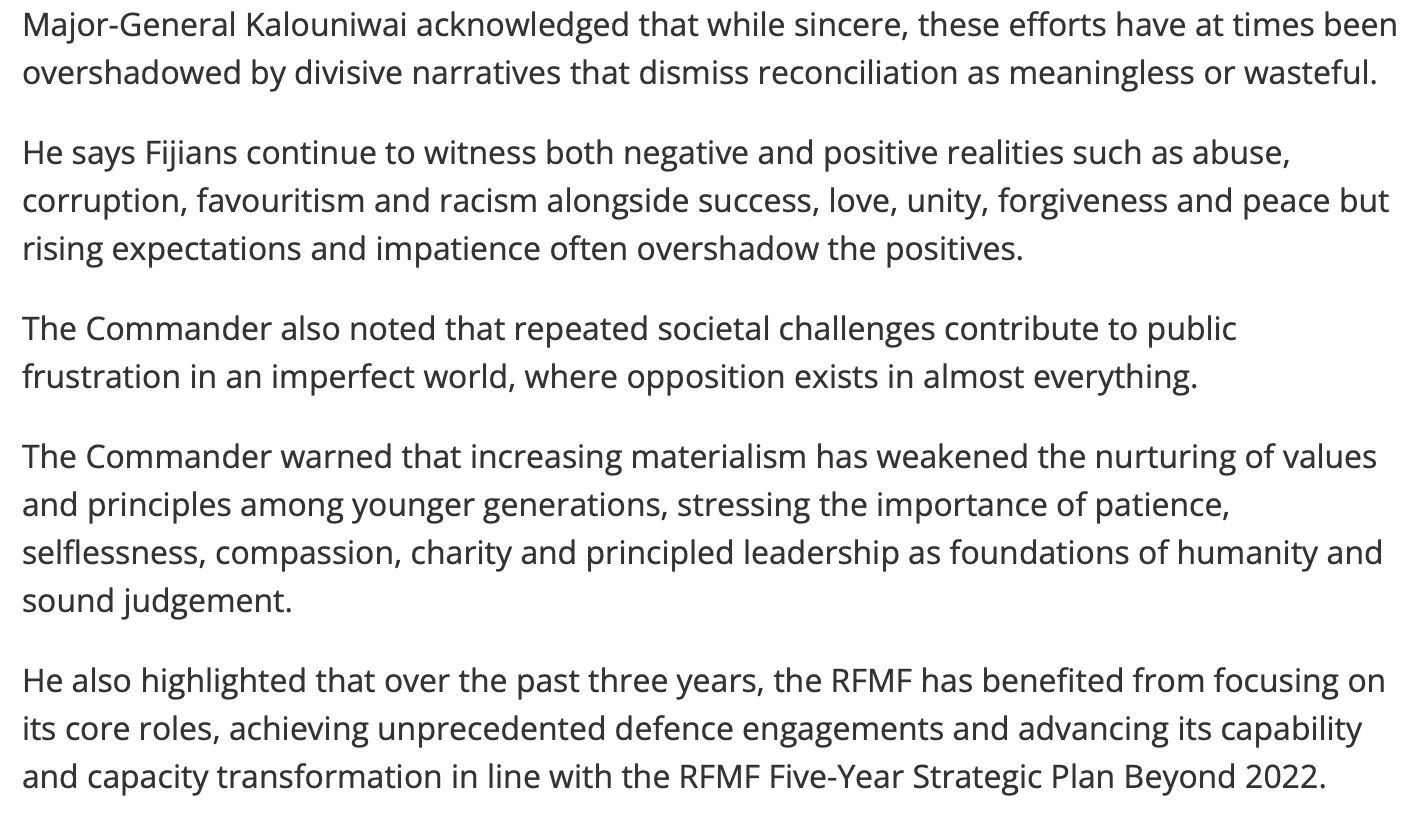
In the context of Fiji’s military history—marked by past political interventions and an ongoing push for reform under Major General Kalouniwai’s leadership, including reconciliation efforts, pledges of civilian supremacy and a commitment to breaking the cycle of interference — the handling of this incident presents a critical test. The RFMF has repeatedly emphasized a “fresh start,” with vows of transparency, accountability and strict adherence to democratic processes and the chain of command.
How Fiji’s leadership responds— whether through robust internal accountability for both men that reinforces these principles without exception, or through leniency that might undermine them — will reveal whether this talk of renewal and professionalism represents a genuine transformation, or merely rhetoric.
Decisive action to uphold discipline consistently could strengthen public trust in the institution’s evolution; inconsistency risks eroding it further. This moment, therefore, serves as a defining opportunity for the RFMF and the nation to demonstrate serious commitment to a professional, apolitical military dedicated to serving all Fijians under civilian oversight.
Should lay people in Fiji never trust a chief? This one seems to have no brains or courage! Publically humiliating a popular officer is a disaster. This major general is neither patriotic nor working in the best interests of the majority Fijians. Rather it shows the divide between chiefs and general population and this man is protecting the chiefs and a corrupt PM.
To conflate WWII history to current local problems is disingenuous at best, and worse, an attempt at diversion.
In contrast, Fiji is unique and stands alone as a corrupt nation like no other.
Four coups, four constitutions, a violent, tragic, military mutiny are enough to blow your attempt out of the water, to smithereens.
Not to mention, we have a treasonous PM with several treasonous ministers, a treasonous pedo president, and ex-high ranking treasonous military men pretending to be civil servants propping up a coalition of goons.
We won’t mention the farcical garbage of the military led TRC.
Our treasonous gold rolex wearing pm likes to deflect when things aren’t going well for him. He has been a clear failure so far as PM. He hasn’t been able to effectively address any crises within government or the drug crisis and related issues that the Fijian people are bearing the brunt of with a growing feeling of despondency.
The PM remains as ever a one-trick pony with his brand of racism and bigotry. It’s the same and only playbook he has ever known, and he just goes back to it; he doesn’t know anything else.
Remember, too, often it’s not just the conflict that requires a clear thinking approach.
The cause of any disagreement – in this instance, rampant illicit drugs in society with the resultant serious follow-on scourges of HIV, sexual violence, violent crimes against property, murders, general lawlessness including everyday race-based road rage, general mayhem with everyday overt racism, political corruption and police corruption that must be addressed.
Gadai is right. The treasonous PM is wrong. The Commander is wrong and must learn how to deescalate a conflict internally. Conflict management 101- Dirty laundry must not include the public.
Kolouniwai is no General MacArthur.
To be sure, Fiji will not ever come close to the founding ideals of equal rights, equal justice, free speech, free press, and democracy.
Not withstanding the abhorrent aberration of the current incumbent’s bigotry and hate-filled vandalism that’ll take a generation to correct, if not more.
The country has the advantage of a strong democratic foundation that will ensure self correction.
One wonders what Sitiveni Rabuka would be thinking if he had been in Ratu Jone’s position right now.
The irony of the RFMF commander’s comments about being completely neutral is galling for this indo-Australian Fijian.
Sitiveni Rabuka was not charitable towards Mahendra Chaudhry when Chaudhry was PM.
I hope Karma eventually gets Rabuka in the end.
Come on Gadai for some Karma please!