

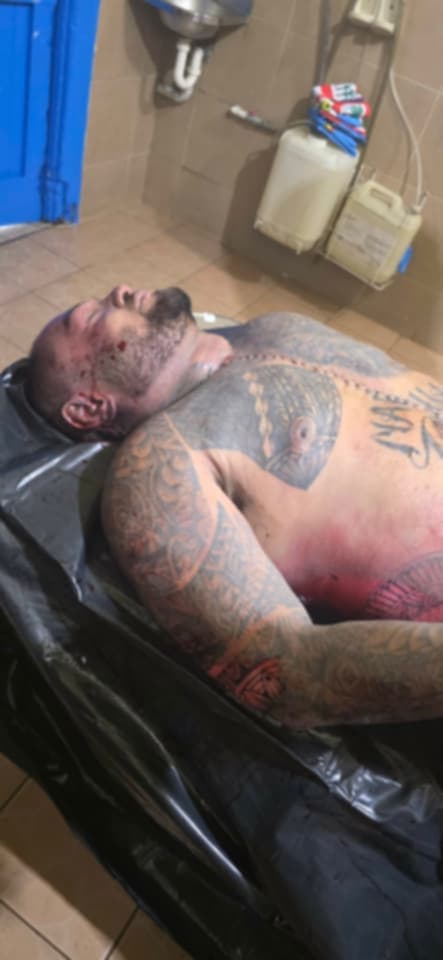
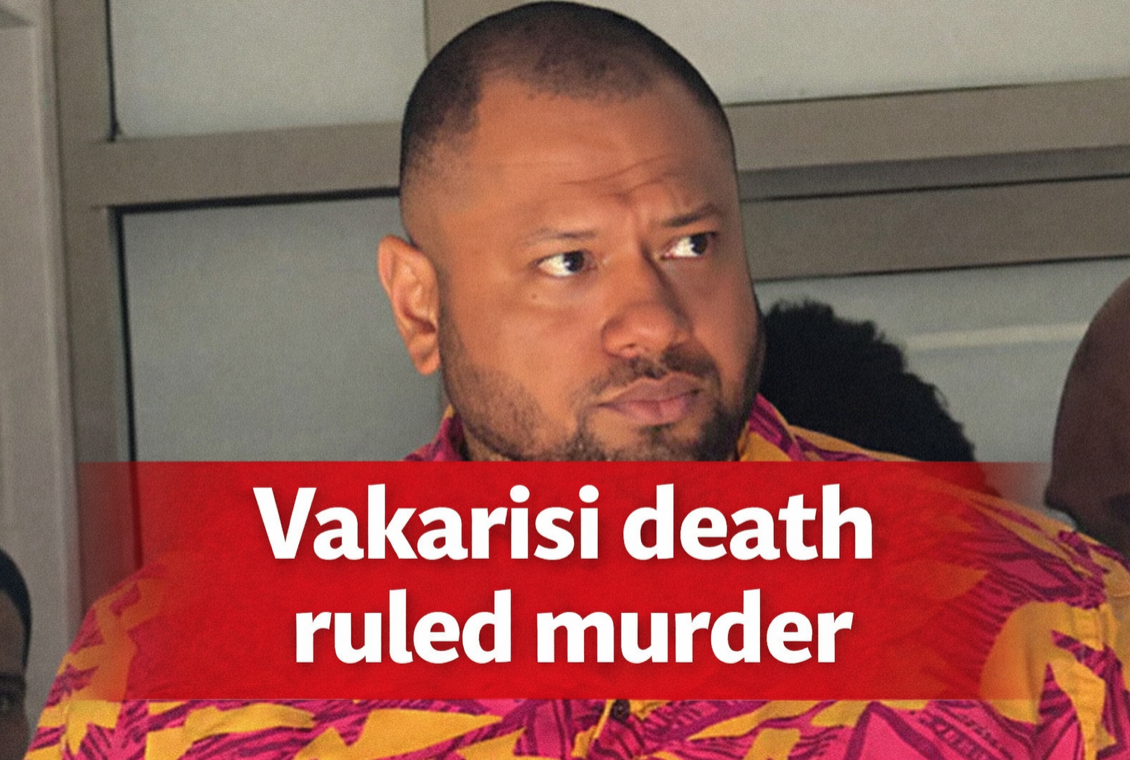
Grubsheet is today taking the unprecedented step of publishing photographs of the body of the accused drug dealer, Jone Vakarisi, who was tortured and beaten to death while in the custody of the RFMF three weeks ago.
We are doing so in the public interest and having established that this is with the knowledge and approval of Vakarisi’s family. Why is it in the public interest? For the following reasons:
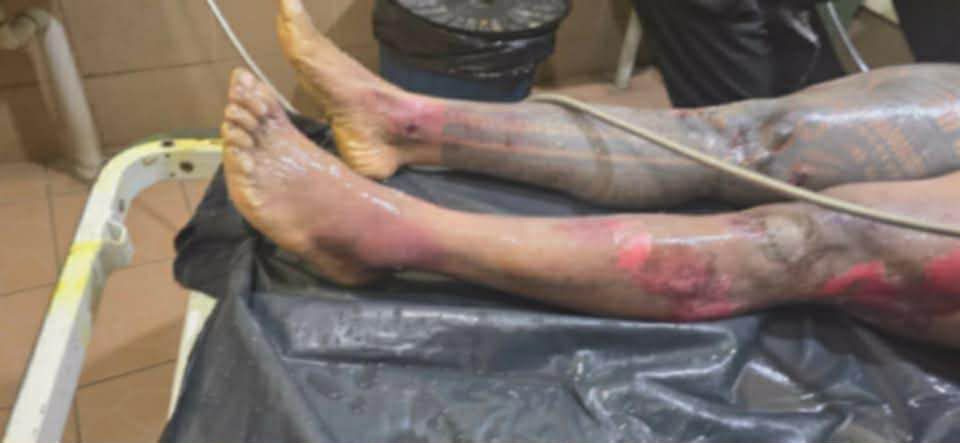
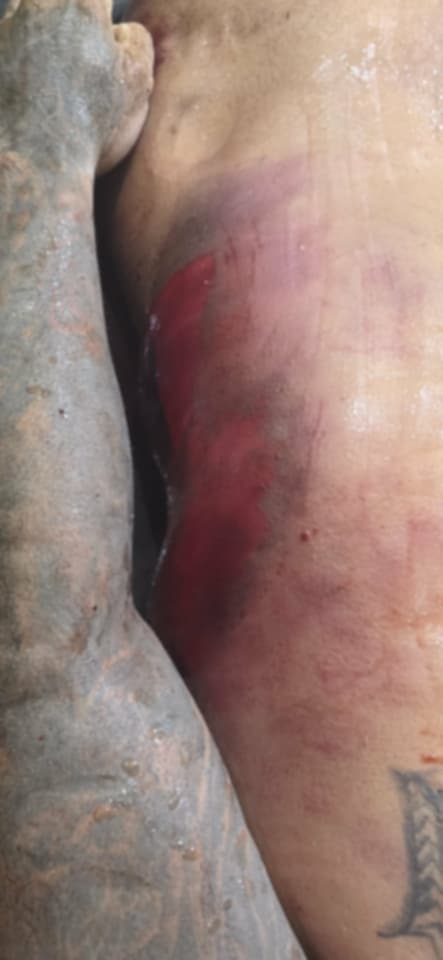
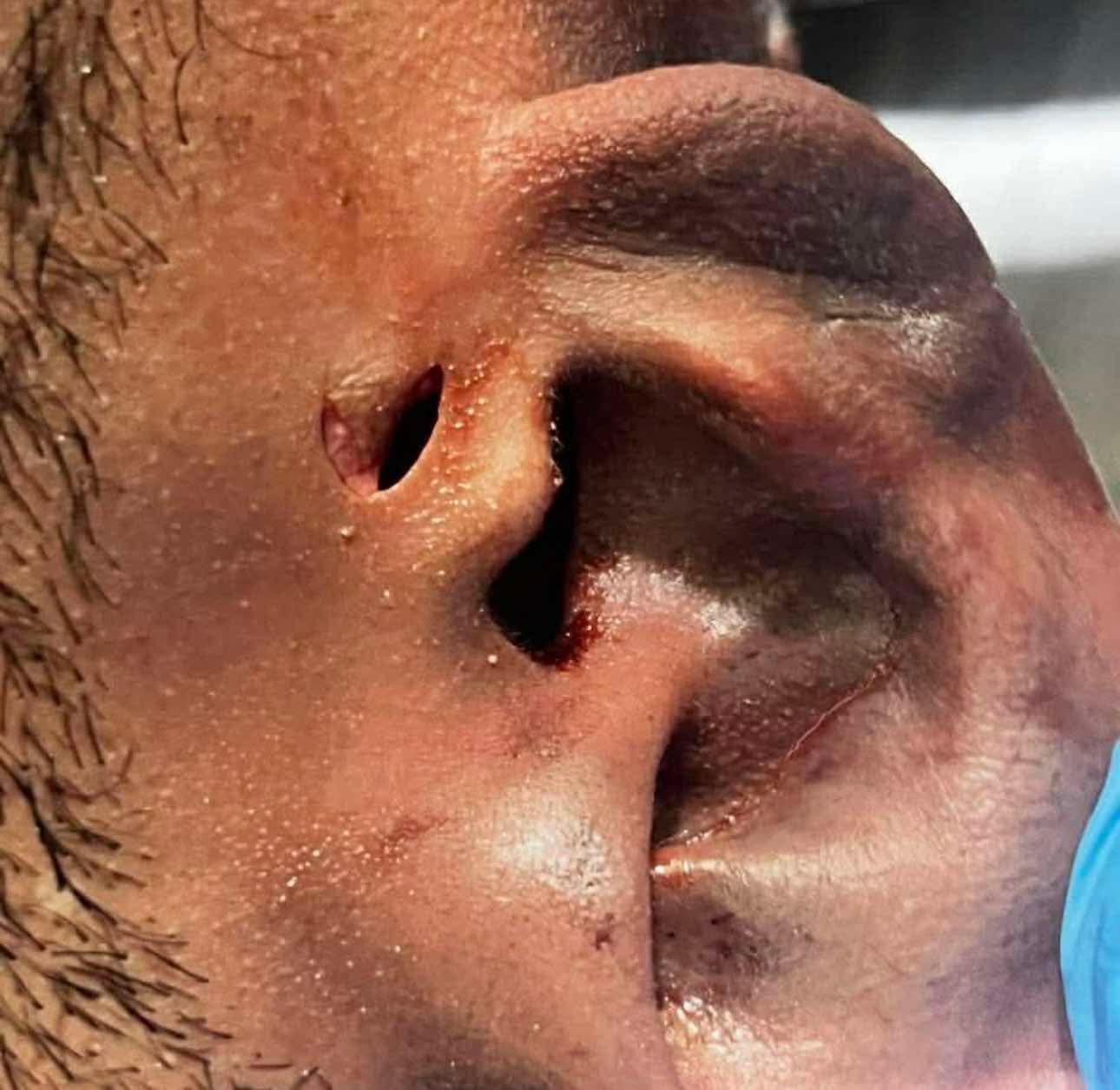
- There is evidence in the photographs of injuries to Jone Vakarisi in addition to those caused by the beating he received that were revealed in his death certificate. They include burns to his body evidently caused by boiling water being poured on him. There are also stab wounds visible near an ear and on one of his legs.
- There was a clear attempt by the RFMF to cover up the circumstances of Vakarisi’s death. The RFMF Commander, Major General Ro Jone Kalouniwai, issued a statement saying he had died of a “sudden and severe medical emergency” caused by a “pre-existing condition”. This was a lie and was proven to be so within hours of the Commander’s statement when Vakarisi’s death certificate surfaced signed by Dr James Kalougivaki – reportedly Fiji’s sole specialist forensic pathologist, whose expertise is unquestioned.
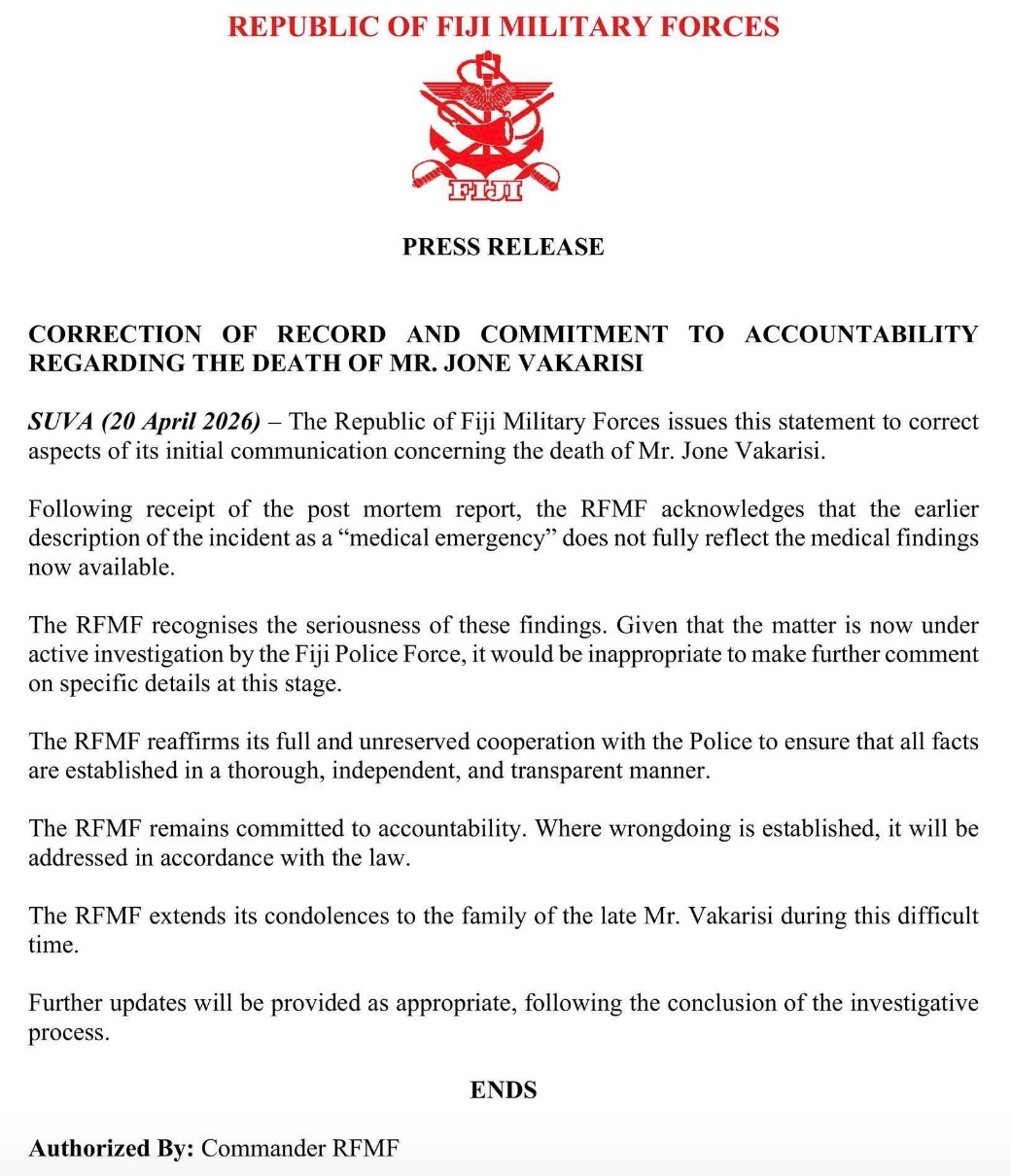
- Ro Kalouniwai was forced into a humiliating backdown in which he issued a second statement acknowledging that he had provided the public with a false account of the circumstances of Vakarisi’s death, though this made no mention of the fact that he had been tortured and killed in RFMF custody.
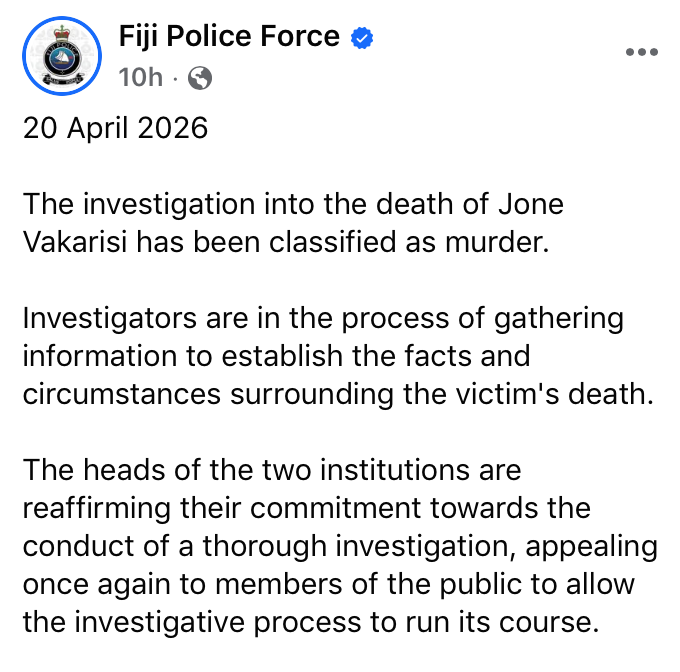
- At the same time, the Police Commissioner, Rusiate Tudravu, issued a separate statement describing the killing as murder and said a police investigation had commenced. Since that statement 19 days ago, no-one has been suspended – least of all the RFMF Commander for misleading the nation – the police have issued no further statement on the progress of the investigation and the story has largely disappeared from the Fijian mainstream media.
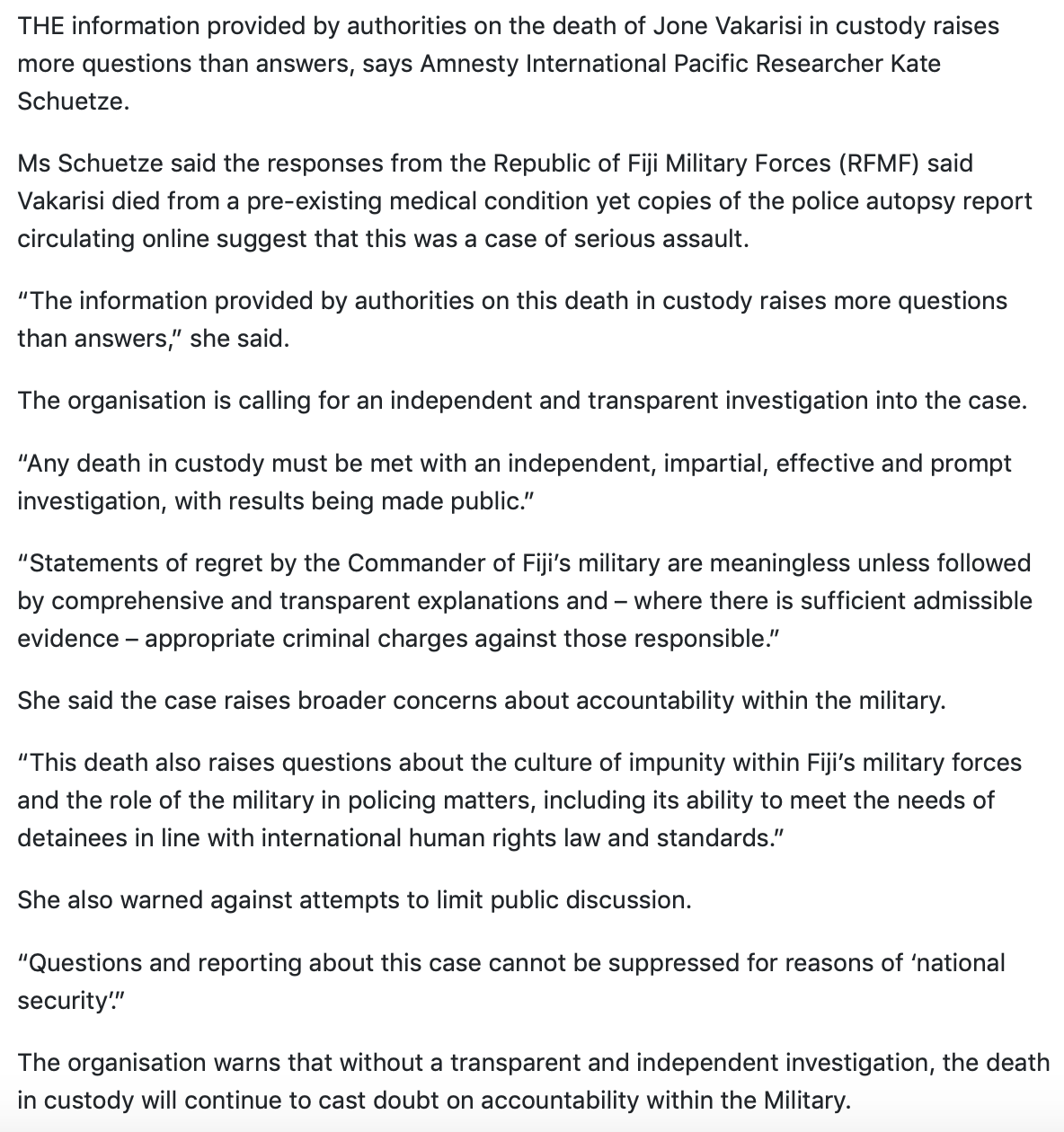
- Condemnation of the extrajudicial killing has come from Amnesty International but while its statement was reported by the Fiji Times, large sections of the media – including those outlets receiving taxpayer funds as “public service” payments – ignored it. Most senior politicians have also chosen not to comment and there has been no condemnation from foreign governments. The Australian Foreign Minister, Penny Wong, and Canberra’s Pacific Minister, Pat Conroy, were in Suva during the week and said nothing about the Vakarisi killing even though Australia has been vocal about extrajudicial killings in countries such as Indonesia and the Philippines. To its shame, the local mainstream media didn’t raise the issue with them at all.
- Since the Vakarisi murder, the government – including the Prime Minister, Sitiveni Rabuka, and his Information Minister, Lynda Tabuya – have introduced a new word into the information lexicon – “mal-information”. According to the government, this is when something is true but is capable of causing harm to the reputation of others. Grubsheet has described this as Orwellian – a crude authoritarian tactic designed to inhibit legitimate public debate and inherently undemocratic.
- True to form, the Coalition’s Online Safety Commission issued a statement last night condemning the circulation of the following images and urging “social media administrators and platform operators to take prompt action to prevent continued dissemination of the material”. That statement (see below) suggests that the Online Safety Commission will be taking action against anyone on Facebook who shares the images and will be asking Facebook’s owner – Meta – to purge the material as contrary to its community standards and perhaps terminate their accounts.
- After careful consideration and having consulted three senior lawyers, Grubsheet has decided to publish these images on the basis that they are clearly in the public interest. Jone Vakarisisi should have been in police custody, not in military custody at the Queen Elizabeth Barracks. The police, not the military, should be leading the joint police/RFMF operation against the drug trade. That the RFMF Commander lied about the circumstances makes him unfit to hold the position and as we have said before, he must resign or be sacked. And the failure of the mainstream media to hold the authorities to account and the government’s attempt to suppress the free flow of information is inexcusable and must be confronted.
You have the choice not to see these images by clicking off this page now. But they are important in raising serious questions about the conduct of the security forces and the government. They are also a sad reminder that 26 years after some of the 2000 mutineers were beaten to death by loyalist troops, nothing has changed in Fiji. Contrary to the claims of politicians and the RFMF Commander that the military has entered a new era of discipline and accountability, the buturaki culture in its ranks continues to thrive. The buck for this also stops with Ro Kalouniwai, just as it was laid at the feet of Frank Bainimarama in 2000.
For more than two decades, there have been calls for those responsible for the extrajudicial killings in 2000 to be brought to justice. The same applies in this instance if not more so. Because the 2000 killings were retribution in the heat of the moment for the murder of innocent loyalist troops. This killing was during a routine interrogation at the Camp that should have been governed by clearly-defined rules of proper conduct.
The fact that Jone Vakarisi was allegedly involved in the drug trade is no excuse for his murder. Those who ordered his torture and those who killed him must be brought to justice. And the RFMF Commander should also pay for his deception with his job if the rule of law and proper standards of conduct, transparency and accountability are to be upheld.
There’s an old saying that sunlight is the best disinfectant. And Grubsheet, for one, intends to shine whatever light we can on this scandalous violation of human rights and the rule of law.

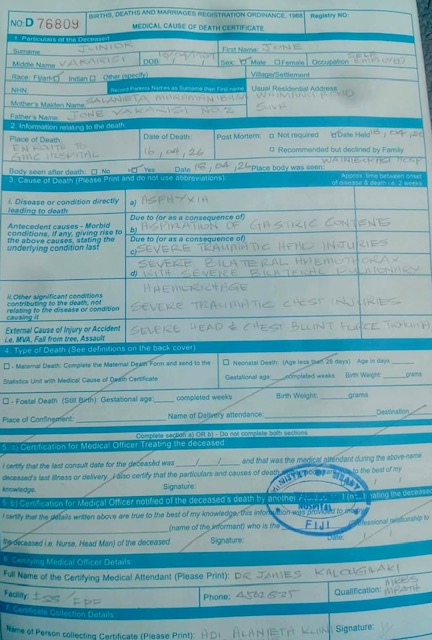
The official findings of the cause of death.

The full death certificate signed by Dr James Kalougivaki that was provided to Jone Vakarisi’s family.
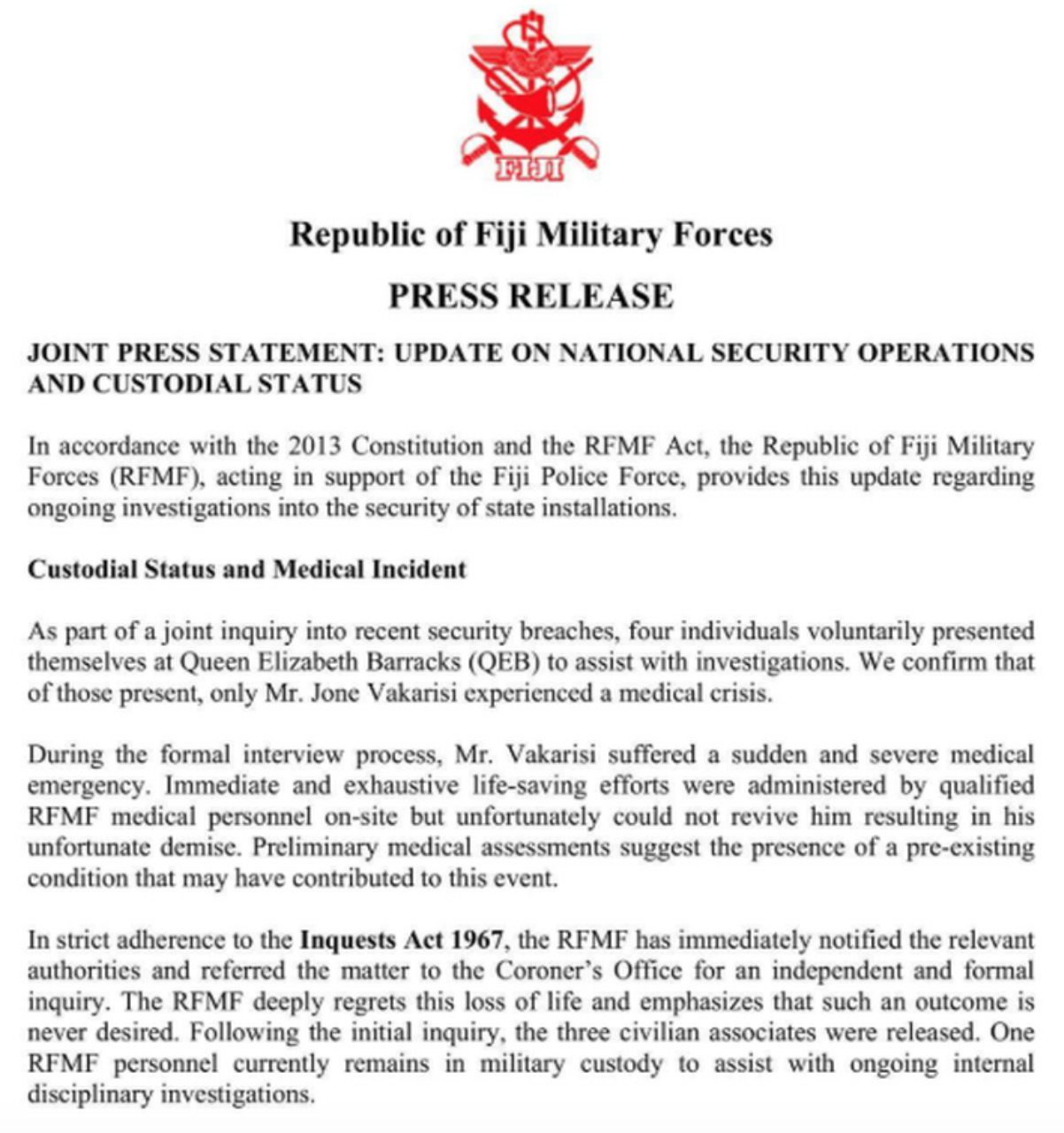
The RFMF Commander’s initial statement.
The Commander’s second statement after the release of the death certificate.
The Police statement. But no further statement on the progress of the “investigation” almost three weeks on.
Last night’s warning from the Online Safety Commission. It is a warning Grubsheet has chosen to ignore in line with our duty as a journalist to our readers and the truth.
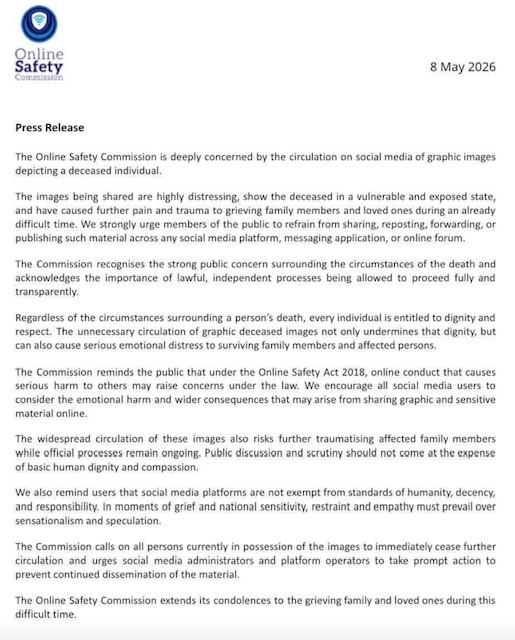
That statement was in response to a wave of Facebook postings during yesterday afternoon and evening.
Note the number of “shares” on just this one posting by New Zealand-based lawyer Rajendra Chaudhry as of this morning. (1,400)


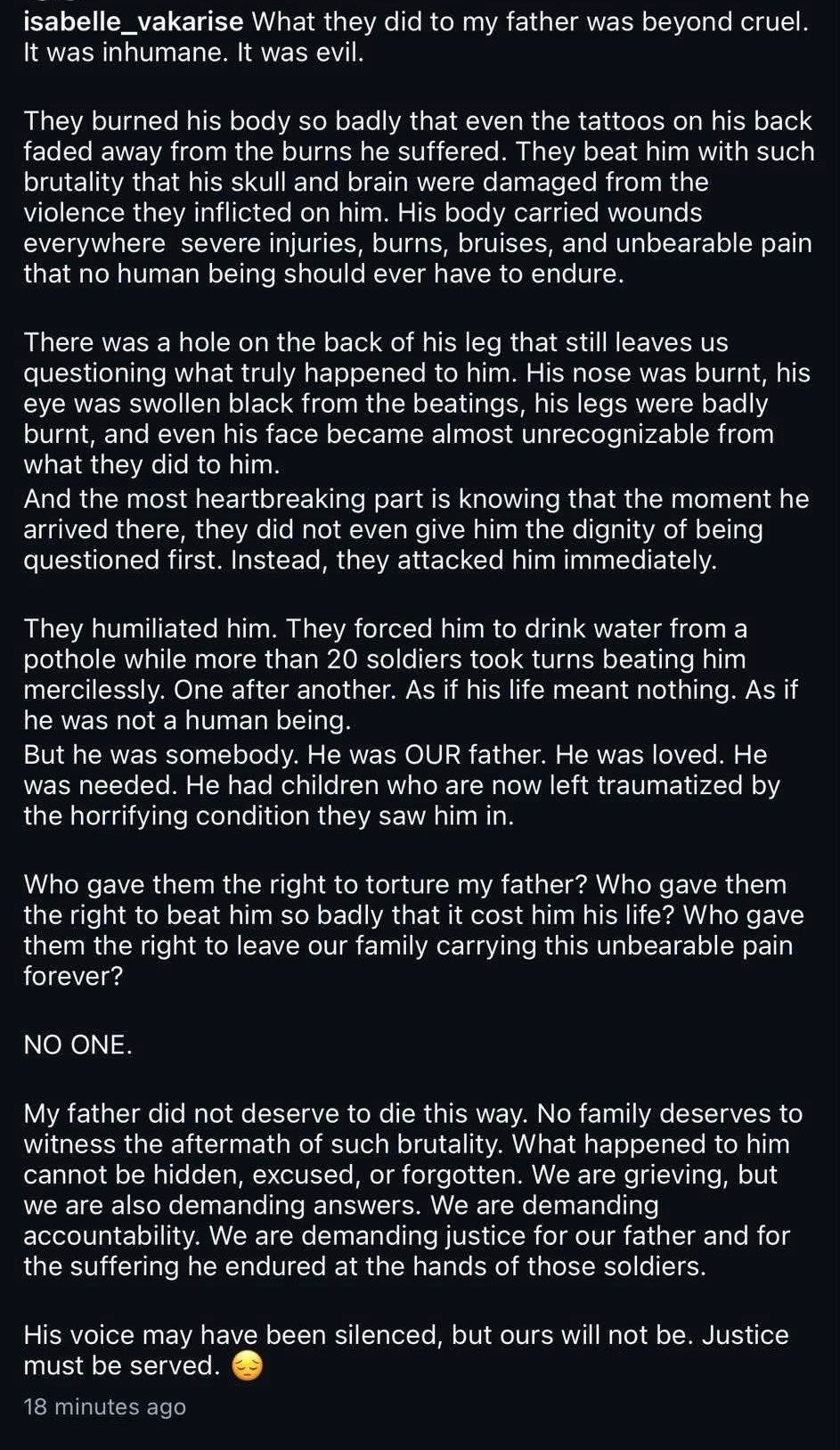
A Facebook posting yesterday from Isabelle “Vakarise”, Jone Vakarisi’s daughter.

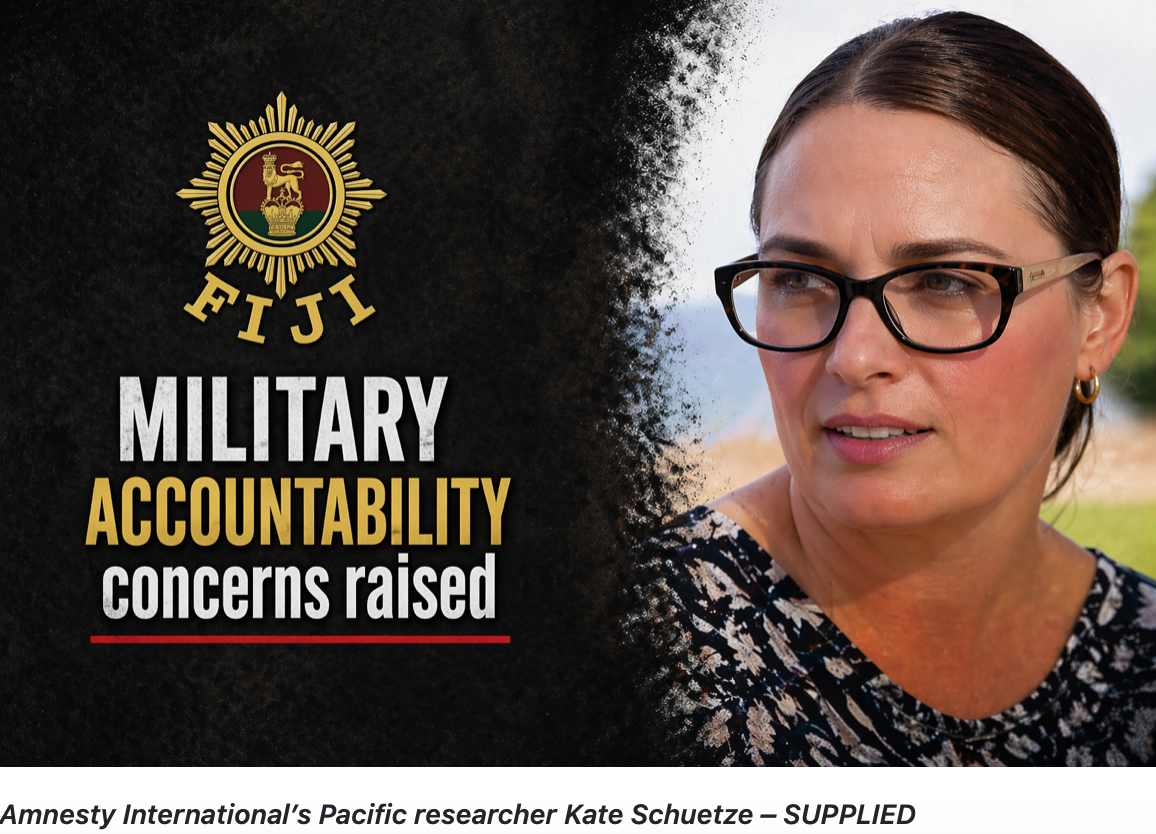
Finally, the Amnesty International statement that was ignored by much of the Fijian mainstream media, though not the Fiji Times.
The silence from foreign governments – and especially Australia and New Zealand – has been deafening. Is keeping Fiji out of the clutches of the Chinese more important than human rights?
THIS HAPPENED UNDER A CIVILIAN GOVERNMENT RULE.
LET THAT SINK IN.
________________________________
A civilian dying in military custody is not merely a tragedy; it is a damning indictment of a system that has forgotten the most basic boundaries of lawful authority. A civilian is not a battlefield captive, not an enemy combatant, and not a trophy to be passed through the hands of soldiers. If the deceased was suspected of wrongdoing, the lawful destination should have been clear: police custody, formal arrest procedures, access to due process, and the protection of civilian law. Instead, the person ended up under military control — a place where no civilian should be casually deposited — and now a life has been lost in circumstances that demand more than sympathy. They demand accountability.
What makes this even more intolerable is that this did not happen under a declared state of emergency, martial law, or some extraordinary suspension of normal civilian order. This happened under ordinary civilian rule, where the Constitution, the courts, the police, and the civilian justice system are supposed to function. That distinction matters. In a democracy, the military is not a substitute police force. Its role is not to detain civilians as a matter of convenience, intimidation, or administrative laziness. When civilians can be taken into military custody during normal times and later turn up dead, the line between lawful governance and coercive rule begins to rot from the inside.
The death of this civilian must not be buried beneath official language, procedural excuses, or vague promises of an “internal inquiry.” Internal inquiries are not enough when a civilian dies in the hands of an institution that should never have held them in the first place. The public deserves to know who authorised the detention, why the police were bypassed, what happened while the deceased was in custody, who was present, and what chain of command allowed this failure to unfold. Anything less would be a performance of accountability, not accountability itself.
This is not just about one death. It is about the dangerous normalisation of military involvement in civilian life. When military custody becomes an option for civilians outside a state of emergency, the rule of law is weakened, police authority is undermined, and citizens are left wondering whether their rights depend on the mood of the uniformed officer standing in front of them. A civilian government that allows this to happen must answer for it. Not with slogans. Not with condolences. Not with silence. With names, evidence, prosecutions where warranted, and a firm guarantee that no civilian will again be swallowed by a military process where only the dead can testify to what went wrong.
Thanks chatgpt. Honestly why bother using AI for an anonymous comments section? What does it gain you?
If your only rebuttal is ‘AI wrote this,’ I’ll take that as a compliment.
How to you expect an institution trained to kill to response to someone who barges into camp trying to steal weapons?
These are not police officers. Solders operate blindly via command and military training instincts. Eliminate threat that comes its way. Vakarisi effed around and found out big time. Military response was legit.
Not a single shred of evidence has been presented to support the claim that Vakarisi tried to steal weapons from the armoury. If the evidence is indeed available, then the only competent authority to test it is the Court, and not the brutish thugs in Delainabua who only know how to kill and torture.
I think the army is divided. Kalouniwai has lost control hence his silence. His contract also expires in September and maybe he wants another term and is trying to please the government and the mobs who are out for blood.
Pio and Tudravu merely let out squeaks every now and then.
The junior officers are a law unto themselves. They are not listening to the police, the commander nor the lawyer that recently spoke about brutality on his client.
Fiji is spiraling out of control and the world is watching.
I expect Grubsheet to censor me, if not, mock me, this is his right, this is his blog.
Our difference is , foreign policy or better stated, loyalty to West or East.
Until there is revolt from the inmates of the West, my appreciation, trust and honour is the peoples and governments of the East.
The Governments of the West are occupied and their ethos is lie, cheat, steal,sanction, destroy, kill, exterminate, the chosen.
“In line with INTERNATIONAL human rights laws and standards” Kate Schuetze . Amnesty International. bwahahaha.
Where have you been, living under a rock?
The West has in no uncertain terms burned international law. Stop pushing hypocrisy, propaganda, we Fijians are not stupid. iTaukei are especially astute at seeing, detecting bullshit, whether they choose to go along with it or not is conscious decision.
FEAR: Unfortunately, Fijians are subject to a huge amount of fear, to the point it is debilitating. ( there is a paper here, a Doctorate in it. maybe there is one already out there?)
NO: Unfortunately, saying NO, is a horrible thing for Fijians to experience. So, a straight answer is not what you will get. Story. True or False ? ” Cakobau , Tui Viti, gave his war canoe to Queen Victoria, so that when the inevitable kerekere came for its use, he could say it was not his to give”.
FRUSTRATION: All of us in living in Fiji , live with extreme frustration. How do we deal with it ( another paper – another Doctorate ) ? With extreme patience as God expects, the way the world should be, until we don’t and explode ! We are human after all and frustration is something that builds and explodes. Kennedy has something to say about frustration with governments.
CULTURE: Yes, in this instance, iTaukei culture, where the penalty ( buturaki) is derided but the crime is not mentioned ( viavialevu ).
This is Fiji and Fijians have a culture and no amount of blahablahablaha by European Western hypocrisy needs to poke their dirty noses.
As for the New Zealand and Australian people, best you join China, your system of government is compromised and occupied, and you are aligned with an empire that has reached its end in all aspects, moral and power.
VIAVIALEVU: Arrogance, actually not many cultures ( cultures with values) abide this trait beyond a certain measure. iTaukei are very patient, and then they are not and the result of pent up frustration is explosive.
COMMUNAL: iTaukei culture is communal, and communal societies have law. At the Deed of Cession , iTaukei agreed to abide by English Law and they handed over a club, the final arbiter of law up to that time. Under Colonial government, there was allowance for native, communal law. This was removed prior to Independence, and now there is no place for communal law, culture or sensibilities.
ARMY: The RFMF, the melting pot of iTaukei people, common man and chief , different dialects from across the country with sensibilities, with the Constitutional responsibility of maintaining the well being of the people of Fiji, THAT includes the iTaukei, yes the ones living in cities, they are not trash, they do not need viavialevu gangs and viavialevu gang leaders terrorizing their lives. Life is tough enough without this sh*t!. Haiti, Jamaica, Moresby are not places to be emulated, and the Army, with its pathetic, weak , spinless Commander who has no ability to say NO!, brought about a situation where the frustrations of the rank and file were by order unleashed and they dealt with the situation as they only know how.
An iTaukei army, communal, cultural, Constitutionally responsible for the State , can not stand by and let the country go from rot to putrid.
Men and women of the army, watch as these gangs in parliament oversee the demise of our country into a beggar State; to the West, to foreign billionaires, to local selected elites and worse, into a dysfunctional State; Justice System corrupt from the head down, Courts, Police and Drug Lords on the rise with tentacles ensnaring the elites of society, whilst poverty and death are the fruit.
Our regime reflects the US regime. One a President, ours a Prime Minister, both are Zionists and or surrounded by Zionists who must be the most stupid people on the planet. They both unleash their military illegally and the consequence is horrific for the rank and file.
The Commander must go, he has caused enough humiliation for the army, a man who can not say NO, on so many levels, is a humiliation for the people of Fiji.
A regime PM who wears his price on his wrist must also go, in fact, the buck should stop with him, he did not bring about a state of emergency prior to unleashing the army, to give them clear direction ( rules of engagement) and some cover of law, and this from an ex Army Commander who know better, but has obviously lost his marbles.
When one does wrong, there is a consequence, there is a ripple effect, family and beyond.
Ian, I have no desire to censor you and happen to agree with almost everything you say here except for one thing – your preference for China over Australia, NZ and other western democracies.
The people of China have no say in who governs them, the people of the West do. And I am at a loss to understand why someone like you who goes on to talk about accountability in the Fiji context would express a preference for a system of government that isn’t accountable to the people at all.
China routinely executes its citizens. Is that what you want in Fiji? The Chinese people have been under the boot of the Chinese Communist Party since 1949 and can’t do a damn thing about it. And when democracies like Hong Kong are brought under the control of the CCP, the record shows that democracy is extinguished. That’s why people like me oppose the take-over of Taiwan. For all its imperfections, democracy is far better than dictatorship.
GD,
They say there are 2 certainties in life, taxes and death.
There is one other, change!
The CCP – has evolved , since 1947.
China has been subject to a miraculous change, and all credit to the Communist Party of China.
There has never been anything like it in human history.
The One Party State, has allowed for the people to be involved and have agency in the democratic administration of the country from Village Committee all the way up to National Government. The OPS has sovereign control over the nations ability to create and direct the creation of credit, the most powerful force on earth. Just one direction taken, has been the education of the people, and with this, just in the field of engineering, they produce 4 million a year, 10 years, 40 million, 20 years- 80 million engineers.
International Law – Hong Kong is part of China.
CCP was abiding by law and treaty, until the West and a billionaire, media oligarch, started a colour revolution with the usual playbook, violence being one of them. CCP, well aware, crushed stupidity with a silk hand and saved Hong Kong from the fascist West. Hong Kong lives, the vast majority thankful and happy, except for entitled useless pampered youth who don’t have jobs. CCP will take care of Hong Kong and bring it into the fold, into the future. If the West had persisted, it would have regressed back to a backwater fishing village. Never !, CCP takes care of its people. Look to the Urghirs, being brought out of the middle ages into the 21st century, nobody is left behind in China.
Chinese are patient, Taiwan will come around, but unfortunately they have been to slow about it. Western sanctions have pushed, forced China to develop their own chip industry to do everything Taiwan and the West can do but always better. The US Inc war against Iran has shown how completely useless the States are at defending anything. Taiwanese need to take to heart Kissinger’s observation “ To be an enemy of the United States is bad, to be its friend is deadly”. Taiwanese , Japanese, South Koreans, all smart, educated, pragmatic, know what to do, stay the hell away from the Great Satan, and if the Aussies and Kiwi people had half a brain, they would do the same, being part of the 5 brown eyes could be deadly. Democracies my foot, how delusional can one get.
Alternative media in the West have coined what is happening in the West as an “Epstein Regime”.
The total corruption, moral bankruptcy and criminality across all of Western leadership is systemic, meaning, there is a system breakdown and any blind Freddy should see it.
Main Stream Media is owned by a few oligarchs and all they do, 24/7 is lie, pump propaganda and censor . Journalists within this system have been called “presstitutes”.
In Fiji, loads of money have been handed out to what might pass as our msm.
Writers, who become carrier journalists and public relations people must tow the line, its a living, the West has expectations and loyalty is a must.
Change.
Was Jone Vakarise’s death in custody a spontaneous act of violence—or the logical outcome of contradictory policy flowing from the very top?
In the weeks before the incident, two radically different strategic frameworks emerged from Fiji’s leadership. They were never reconciled. The result was not just confusion, but dangerous role ambiguity at operational levels—with fatal consequences.
Two playbooks, two worlds apart:
· Counter-Insurgency (COIN) Playbook – followed by the military. It assumes an embedded, elusive enemy operating among civilians. Its core principle is discrimination: identifying, isolating, and capturing specific combatants while minimizing harm to bystanders. Detention is for intelligence extraction, not punishment. Force is calibrated, controlled, and constantly reviewed.
· Hybrid War Framework – announced by the Minister. It treats the threat as diffuse, existential, and state-directed: cyber, economic, political, and conventional tactics combined. Under this lens, everyone is a potential asset or threat. The response is total societal mobilization, blurred lines between enemy and citizen, and suspension of normal legal constraints. Detainees become combatants. Harsh treatment becomes “necessity.”
One is a scalpel. The other is a sword.
Now ask: What happens when the Commander is operating under COIN logic—targeted, restrained—while the Minister publicly declares a hybrid war, and the Prime Minister is not aware, not aware enough to clarify something so vitally important to the nation? What does a junior soldier or cell guard understand? That detainees are rights-bearing suspects? Or enemy combatants in a war without end?
This policy vacuum—between the Commander and the Minister, between the Line Minister and the Prime Minister—did not merely permit abuse. It invited it. If senior leaders cannot agree on whether Fiji is in a police operation or a total war, tragic outcomes in custody are not anomalies. They are inevitabilities.
Vakarise may have died in a cell. But the failure began in a Cabinet room. A full Committee of Inquiry is needed, otherwise some poor sod wil take the blame.
Cry me a river.
You live by the sword, you die by the sword.
Where was his family when he was brutalizing one and all?
The only way that the truth will come out is to fly in two trained and experienced CID Detectives from Australia or New Zealand. Give them access to what has been ‘ investigated’ so far and give them full rights to carry out an investigation the way that it would be done in a civilised country.
It could be a training exercise for the local guys to see how it is really done when you want to solve a murder case and not just go through the motions and then give up, when it becomes too hard or outside pressure shuts you down.
This is the only way that will provide all the relevant parties with the facts they are seeking and get justice for a family who have had a family member killed by a government entity. The person or persons who carried out this heinous crime need to be found and held accountable. And the person in charge of the perpetrators should be removed from their position, immediately.
Will that happen? No, of course it won’t. This is Fiji.
Some of us have known Vakarisi from the time he commenced his criminal journey…from being a petty drug peddler to becoming a drug lord and leading a gang…I can guarantee that he was not a good man in this regards.
Having said that, we all know that he was someone’s son, someone’s husband, someone’s father and so on….In a country which follows good governance, rule of law and is governed under democratic principles, the military has no authority to investigate during peacetime…that is a Police job…he was not supposed to be in the Military camp but in Police custody.
He didn’t deserve the treatment he received…If he was shot breaking into the Military magazine, that would be another story…but not dehumanized in the way it is revealed in the pictures…the soldiers are merely executioners but leadership at all levels needs to be held accountable…we are all watching what happens as far as accountability goes.
Get a grip. Accountability??!!! This happened in FIJI.
In an ideal Fiji or anywhere Jone Vakarise would not have died like this , who knows how his life trajectory would have gone , was he turning his life around from crime or would a gang war have taken it ?
Those involved in his death will be made to account for their actions and that’s 100% necessary .
Showing the graphic injuries serves no purpose .
Dead bodies if injured , all look horrific.
Who is this helping?
Already there is an element of giving an alleged criminal some sort of legend status because of how he died and not how he lived as a drug lord.
I am of the view , bodies of deceased drug addicts are also extremely distressing but we don’t see those bodies .
I feel showing these images can disrespects the pain of families of victims of those who died by drugs , they are the forgotten souls except to their families.
When criminality is present, traditional norms take on a different element.
One can simultaneously condemn how he met his death and also condemn how he lived .
It is shocking Jone died this way but I am not going to let pictures of a an alleged criminal who died violently blind me to how he lived and the misery drugs are inflicting on Fiji .
Dead bodies are powerful imagery that require sound judgement in posting .
Let the investigation process take its course .
If the criminal court releases photos , so be it .
But often they don’t for very sound reasons.
RIP Jone ..may your death be a message to all about how not to live and for those responsible for his death , understand their wrongfulness and may his family find some comfort through the investigation process
I’d remove the pictures as I don’t think they are helpful, I think everyone has a good enough imagination.
Your concerns are noted but I have made the decision in consultation with three separate senior lawyers that the public interest demands that the full extent of the RFMF’s brutality and the Commander’s lies be laid bare, and in the knowledge that this is supported by the victim’s family.
There is a degree of sanctimonious cant being peddled by some people, including Victor Lal at Fijileaks, that most of these images should have been withheld, in part to protect the sensibilities of the Vakarisi family. Yet for two decades, Victor Lal has had no compunction in publishing far more graphic images of the mutilated bodies of the 2000 mutineers who were beaten to death by loyalist forces in the immediate aftermath of the assault on the Queen Elizabeth barracks and the attempt to kill Frank Bainimarama. Incidentally, while Victor Lal has published these bloody images on multiple occasions, Grubsheet chose not to do so.
Why the double standards? That is for Victor Lal to explain. But it strongly suggests that one rule is being applied for those soldiers who, in the heat of the moment, killed mutineers in their ranks who had taken innocent loyalist lives 26 years ago and another for the officers and men who beat Jone Vakarisi to death three weeks ago during what should have been a disciplined interrogation as part of a joint police-military criminal operation.
The risible claim by the RFMF Commander that Vakarisi died of natural causes is laid bare by the brutality of the images Grubsheet has chosen to publish. But this was only one lie contained in Ro Kalouniwai’s original statement. He also said Vakarisi had voluntarily presented himself at the Camp. Wrong. He was seized by troops and taken there.
Those lies cannot be allowed to stand, which is why I chose to publish the full series of photos to lay this fallacy to rest once and for all and to make the important point that nothing has changed in 26 years. Extrajudicial killings are still part of the repertoire of the RFMF despite the sanctimonious and repeated assertions by the Commander that under his leadership, the RFMF has changed.
The record shows that it hasn’t changed at all. We await a full and proper investigation and for the perpetrators to face the full force of the law. And partly as a means to ensure that this happens and for a wider debate when the mainstream media shows every sign of being part of a cover-up, these images stay.
Mataniganisau is the answer.
Prayers and fasting is the answer.
GCC fasting and praying.
RFMF fasting and praying.
The pm fasting and praying wearing a gold Rolex.
Churches and congregations fasting and praying.
All problems will soon disappear.
RFMF Church Service today confirmed by Commander Kalouniwai that it was an accident, it never meant to happen. Those who are responsible will be held accountable.
An “accident”? Oh really? This underlines the importance of these images being published. Because anyone who sees them immediately knows that this was no accident. It was a vicious incidence of torture that was sustained and deliberate and resulted in a man’s death.
If Kalouniwai is portraying it as an “accident”, all the more reason for him to go.
Very sad indeed and my sincere condolences to the family…the government of the day must carry our an independent investigation of the matter and culprits must be brought to the justice of the law…Our Living God, Yahweh is a merciful God, He loves everyone, even the most sinful…and gives everyone the freedom of choice to follow HIM or Not, What an Amazing & Justice God….Mathew 26:52 “Then said Jesus unto him, “Put up again thy sword into his place, for all they that take the sword shall perish with the sword.”…let us be merciful and repent our sins before the coming of the LORD, Jesus Christ! Repent Fiji before its too late! His Second Coming is inevitable as His first arrival! God Bless Fiji!
The Army Commander is a big Lamu lamu and has no credibility to lead the military. He knew what happened and what caused the death but he was quick at attempting to fool the public. If the very head of institutions that are supposed to safeguard the public are compromised, Fiji has gone to the dogs.
Fiji went to the dogs when you voted in the change you wanted.
The country was given away to dogs, surrendered to mongrel dogs when we elected them and then wildly celebrated the “change” in December 2022 with the scavenger, hungry, bottle-collector dirty dog, a serial adulterer, and repeat treasonist, the one and only snake Sona Rolex.
The electorate in their infinite wisdom let loose the pack upon ourselves- a pack without breed, no class, no shame, no world view, no creed, and insatiable greed.
Examples include a baboon AG preceded by a lying saimese cat-in-hat dog AG, who was — get this– followed again by the bum-bling baboon AG.
They were joined by the all-bark-and-no-bite karia hichjra baiman kuta, and a rabid drunk mongrel kuta from the same stinky alley as the karia hichjra kuta, and their five blood-sucking puppies borrowed in from under the opposition fence — Shalen Kumar, Virendra Lal, Sachida Nand, Vijay Nath, and Sanjay Kirpal.
Crippled brains all, as is typical of cross breed twins from different fathers. Straight to the teats of public coffers. Dogs have no shame.
Together they snarled, growled, howled, charged, and mounted each other in their rush to the feeding bowl, tipping over every corruption bin along the way, with the addicted porn and weed biatch salivating for the best bone(r)s. Brutal.
To celebrate it all, there was much dancing in the streets and alleys by like-minded scavenger cross breed biatches of the NGO class–the lowest of the low.
The mangy rangy old Sona Rolex assembled a pack to match his intellect from amongst his kilavata, kaivata, vuvale, and half educated dimwits to compliment the rest of the thieving pack.
Examples include the mumble jumble speaking methnol ostrich tourism ‘head’, with a pedophile thrown in for good measure.
Point being, all these dogs together have taken the piss out of the gullible electorate, leaving not a fire hydrant dry as they go laughing like hyenas all the way to the bank.
The flea invested mutts must know every dog has its day. Your time will come.
Why do we have to hide atrocities. In fiji we tend to do just that. Hide domestic violence, rapes, murders, child abuse, corruption and practically anything that suits the narrative at that time. Some call it culture of silence. Enough of that .
The culture of silence is euphemism for toeing the line or, in native parlance, vasota ga.
Fiji has gone to the dogs.
Not so.
Perhaps a more accurate observation may be to say large packs of dogs have come to Fiji. O
It is deeply distressing to read about the circumstances of Jone Vakarisi’s death.
Regardless of any individual’s past, a death in custody is a tragedy that impacts the entire community and leaves a family in unimaginable pain.
It is a positive step to hear the Commander speak openly about accountability and the need for due process (keeping in mind the Military’s initial report on the deceased).
One can only hope that this investigation is handled with the transparency the family deserves and that it leads to a future where such tragedies are never repeated.
My heart goes out to his children and loved ones.
Speaking about accountability generally is not the same as the Commander being accountable for his own actions in attempting to cover up what happened. His public comments fall woefully short of genuine transparency and accountability.
I cannot disagree to what you have stated, Graham.
What is happening with the extra-judicial killings in the Police force and in the Army camp; one would have thought that these things only happen in despot, third world countries overseas ruled by dictators and imbeciles.
But when you think about it, that is exactly what Fiji is – for those who do not realise it.
You only have to look at the leaders and the ministers in government and the GCC.
And now they will pray and fast. Commit murder, then perform a matanigasau and bulubulu and pray and fast – the Fijian way to do things – the only way and the right way!!!. The vulagi will never understand the way Fijians do things.
Sad to see Kai viti killing Kai viti then when everything fails for them, they will turn around and blame Kai Injia and vulagis. #DVC.
The indigenous/ i-taukei/native/fijians/itaukei ni vanua/taukei ni qele, etc., have been brainwashed for generations that vulagi Indos will steal their land.
1987, 2000, methodist ethno-nationalists and extremists have reinforced the falsity over and over for many generations.
Enter porn queen Lnyduh–minister of Mal-Information and BS.
In cahoots with native “ratu” gativi “rob” cromb, rokoseru nabalarua, and hardcore entho-nationalist custodians and champions of all things itaukei: methnol tourism minister tsunami qavoka, gangsta ginger farmer lands/itaukei minister vasu, trust-funds-happy current lands minister vosarogo, director lands vuniamatana, director environment, sona rolex pm and the entire crew of sycophants dominated by ethno-nationalist natives in cabinet –you’d think they all would fiercely protect indigenous resources and lands. You’d be wrong.
All hail the charlatans of waste to energy incinerator in Naikorokoro, Saweni, Lautoka.
See: https://www.fijitimes.com.fj/opinion-i-burning-question-can-fiji-turn-its-waste-problem-into-the-answer-to-its-energy-crisis/
And not a single Indo-Fijian in sight to “steal” native lands!