
It’s a stark sign of the sorry state of Fijian democracy that we sent a whole lot of people to parliament at the last election in 2022 who haven’t reflected our choice at all when it comes to constitutional change.
More Fijians voted for Frank Bainimarama‘s FijiFirst than any other party, whose core foundation was the 2013 Constitution. Others gave the NFP five seats believing that its principal role would be to keep the bastards honest whoever won. Yet none of that has been reflected in the way the majority of MPs – 38 of them – voted in favour of Sitiveni Rabuka junking the 2013 Constitution.
Frank Bainimarama, of course, failed to take government by just one vote on the floor of the House. And when FijiFirst imploded and he and Aiyaz Sayed-Khaiyum left the parliament, the remaining MPs had a clear duty to keep reflecting the views of those who’d sent them there. Not Frank and Aiyaz but the voters. And to honour the principles they had stood for.
Fat chance. And the level of that fundamental betrayal of trust – of not living up to the promises made to electors in 2022 and defending the principles on which they were chosen – is the most stark feature of the way individual MPs voted last night to change the supreme law.
It isn’t just those turncoats who abandoned the remaining former FijiFirst MPs and were bought off by Sitiveni Rabuka – individuals such as Ioane Naivalurua and Viliame Naupoto and, unforgiveably, the Indo-Fijian defectors Sachida Nand and Shalen Kumar.
What’s notable about last night’s vote is how the remaining opposition voted – in the case of the formal Opposition Leader, Inia Seruiratu – who gets $200,000 and a house to OPPOSE – choosing instead to abstain and allow the Prime Minister to get his way.
Those nine abstentions included Seruiratu’s fellow MPs Parveen Bala, Hem Chand, Virendra Lal, Alvick Maharaj, Joseph Nand, Vijay Nath, Rinesh Sharma and Jone Usamate, who we might have expected to also take a stand for principle but didn’t.
Those abstentions have allowed Sitiveni Rabuka to triumph and pave the way for the abolition of the 2013 Constitution, which these bastards swore to uphold. Not to amend it for the common good and in line with the principles on which they were elected but stand aside and allow the chiefs to lord it over the country, the abolition of FICAC, for our children to be again beaten in our schools and the break-up of Fiji with an independence vote for Rotuma.
Yet the real bastards are those in the NFP who Fijians chose to keep Frank’s bastards or Siti’s bastards honest irrespective of the result in 2022 yet have sided with Rabuka by voting “yes”.
They are the real turncoats and traitors to the people – Biman Prasad, Pio Tikoduadua and Sashi Kiran (Lenora Qereqeretabua chose not to vote at all) And if they vote with Rabuka again at the third reading of the constitution bill in a month’s time, inshallah, they will feel the wrath of the electors when election day finally comes.
Grubsheet made a plea earlier in the week for the nation’s MPs to honour the wishes of those who put them in the parliament in 2022. That was all they had to do. Yet only five in the ranks of the opposition examined their consciences and did the right thing.
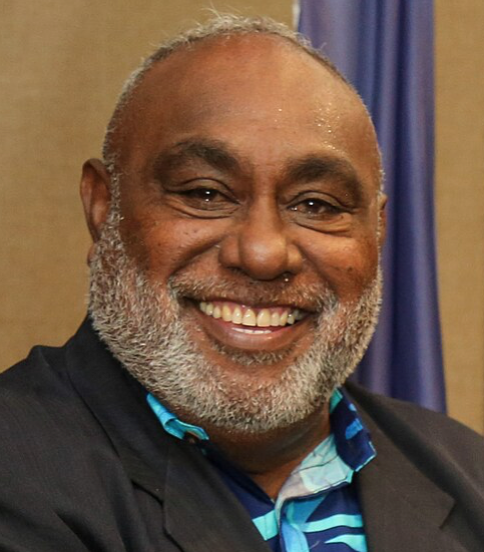
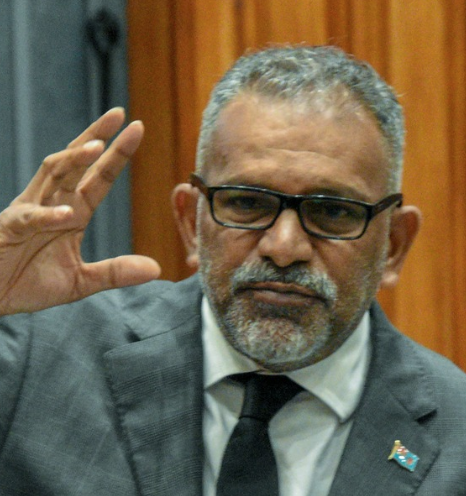
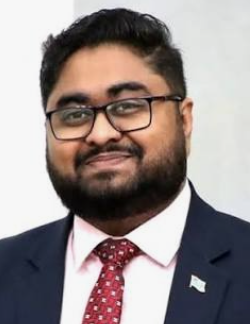
They are the genuine heroes of this vote – Semi Koroilavesau, Faiyaz Koya, Premila Kumar, Ketan Lal and Viam Pillay.
The Faithful Five. Those whose leader again abandoned them (first Frank Bainimarama and now Inia Seruiratu by choosing to sit on the fence) and in the sure knowledge that all was lost, still kept the faith with their electors and honoured the wishes of those who voted for them four years ago.
They deserve our heartfelt thanks and to be rewarded come election day. As for the rest. Next to frigging useless.
_____________
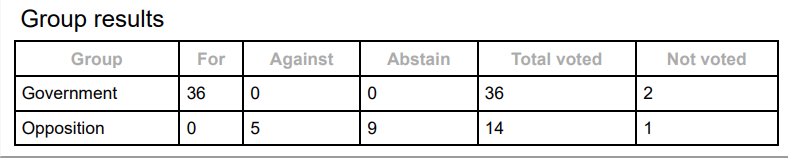
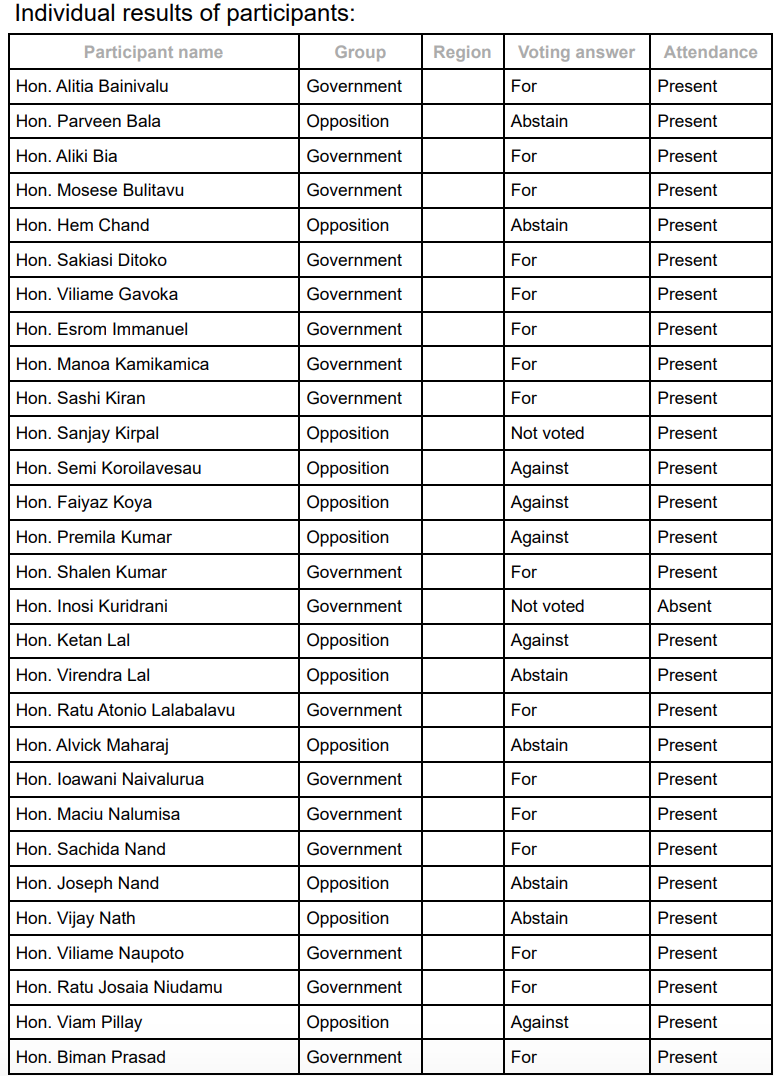
How MPs voted:
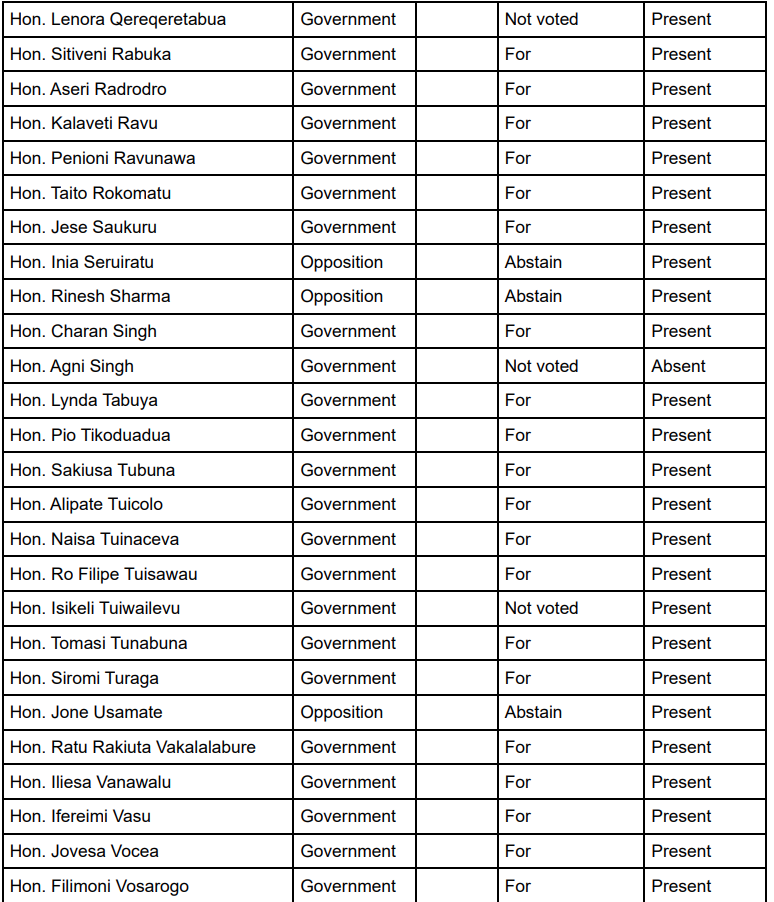
For — 36: Alitia Bainivalu; Aliki Bia; Mosese Bulitavu; Sakiasi Ditoko; Viliame Gavoka; Esrom Immanuel; Manoa Kamikamica; Sashi Kiran; Shalen Kumar; Ratu Atonio Lalabalavu; Ioane Naivalurua; Maciu Nalumisa; Sachida Nand; Viliame Naupoto; Ratu Josaia Niudamu; Biman Prasad; Sitiveni Rabuka; Aseri Radrodro; Kalaveti Ravu; Penioni Ravunawa; Taito Rokomatu; Jese Saukuru; Charan Singh; Lynda Tabuya; Pio Tikoduadua; Sakiusa Tubuna; Alipate Tuicolo; Naisa Tuinaceva; Ro Filipe Tuisawau; Tomasi Tunabuna; Siromi Turaga; Ratu Rakiuta Vakalalabure; Iliesa Vanawalu; Ifereimi Vasu; Jovesa Vocea; Filimoni Vosarogo.
Against: — 5 Semi Koroilavesau; Faiyaz Koya; Premila Kumar; Ketan Lal; Viam Pillay.
Abstained: — 9 Parveen Bala; Hem Chand; Virendra Lal; Alvick Maharaj; Joseph Nand; Vijay Nath; Inia Seruiratu; Rinesh Sharma; Jone Usamate.
Marked “not voted” — 3 Sanjay Kirpal; Lenora Qereqeretabua; Isikeli Tuiwailevu.

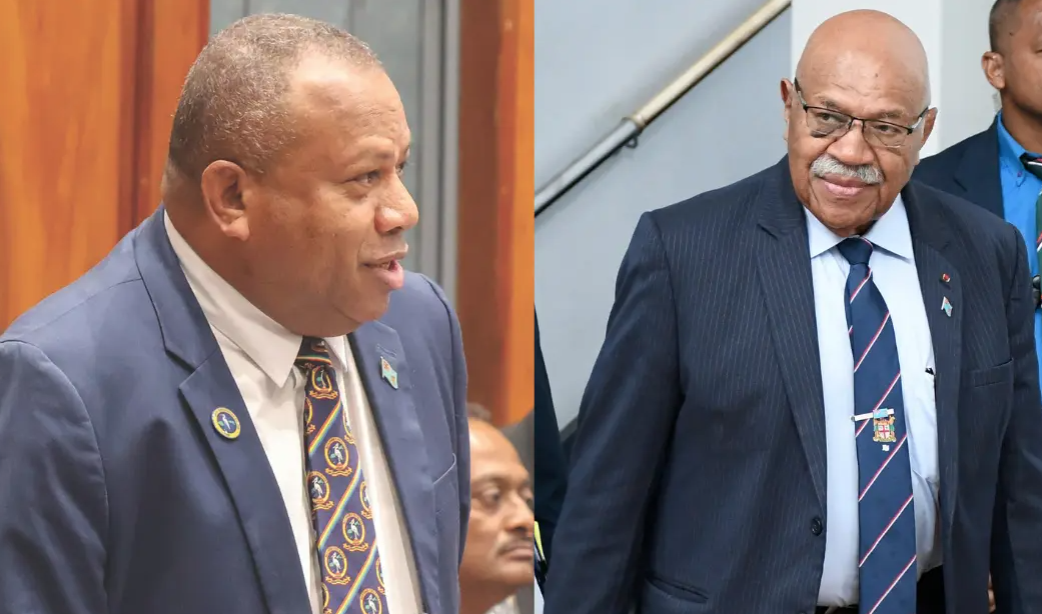
The Faithful Five:

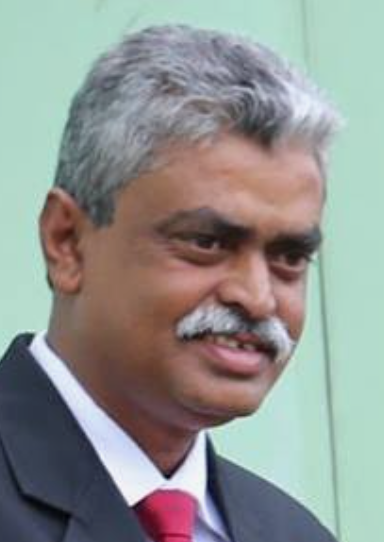
“We can be heroes. Just for one day.”…
Beyond disappointing.
It will be interesting to see if any of these votes change after thorough debate. There has not been the time to process/digest all of the information and hidden dangerous details in this constitution. MP’s had better make use of this 30 days period to see what it is they are voting for rather than have their tired brains rush over detail.
It is also interesting to see the Commander finally taking stand about the extension of the Immunity clause.
Lenora and Isikeli voted yes virtually.
No, read the official parliamentary results. They didn’t vote. Which is hardly a demonstration of the power of their convictions. Or to put it less charitably – gutless.
It’s plain -apart from being gutless, abstaining equates to enabling.
Baimaan is a sick man.
What goes through my mind is the fear that Indians could eventually be pushed into becoming second-class citizens in their own country.
The 2026 Constitution is being presented as one that brings equality to all races. But how can there be genuine equality if Indians are not represented equally in Parliament, while institutions such as the Senate and GCC are overwhelmingly or exclusively iTaukei?
Parliament makes laws that affect everyone—including decisions on scholarships, civil-service employment, government opportunities and the allocation of public resources.If one community has significantly greater representation and influence over the institutions that make those decisions, then the question is simple: how can we guarantee that equality in the Constitution translates into equality in practice?
It’s baffling to think that Indians who abstained and those who voted yes are adamant and desperate to make Indians second class citizens in their own country.
I have heard the argument that it’s the iTaukie’s land, and as such being guests in the country, it is up to the iTaukei people to look after the Indo-Fijians (and other vulagi), and I have heard (probably brainwashed) Indo-Fijians spout this same idea. I have heard Indo-Fijians say that if they hand over authority to the iTaukie they will be cared for.
But there is something very sinister (not to mention narcissistic and entitled) about helping or looking after people only in circumstances in which one has all of the power in the relationship, and there is no equality. It subtly forces compliance and subjugation.
The proposed constitution as it stands has no real equality. It just has a few words of equality sprinkled here and there. And in deleting the need for a referendum in any subsequent Constitutional changes, the minorities will be at the whim of the government of the day, which then has the power to make their lives even less equal. There should always be a need for a referendum in Constitutional change.
There is no way any government MP can sugar coat the power of taking a referendum mechanism out of the proposed constitution.
This is very neat commentary Mr Davis.
What’s interesting to note is the Speaker’s bias. Did you notice the tone and reactions against Op MPs like Faiyaz Koya and Ketan Lal – very unbecoming of a speaker.
We look forward to seeing your articles about the Speaker.
The Speaker’s blatantly biased interpretation of the number underscores what we all know and fear. At the end of the day the I Taukeis will rally around Rabuka because they know ultimately they will come to no harm by supporting a predominantly racist party fighting for indigenous supremacy.
Stuff democracy and fairness. It is their country and they will run it however they wish, least of all using the western metric of ‘good governance’ and ‘democracy’. Favouring one’s family, clan, mataqali and vanua etc is culture and the western concept of merit, objectivity and transparency does not apply to people born with that special privilege.
The quality of debate and the interpretation by the Indo Fijian members of Parliament of what it means to help progress the bill to the next step speaks volumes of the class and quality of these individuals. If they can continue to be hoodwinked by Rabuka and cannot see his agenda, God save us.
Perhaps a lesson for the next election when we really need to ascertain the IQ of people before giving them our votes. Even so called Professors have failed the test.
The most disappointing part of this vote is seeing MPs abandon the very principles they campaigned on. Voters trusted opposition parties and crossbenchers to provide checks and balances—to keep the government honest, not to clear the path for radical constitutional overhaul. The “Faithful Five” were the only ones who actually respected their mandate.
No man is an island.. the same can be said of islands themselves. No island is an island. You can have the best democracy in the world but it ain’t worth nothin if it ain’t making the moolah.
Fiji was once a collage of success. A good back bone of primary industry propped up by successful private sector investment that kept the image very much embedded in the global context on a number of levels despite it’s tiny existence. Investors profiteered handsomely but they put the country on the map for all the right reasons.
FFWD 4 coups later and a Constitution in limbo, it appears that whilst everybody can live with each other they still don’t know “how” to live together. There are no externalities that have forced a hand here, just pathetic leadership all the way through.
Nobody seems to have any desire to forge a path to long term success and stick to it. Those that attempted to do so may have had the best intentions , yet they still went about it the wrong way. One failure after another….in one place….at the top…it’s …leadership. An inability to get all parties onside with a clear set vision.
As old habits die hard , it will become less desirable for the rest of the world to feel the need to invest its time and effort making hay while the sun shines on Fiji’s shores as the entire crop can be decimated when an event occurs . Not if , but when. If you pick it correctly then the risk is rewarded , to some extent. Fail to do so and risk taking a hit, sometimes for longer periods than expected.
Investors want stability, integrity and a capable hand. Most of these went out the door long ago. Those who could once bridge a gap by offering a capable hand are no longer around. All that is left are the left overs of an era. Not the best picks by any measure to take the country forward, long term.
What the country lacks is a thorough social anthropological evaluation to pin point how the social composition can best be leveraged to provide economic productivity in future. Not every person is cut out for every type of work. If you don’t identify how and where to deploy productivity and simply allow it to find it’s way in the modern age of Ai you will get burned.
Fiji is fortunate. It has capability and a reasonably smart population that can be scaled very quickly by way of education and other variables. It only requires development of industrial base and some consistency to flourish. If you look around the world you will find examples of this. Smart governments are conscious of the need to match inputs with productivity of process and output.
China is a prime example. It became the manufacturing epi center of the global economy , pivoted to efficient supply chain flows and is now ready to mobilize on the high tech frontier as a competitive partner to no other than the industrial might of the greatest capitalists the world has ever seen, the yanks! I say competitive partner because that is where the world is in 2026. Neither country can live without the other yet they are still worlds apart. Competition is what keeps them together , not, apart.
You can have the best Rugby players in the world, yet if their heads are in the clouds they will drop a gear when playing against inferior opposition. Why do they risk losing the game by adopting a game plan that seeks to do only the bare minimum required to defeat that opposition. While it might provide a favorable result this “mindset” of game execution will often risk a losing result or a hurry up in the final ten minutes of play just to maintain a slim lead and get the win. We have seen this so often with Fiji rugby in sevens or 15s. An inability to put the hammer down when you are 40 points up and finish on a high. Consistently execute in disciplined fashion irrespective of the advantage you find yourself in…Win and win well. If you are talented and the best athletes on the field then you “deserve” to win well. Hold that thought in your head and don’t let it slip…ever…for 25 minutes…80 minutes…4 years or a lifetime.
I feel the I-Taukei have the spoils at their feet yet they also have it all to lose. They could blow the lot for no other reason than being themselves. I can’t fault them for that but there is a time and a place for everything in this world. It requires real balls to recognize when and where to do what and how to do it. If you can discipline yourself to make not only, good decisions, but the right decisions irrespective of whether they seem right at the time then the rewards will come. Sometimes the best decisions go against the grain of conventional wisdom and desires. They surprise everyone for the “right” reasons.
I hope there are a few pf these people still left in the ranks. Perhaps things might just get better when it seems all is lost.
Rabuka needs to call a snap election , let voters judge if he has been the cause of Fiji’s ground hog day since 1987 .
A strong Constitution for me would have a clause saying if you have staged a coup you are never allowed to enter politics for the rest of your days .
The 2013 Constitution, drafted under Bainimarama’s military government, contains explicit immunity provisions in Chapter 10. These grant broad protection from criminal, civil, and professional liability for actions taken during the coups and the subsequent military rule. The immunity is described as “absolute and irrevocable”—meaning it cannot be undone through ordinary legal processes. It protects not just the coup makers themselves but also the decrees and laws made under military rule.
Coups are a habit in perpetuity. The 1987, 2000, and 2006 coups weren’t just failures of leadership in the moment. They were investments in a system where the payoff for seizing power included permanent legal protection. The 2013 Constitution didn’t just fail to punish past coups—it constitutionalized their impunity, making it structurally impossible to hold anyone accountable through the courts.
The Constitutional Review Commission, which submitted its report in September 2026, has recommended the repeal of Chapter 10 immunity. The Commission noted that there was “universal support” in public submissions for removing these provisions, with submitters describing them as an “ongoing, practical obstacle to justice and accountability”. Even the RFMF itself supported removal, though it proposed that immunity for past coups be conditional on truth-telling.
But here’s the catch, and it’s a significant one. The Commission acknowledged that the Supreme Court’s August 2025 advisory opinion recognized the immunity provisions as part of the constitution’s entrenched framework. The Court’s ruling, while lowering amendment thresholds, didn’t invalidate Chapter 10 itself. The Commission’s primary recommendation—repealing Section 159 to remove the entrenchment—therefore faces a direct legal hurdle. The Commission itself proposed alternative pathways, including asking the Supreme Court to reconsider, or a “harm reduction” approach requiring beneficiaries to take an Oath of Reconciliation.
This is the crux of the issue. Even when the political will exists to remove immunity, the legal structure resists. The very constitution that needs amending was designed to make that amendment extraordinarily difficult, and the courts have thus far declined to strike down the immunity provisions outright.
The immunity provisions are not an abstraction. They mean that Sitiveni Rabuka, the current Prime Minister, remains legally shielded for his role in the 1987 coup. Frank Bainimarama, who seized power in 2006, remains shielded for that coup and for the decrees issued during his rule. The 2000 coup perpetrators—those who weren’t convicted—remain shielded. The system has effectively said: certain crimes, if committed by certain people with guns, are beyond the reach of law.
My earlier comment and point that “nobody seems to have any desire to forge a path to long term success” is directly connected to this. You cannot build long-term success on a foundation that says the rules don’t apply to those who break them most severely. Investors know this. Citizens know this. And the military knows it too—which is precisely why the habit persists. The message sent to every officer with ambition is: if you succeed, you’re protected; if you fail, you’re not. That’s not a deterrent. It’s an incentive structure.
The review recommendations are now with Cabinet and Parliament. Whether they are adopted, watered down, or shelved will be the real measure of whether Fiji’s political class is serious about breaking the cycle. If the immunity provisions survive—even in modified form—the “habit” I described in my piece yesterday will remain rational, and the 2027 election will be conducted under the same shadow that has darkened every previous transition.
The military’s assurances of non-interference in 2027 are welcome, but they don’t change the underlying calculus. As long as the constitution itself says that coup makers are above the law, the habit has structural support. Removing that support is the precondition for everything else I wrote about—the investment, the long-term planning, the disciplined execution. Without it, Fiji is trying to build a house on a foundation that legally permits anyone with a gun to tear it down.
Island in the stream…I have fond memories of my parents playing this song in the car as a child.
I very much appreciate Major General Kalouniwai’s comments , he recognizes and supports what the role of the military is in a democracy.
Today, you don’t necessarily need a military to overthrow a government. You can have enormous influence by controlling a powerful media platform, manipulating algorithms, controlling critical trade, or disrupting daily life to the point where unrest develops.
That is why unity is the most powerful force citizens can have.
Every country needs leaders who bring people together as equals, rather than continually defining them by their differences.
Birth is simply nature. Culture is what we teach, share and pass on.
Building a national identity where people can retain and celebrate their different cultures, while standing together as equal citizens of one country, is what builds nations.
As for immunity, nothing good can come from it. It is a poison leaching into the community well .
Bula my fellow Fijians
It is most unfortunate that the Coalition Government is rushing and bulldozing the
passage of Bill 32 Consitution Amendment Bill 2026.
The said Government is utilizing illegal and udemocratic means to do so.
I agree with the Leader of the Fiji Labour Party’s “claims the Government treated the Supreme Court opinion as law without presenting a Bill to Parliament to convert the opinion into law”.
See https://www.fijivillage.com/news/mps-had-no-time-to-properly-scrutinise-constitution-amendment-bill-chaudhry-4af26f/
In my humble and layman’s view the opinion of the Surpreme Court does not automatically
becomes law. The opinion has to go first go through the Parliamentary process to become law.
The 2013 Fiji Constitution is the SUPREME LAW of the land. To change its provisions any
amendment to it must follow the rules stipulated therein. The requirement of 75% of the MPs
and 75% of the registered voters is still valid and lawful.
The Parliamentary Speaker’s interpretation that only 2/3rd of the sitting MPs vote is
sufficient to pass the Constitution bill is incorrect, unlawful and ultra vires the 2013 Fiji Constitution. As such, the vote and decision taken by Fiji’s Parliament on Oct 2nd is void, illegal,
or unenforceable.
I urge the legal experts, political parties, Fiji Law Society, NGOs and all concerned
citizens of Fiji to become active & vocal to protest against this assault on Fiji’s
democracy and Supreme Law.
Immediate action must be taken to file papers in the relevant Court challenging the
implementation of the Supreme Court opinion as the supreme law, the Parliamentary
Speaker’s ruling on Oct 2nd that only 2/3rd vote of the sitting MPs is required to
pass the 2nd reading of Bill 32 and the Parliamentary decisions taken on Oct 2nd.
There is no time to waste to stop this apparent attempt to hoodwink the people
of Fiji by the Coalition Government.
May God save Fiji
Kai Lautoka